
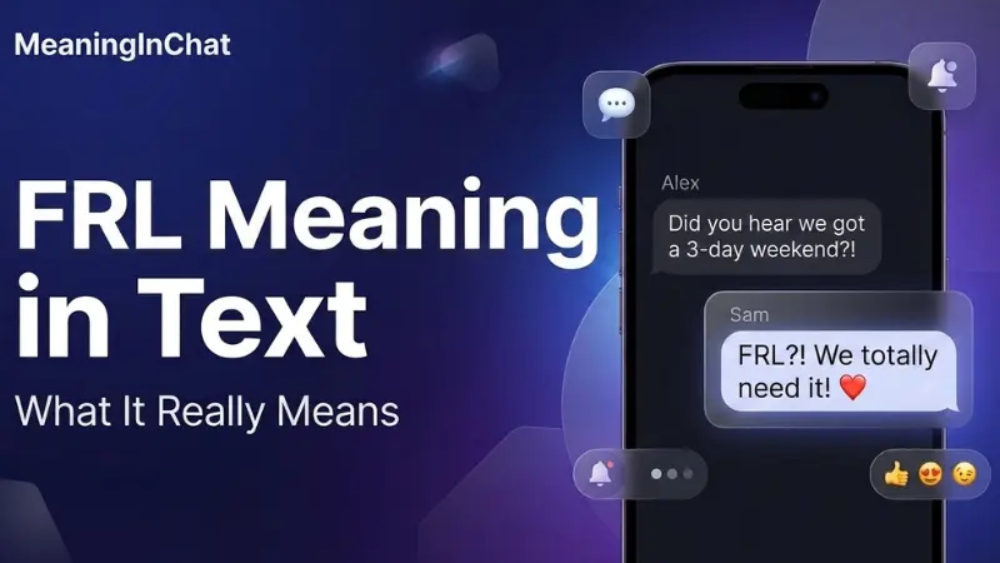
FRL most commonly means “For Real?” in text messages and online chats. People use it to express surprise, ask if something is true, or react to unexpected news. You’ll commonly see FRL on Snapchat, Instagram, TikTok, WhatsApp, Discord, and other messaging apps whenever someone wants quick confirmation or says, “Are you serious?”
Texting has made conversations faster than ever, and abbreviations play a big role in keeping messages short. While terms like LOL, BRB, and TBH are familiar to most people, newer slang such as FRL can still confuse users when it appears in a chat.
If you’ve searched FRL meaning in text, you’re probably trying to figure out what someone meant after replying with “FRL?” In most conversations, it’s simply another way of saying “For Real?” to show surprise, disbelief, or ask for confirmation.
In this guide, you’ll learn what FRL means in texting, what it stands for, when to use it, real conversation examples, common mistakes, and how it compares with similar abbreviations like FR, TBH, and NGL.
What Does FRL Mean in Text?
If you’ve received a message saying “FRL?”, you might wonder what the sender is trying to say.
In most online conversations, FRL means “For Real?” It’s a quick way to ask if something is true or to react with surprise after hearing unexpected news. Instead of typing the full phrase, people shorten it to FRL to keep conversations fast and casual.
For example:
Friend: “I just won free concert tickets.”
You: “FRL?”
Here, FRL means “For real?” or “Are you serious?”
Another example:
Friend: “I’m moving to another country next month.”
You: “FRL? I didn’t see that coming!”
The abbreviation is most common on Snapchat, Instagram, TikTok, WhatsApp, Discord, and text messages, where short replies help conversations move quickly.
If you’re learning internet slang, it’s also helpful to know the difference between similar abbreviations. For example, FR means “For Real”, while TBH means “To Be Honest”. You may also come across NGL, which people use before making an honest admission, or LMK when asking someone to let them know something. Learning these common texting abbreviations makes online conversations much easier to understand.
What Does FRL Stand For?
Many people also search what does FRL stand for after seeing it in a text or social media comment.
In texting, FRL stands for “For Real?” The phrase has been part of everyday English for years and is commonly used when someone wants to confirm surprising news or show disbelief. As texting became faster, many users shortened the phrase to FRL, making it quicker to type while keeping the same meaning.
You’ll often see FRL in situations where someone shares unexpected information, exciting news, or a surprising opinion. Instead of writing “For real?” in full, people simply reply with “FRL?”
For example:
- “I met my favorite singer yesterday.”
Reply: FRL? - “Our exam got canceled.”
Reply: FRL? That’s awesome!
The meaning stays the same across most messaging apps, including Snapchat, Instagram, TikTok, WhatsApp, Discord, and regular text messages.
Many texting abbreviations are built from everyday English phrases. After learning FRL, you may also recognize FR (For Real), WYD (What You Doing?), and RN (Right Now). Knowing these common abbreviations makes it much easier to understand conversations on social media and messaging apps.
Common Ways People Use FRL
Keep this section short and practical instead of adding long explanations.
| Situation | Example | Meaning |
| Reacting to surprising news | FRL? You won the lottery? | Are you serious? |
| Asking for confirmation | FRL, the event is free? | Is that really true? |
| Showing disbelief | FRL? I can’t believe it. | Expressing surprise |
| Responding to exciting news | FRL? That’s amazing! | Genuine excitement |
| Casual online chats | FRL? Tell me more. | Asking for more details |
Where Did FRL Come From?
Although FRL feels like a modern internet abbreviation, the phrase “For real?” has been part of spoken English for decades. People have long used it to question surprising statements or confirm whether something is true.
As texting and social media became more popular, users started shortening common phrases to save time. Just like LOL, BRB, and OMG, “For real?” was abbreviated to FRL in many online conversations. Today, it’s commonly used on Snapchat, Instagram, TikTok, WhatsApp, Discord, and text messages whenever someone wants quick confirmation or reacts to unexpected news.
Many internet abbreviations became popular during the early days of texting for the same reason—they made conversations faster. Along with FRL, you’ll often see terms like OMG for surprise, BRB when someone is stepping away, and LOL to show laughter. Learning these common abbreviations helps you understand online conversations more naturally.
When Should You Use FRL?
Knowing what FRL means is only part of the picture. It’s also important to know when it sounds natural in a conversation.
FRL is best used in casual chats when you want to react to surprising news or check if someone is telling the truth. It works well with friends, classmates, family members, and online communities, but it isn’t suitable for formal emails or professional communication.
Some common situations include:
- Hearing unexpected news
- Asking if something is true
- Reacting to exciting announcements
- Showing surprise or disbelief
- Replying to a shocking social media post
For example:
Friend: “I got front-row concert tickets.”
You: FRL? That’s incredible!
Or:
Friend: “School is closed tomorrow.”
You: FRL? I hadn’t heard that.
When FRL Fits Best
| Situation | Use FRL? | Example |
| Texting friends | ✅ Yes | FRL? That’s awesome! |
| Snapchat chats | ✅ Yes | FRL? Send a screenshot. |
| Instagram DMs | ✅ Yes | FRL? Congratulations! |
| ✅ Yes | FRL? I can’t believe it. | |
| Gaming chats | ✅ Yes | FRL? We actually won! |
| Business emails | ❌ No | Use complete sentences instead. |
FRL is just one of many abbreviations people use in casual conversations. You might also see HMU when someone wants you to contact them, LMK when asking for an update, or OMW when letting someone know they’re on the way. Learning these common slang terms makes texting and social media conversations much easier to follow.
Real-Life Examples of FRL in Conversations
One of the easiest ways to remember FRL is by seeing how people use it in everyday conversations.
Example
Friend: “I just got a promotion at work.”
You: FRL? Congratulations!
Example
Friend: “Our favorite band is coming to town.”
You: FRL? We have to get tickets!
Example
Friend: “I finished the project in one day.”
You: FRL? That’s impressive.
Example
Friend: “The restaurant gave us free dessert.”
You: FRL? Lucky you!
Example
Friend: “I met my favorite YouTuber today.”
You: FRL? No way!
These examples show that FRL is mainly used to express surprise or ask if something is really true. It’s a quick, friendly response that’s common in texting and social media conversations.
If you enjoy learning through examples, you may also like our guides on ICL meaning in text, NGL meaning in text, TBH meaning in text, and FR meaning in text. These abbreviations are often used alongside FRL in everyday online conversations.
Is FRL Always “For Real?”
In almost every texting and social media conversation, yes. If someone sends FRL, it almost always means “For Real?” or “For Real!” The exact meaning depends on the context, but both express surprise, excitement, or a request for confirmation.
For example, if a friend says they won free concert tickets, replying with “FRL?” means you’re asking if it’s really true. If someone writes “FRL, that’s amazing!”, they’re emphasizing that they genuinely mean what they’re saying.
Outside of texting, the letters FRL can stand for different organizations or technical terms in specific industries. However, those meanings are unrelated to casual online conversations and are rarely seen in everyday chats.
As a simple rule:
Reaction to something exciting → FRL! = “Seriously!” or “For re
Question after surprising news → FRL? = “For real?”
Context is important when reading internet slang because many abbreviations can have more than one meaning. If you enjoy learning how context changes the meaning of online expressions, you may also like our guides on IMO meaning in text, IDK meaning in text, IKR meaning in text, and SMH meaning in text.
FRL vs FR vs NGL vs ICL
Many texting abbreviations express surprise or honesty, but they aren’t used in the same way. Here’s a quick comparison to help you know when each one fits best.
| Abbreviation | Full Form | Meaning | Example |
| FRL | For Real? | Asking if something is true or showing surprise | FRL? You won? |
| FR | For Real | Showing agreement or emphasizing seriousness | That movie was amazing, FR. |
| NGL | Not Gonna Lie | Introducing an honest opinion | NGL, I enjoyed it. |
| ICL | I Can’t Lie | Sharing a sincere thought or confession | ICL, I was nervous. |
The biggest difference is that FRL is usually a question or surprised reaction, while FR, NGL, and ICL are used to express personal opinions or emphasize honesty.
If you often see these abbreviations online, check out our detailed guides on FR meaning in text, NGL meaning in text, ICL meaning in text, and TBH meaning in text. Knowing the difference between these similar slang terms makes texting and social media conversations much easier to understand.
Common Mistakes People Make With FRL
Although FRL is easy to understand, people sometimes use it incorrectly or misunderstand its meaning. Here are the most common mistakes to avoid.
Assuming Everyone Knows FRL
Unlike abbreviations such as LOL or OMG, FRL isn’t recognized by everyone. If you’re chatting with someone who isn’t familiar with internet slang, writing the full phrase “For real?” may be clearer.
Using It in Professional Communication
FRL is meant for casual conversations. It shouldn’t be used in business emails, academic writing, or formal messages. In professional situations, use complete questions like “Is that true?” or “Could you confirm that?”
Confusing FRL with FR
Although they look similar, they have different meanings.
- FRL = For Real? (a question or surprised reaction)
- FR = For Real (used to emphasize sincerity or agreement)
Using the correct abbreviation makes your message easier to understand.
Ignoring Context
Like many internet abbreviations, FRL depends on the conversation. In texting, it almost always means “For Real?”, while in other fields it may have a completely different meaning.
Avoiding common mistakes becomes much easier once you understand how similar abbreviations are used. You may also find our guides on FR meaning in text, OMG meaning in text, LOL meaning in text, and TBH meaning in text helpful for understanding everyday internet slang.
📚 See Also
Want to learn more internet slang? These related guides explain other popular texting abbreviations commonly used on Snapchat, TikTok, Instagram, WhatsApp, Discord, and text messages.
- FR Meaning in Text — Learn what FR stands for and how it’s used to emphasize honesty or agreement.
- NGL Meaning in Text — Discover how NGL is used before honest opinions and surprising confessions.
- ICL Meaning in Text — Find out why ICL means “I Can’t Lie” and when people use it online.
- TBH Meaning in Text — Explore the meaning of TBH and why it’s one of the most common internet abbreviations.
- WYD Meaning in Text — See what WYD means and how it’s used to start conversations in text messages.
FAQs
What does FRL mean in text?
FRL most commonly means “For Real?” People use it to express surprise or ask if something they just read or heard is true.
What does FRL stand for?
In texting, FRL stands for “For Real?” It’s a casual abbreviation commonly used on social media and messaging apps.
What does FRL mean in texting?
If you’re wondering what FRL means in texting, it has the same meaning as in regular text messages. It’s a quick way to ask “Are you serious?” or “Is that really true?”
Is FRL the same as FR?
No. FRL usually means “For Real?” and is used as a question or reaction, while FR means “For Real” and is used to emphasize that something is genuine or serious.
Can I use FRL on Snapchat and Instagram?
Yes. FRL is commonly used on Snapchat, Instagram, TikTok, WhatsApp, Discord, Facebook Messenger, and text messages. Its meaning remains the same across these platforms.
Should I use FRL in professional emails?
No. Since FRL is informal internet slang, it’s best to avoid it in workplace emails or business communication. Use complete sentences instead.
Conclusion
Now that you know the FRL meaning in text, you’ll quickly recognize it whenever it appears in a conversation. In most cases, FRL stands for “For Real?” and is used to react to surprising news, ask for confirmation, or express genuine disbelief.
Whether you’re chatting on Snapchat, Instagram, TikTok, WhatsApp, Discord, or through regular text messages, FRL keeps conversations short, natural, and engaging. As with most internet slang, the meaning is easy to understand once you consider the context.
Using FRL appropriately can make your online conversations feel more natural, and knowing similar abbreviations will help you communicate with confidence across today’s most popular messaging platforms.
