
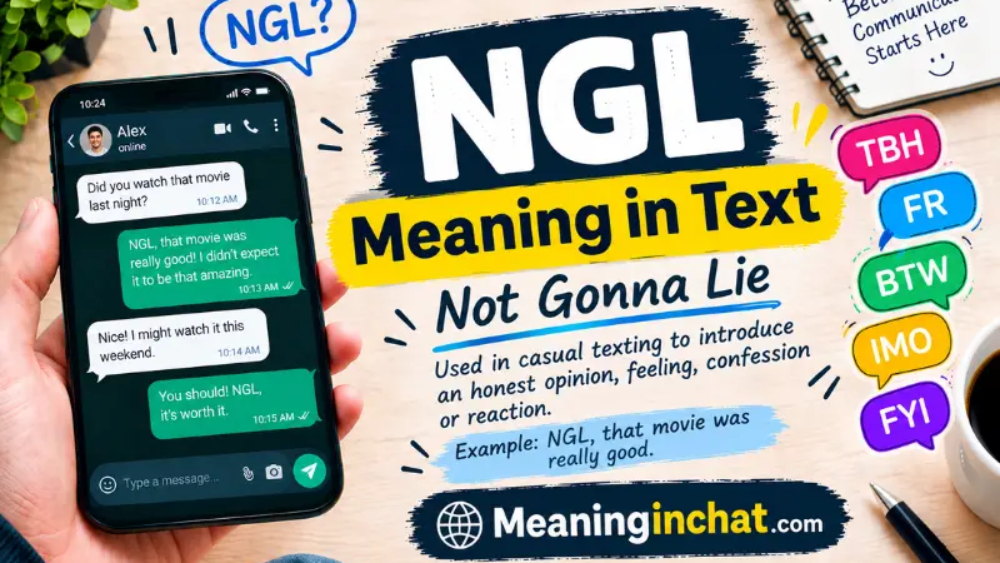
Ever received a message that starts with “NGL…” and wondered what those three letters actually mean?
NGL stands for “Not Gonna Lie.” People use it in texting, chats, comments, and social media when they want to be honest about what they think or feel.
For example, if someone texts “NGL, that was actually really good,” they’re basically saying, “Not gonna lie, that was actually really good.”
The abbreviation is usually casual and conversational. It can introduce a compliment, criticism, personal opinion, embarrassing confession, or simply something the sender wants to say honestly.
NGL Meaning: The Short Version
NGL = Not Gonna Lie
It is commonly used before or after a statement to emphasize honesty.
“NGL, I really like this song.”
= “Not gonna lie, I really like this song.”
You can also see it at the end:
“That movie was pretty good ngl.”
The meaning doesn’t change. The person is emphasizing that their statement is genuine.
What Does NGL Mean in Text?
When people search what does NGL mean in text, they’re usually seeing the abbreviation in a casual message or social-media post.
NGL can be used when someone wants to give their real opinion without making the statement sound overly formal.
For example:
“NGL, I didn’t expect you to win.”
The person is honestly admitting that they didn’t expect the other person to win.
Or:
“Your new profile picture looks amazing ngl.”
Here, NGL adds emphasis to the compliment.
It can also introduce something negative:
“NGL, I’m disappointed.”
So NGL isn’t automatically positive or negative. The statement that follows tells you what the person actually means.
Why Do People Say “NGL”?
The ngl meaning is closely connected to honesty.
People often use it when they are about to say something they might normally soften or keep to themselves.
Think of NGL as a conversational signal that says:
“I’m being honest here.”
For example:
- “NGL, I’m tired.”
- “NGL, that outfit looks great.”
- “I thought it would be boring ngl.”
- “NGL, I was nervous.”
In each case, the abbreviation makes the statement feel more personal and informal.
It doesn’t necessarily mean the person was lying before. It’s simply a way of highlighting that the following statement is their genuine opinion or admission.
NGL Can Be Positive, Negative, or Personal
One reason NGL can sometimes be confusing is that people use it in very different situations.
When giving a compliment
“NGL, you did really well.”
The sender is emphasizing that they genuinely think you did well.
When criticizing something
“NGL, I don’t like this design.”
Here, NGL introduces an honest negative opinion.
When admitting something
“NGL, I forgot about the meeting.”
The sender is openly admitting something.
When sharing an unexpected opinion
“NGL, I actually enjoyed that movie.”
The speaker may be saying this because their opinion goes against what others expected.
So if you see NGL in a message, don’t assume it’s criticism. Read the rest of the sentence to understand the actual tone.
What Does NGL Mean in Chat?
In casual chat, NGL is often used as a quick way to make a message sound more honest or direct.
Imagine someone asking:
“Did you like the new episode?”
You might reply:
“NGL, it was better than I expected.”
Or:
“NGL, I didn’t really like it.”
The abbreviation fits naturally into conversations because it sounds similar to something people would say aloud.
It can appear at the beginning:
“NGL, that’s hilarious.”
In the middle:
“That was, ngl, one of the funniest things I’ve seen.”
Or at the end:
“You’re actually really good at this ngl.”
The position can change, but the basic meaning remains “Not Gonna Lie.”
Examples of NGL in Real Conversations
Here are a few situations where you might naturally see NGL.
Friend: “Should I buy these shoes?”
You: “NGL, I think the other pair looks better.”
Friend: “Did you enjoy the party?”
You: “NGL, it was actually really fun.”
Friend: “Were you scared before the presentation?”
You: “NGL, I was shaking 😂.”
Friend: “Do you like my new haircut?”
You: “NGL, it looks really good.”
These examples show how flexible NGL is. It doesn’t create the meaning by itself; instead, it adds an informal sense of honesty to whatever comes next.
NGL vs. TBH: What’s the Difference?
NGL is sometimes confused with TBH, which means “To Be Honest.”
They are very similar because both can introduce an honest opinion.
For example:
“NGL, I really like it.”
and:
“TBH, I really like it.”
can communicate almost the same idea.
The difference is mostly in wording and conversational style.
NGL literally means “Not Gonna Lie.”
TBH literally means “To Be Honest.”
Both are common in informal digital communication, and people may use either one depending on their personal texting style.
NGL vs. “Honestly”
You can often replace NGL with “honestly” without changing the main idea.
For example:
“NGL, I don’t want to go.”
could become:
“Honestly, I don’t want to go.”
However, NGL has a more casual internet and texting feel.
That’s why you’ll often see it in:
- Text messages
- Group chats
- Social media comments
- Instagram captions
- TikTok posts
- DMs
- Online conversations
It is much less suitable for formal writing.
Does NGL Mean Someone Was Lying?
Not necessarily.
This is an important point when interpreting the abbreviation.
If someone says:
“NGL, I love your idea.”
they aren’t necessarily suggesting that they lied about something earlier.
NGL simply signals that they want to emphasize the sincerity of the statement.
Similarly:
“That was funny ngl.”
doesn’t mean they were pretending not to laugh before.
The phrase has become a common conversational expression, so people often use it simply to add emphasis.
How NGL Changes the Tone of a Message
Although NGL has a straightforward meaning, it can subtly change how a sentence feels.
Compare:
“That was good.”
with:
“NGL, that was good.”
The second version can sound more personal or candid, as if the speaker is admitting their genuine reaction.
Another example:
“I like your new haircut.”
versus:
“NGL, I really like your new haircut.”
The NGL version can make the compliment feel more spontaneous.
It can also make criticism feel more direct:
“NGL, I don’t think that was your best idea.”
So the surrounding words and relationship between the people matter when interpreting the tone.
Can You Use NGL at the End of a Sentence?
Yes.
Although many people put NGL at the beginning, it can also appear at the end.
For example:
“That was actually pretty funny ngl.”
“I really missed hanging out with you ngl.”
“This might be my favorite one ngl.”
In these cases, NGL works almost like a small tag that reinforces the statement.
The lowercase form “ngl” is especially common in casual texting.
Is NGL Considered Slang?
Yes, NGL is commonly treated as internet slang or texting shorthand.
Its full form is “Not Gonna Lie,” which itself is an informal version of “Not Going to Lie.”
The abbreviation became popular through online communication because it is quick to type and fits naturally into casual speech.
You can use it with friends or in informal online conversations, but it would generally be better to avoid it in:
- Formal emails
- Academic writing
- Business reports
- Official documents
- Professional correspondence
In those situations, writing “honestly” or “to be honest” is usually more appropriate.
How Should You Reply to “NGL”?
There isn’t one special NGL meaning reply because NGL isn’t really a question. It’s an expression that introduces someone’s honest statement.
Your response should focus on what they actually said.
For example:
“NGL, I love your new outfit.”
You could reply:
“Thank you! 😂”
If someone says:
“NGL, I didn’t like the movie.”
you might say:
“Fair enough. I thought it was pretty good.”
And if they say:
“NGL, I was nervous.”
you could respond:
“Honestly, you didn’t look nervous at all.”
In other words, don’t respond to NGL itself. Respond to the opinion or statement that comes with it.
What Does NGL Mean on Social Media?
On social media, NGL generally has the same meaning: “Not Gonna Lie.”
You may see it in captions, comments, replies, or short posts.
Examples include:
“NGL this outfit is everything.”
“NGL, this was the best part.”
“That ending was wild ngl.”
“NGL, I wasn’t expecting that.”
Because social-media conversations are informal, the abbreviation fits naturally into short posts and reactions.
The meaning doesn’t change just because it appears on a different platform.
A Few Things to Remember About NGL
If you want to recognize NGL quickly, keep these points in mind:
- NGL means “Not Gonna Lie.”
- It usually introduces an honest opinion or admission.
- It can be positive, negative, funny, or serious.
- It can appear at the beginning or end of a sentence.
- ngl and NGL mean the same thing.
- It is mainly used in casual digital communication.
- It is similar in purpose to TBH and honestly.
The easiest interpretation is simply: “I’m being honest about what I’m saying.”
See Also:
- HRU Meaning in Text
- OOTD Meaning in Text
- TTM Meaning in Text
- TBF Meaning in Text
- AWL Meaning in Text
FAQs
What does NGL mean?
NGL means “Not Gonna Lie.” It is used in casual conversations to emphasize that someone is giving their honest opinion, reaction, or admission.
What does NGL mean in text?
When used in text messages, NGL means “Not Gonna Lie.” It can introduce a compliment, criticism, confession, or personal opinion.
What is the NGL meaning in chat?
The NGL meaning in chat is usually “Not Gonna Lie.” People use it to make a statement sound candid or emphasize that they genuinely mean what they’re saying.
Is NGL a positive or negative expression?
It can be either. “NGL, you look great” is positive, while “NGL, I didn’t like it” is negative. The rest of the sentence determines the meaning.
Is NGL the same as TBH?
They’re very similar. NGL means “Not Gonna Lie,” while TBH means “To Be Honest.” Both can be used to introduce a sincere opinion.
Can I use NGL in formal writing?
NGL is informal texting and internet shorthand, so it’s generally better suited to casual conversations than formal or professional writing.
Conclusion
So, what does NGL mean? In texting and online conversations, NGL means “Not Gonna Lie.”
People use it when they want to emphasize an honest opinion, reaction, compliment, criticism, or personal admission. You might see it at the beginning of a message—“NGL, I love this”—or at the end—“That was actually fun ngl.”
The easiest way to remember the NGL meaning is:
NGL = Not Gonna Lie = I’m being honest.
If you see it in a message, simply read the rest of the sentence to understand what the person is honestly trying to say.

[…] NGL Meaning in Text […]
[…] NGL Meaning in Text […]