
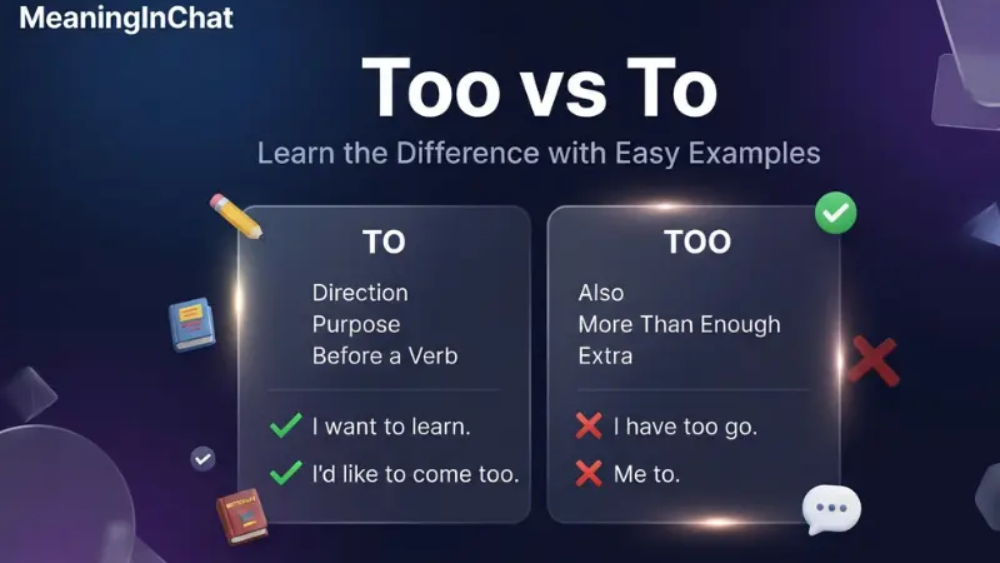
To is used for direction, purpose, or before a verb, while too means also or more than enough. Although they sound the same, they have different meanings and should be used in different situations.
The words to and too sound exactly alike, but they have different meanings and uses in English. Because of this, they’re often confused in writing, even by native speakers. This guide explains the difference with simple rules, everyday examples, and easy memory tips so you can choose the correct word with confidence.
Too vs To at a Glance
| If You Mean… | Use | Example |
|---|---|---|
| Direction or destination | To | We walked to the park. |
| Before a verb | To | I want to learn Spanish. |
| Also or as well | Too | I’d love to come too. |
| More than necessary | Too | The soup is too salty. |
This simple comparison covers the most common situations where people confuse these words. If you’re ever unsure, think about the meaning you want to express rather than how the word sounds.
What Does “To” Mean?
To is most commonly used as a preposition or as part of the infinitive form of a verb. It can show direction, indicate a relationship between people or things, express purpose, or come before a base verb to describe an action.
Here are the most common ways to is used:
1. To Show Direction
Use to when someone or something is moving toward a place or destination.
Examples:
- We walked to the library.
- She drove to the airport.
- Please send the package to my office.
2. Before a Verb
To is used before the base form of a verb to create an infinitive.
Examples:
- I want to learn French.
- They decided to stay home.
- He hopes to become a doctor.
3. To Show Purpose
Sometimes to explains why someone does something.
Examples:
- She called to ask a question.
- We met early to finish the project.
- He exercises to stay healthy.
4. To Connect People or Things
To can also show who receives something or who an action is directed toward.
Examples:
- Give the keys to Sarah.
- I spoke to my teacher after class.
- Please reply to this email.
Once you recognize these patterns, choosing to becomes much easier because it usually connects an action, destination, purpose, or relationship within a sentence.
What Does “Too” Mean?
Unlike to, the word too is an adverb. It has two main uses in English: it can mean “also” or “more than necessary.” The intended meaning depends on the sentence, but both are common in everyday writing and conversation.
1. Too Meaning “Also”
Use too when you want to include another person, thing, or idea. In this sense, it means “also” or “as well.”
Examples:
- I want to come too.
- Sarah enjoyed the movie too.
- If you’re bringing snacks, I’ll bring some too.
2. Too Meaning “More Than Necessary”
Use too to describe something that goes beyond a comfortable, reasonable, or expected amount.
Examples:
- This coffee is too hot to drink.
- The backpack is too heavy.
- It’s too late to catch the last train.
A simple way to remember this meaning is that too often appears before an adjective or adverb to show that something is excessive.
If you’re interested in other commonly confused word pairs, you may also find our guide on To Cute or Too Cute helpful, as it explains another frequent spelling mistake with practical examples.
How to Choose Between To and Too
If you’re unsure which word to use, don’t focus on how it sounds. Since to and too are pronounced the same, the easiest way to choose is by looking at what the sentence is trying to say.
Ask yourself these simple questions:
Does it mean “also” or “as well”?
If the answer is yes, use too.
Examples:
- I’m coming too.
- She likes chocolate too.
- We’d love to join too.
Does it mean “more than necessary”?
If something is excessive, use too.
Examples:
- The soup is too salty.
- It’s too noisy outside.
- This box is too heavy to carry.
Does it show direction or come before a verb?
If the word points to a destination, shows purpose, or appears before the base form of a verb, use to.
Examples:
- We walked to the station.
- I need to finish my homework.
- She went to the doctor.
A good habit is to replace the word with “also.” If the sentence still makes sense, too is the correct choice. If it doesn’t, you almost certainly need to instead.
Confusing to and too isn’t the only common grammar mistake. Many writers also mix up Affect or Effect, another pair of words with different meanings and uses.Common Mistakes People Make
Even though to and too are simple words, they’re among the most frequently confused in English. Most mistakes happen because both words sound exactly the same when spoken. Here are some common errors and how to avoid them.
Using Too for Direction
❌ I went too school.
✔ I went to school.
Use to when you’re talking about movement or a destination.
Using To Instead of Too
❌ I’d like to come to.
✔ I’d like to come too.
When you mean “also” or “as well,” always use too
Writing “To Much”
❌ This bag costs to much.
✔ This bag costs too much.
Because too means “more than necessary,” it’s the correct choice in phrases like too much, too many, and too expensive.
Using Too Before a Verb
❌ I have too finish my homework.
✔ I have to finish my homework.
When the word comes before a base verb, use to, not too.
Learning to spot these patterns makes it much easier to choose the correct spelling without second-guessing yourself. If you’re working on improving your grammar, you may also find our guide on Affect or Effect helpful, as it’s another pair of commonly confused words that often cause writing mistakes.
Too vs To vs Two
The words to, too, and two are homophones, which means they sound the same but have different spellings and meanings. Knowing the role of each word makes it much easier to choose the correct one in your writing.
| Word | Meaning | Example |
|---|---|---|
| To | Shows direction, purpose, or comes before a verb | We drove to the beach. |
| Too | Means also or more than enough | I’d like to come too. |
| Two | The number 2 | She adopted two kittens. |
A simple memory trick is to associate each word with its purpose:
- To → direction, purpose, or action.
- Too → something extra, whether it means also or more than necessary.
- Two → always refers to the number 2.
Many learners confuse all three because they sound identical in conversation. The difference only becomes clear in writing, so paying attention to the meaning of the sentence is the easiest way to choose the correct spelling.
If you’re interested in learning more about commonly confused English words, you might also enjoy our guide on Anyone or Anybody, which explains another pair of words that are often used interchangeably even though they have slightly different uses.
Too or To in Texting and Online Messages
Text messages, social media posts, and online chats are full of typing shortcuts, so it’s common to see to and too used incorrectly. In many cases, the mistake isn’t intentional. People often type quickly, rely on autocorrect, or don’t notice the missing extra “o” before sending a message.
For example, someone might write:
❌ Me to!
The correct version is:
✔ Me too!
Another common mistake is:
❌ I have too go now.
The correct sentence is:
✔ I have to go now.
Although these errors are common in casual conversations, using the correct spelling makes your message clearer and more professional. Taking a second to check whether you mean “also,” “more than enough,” or direction and purpose can help you avoid one of the most frequent writing mistakes in English.
If you’re interested in other grammar topics that often appear in everyday writing, you may also find our guide on Drier vs Dryer helpful, where we explain another commonly confused pair of words with clear examples.
Too or To in Formal Writing
While small spelling mistakes are often overlooked in casual conversations, they can leave a poor impression in formal writing. Whether you’re sending a work email, writing a school assignment, preparing a job application, or creating a business document, using the correct word shows attention to detail and helps your message read more clearly.
Compare these examples:
❌ The meeting is to long.
✔ The meeting is too long.
❌ I would like too apply for the position.
✔ I would like to apply for the position.
❌ Please send the report too my manager.
✔ Please send the report to my manager.
Before sending an important document, take a moment to proofread your writing. A quick review can help you catch simple mistakes like confusing to and too, making your work appear more polished and professional.
If you’re improving your writing skills, you may also find our comparison of Offerred or Offered useful, as it covers another common spelling mistake that often appears in formal writing.Easy Ways to Remember the Difference
You don’t need to memorize a long list of grammar rules to tell to and too apart. A couple of simple memory tricks are often enough to help you choose the correct word.
Remember the Extra “O”
The word too has an extra “o,” and it also means something extra. Whether you’re saying “also” or describing more than necessary, the extra letter is a helpful reminder.
Examples:
- I want to come too.
- The backpack is too heavy.
- It’s too late to leave now.
Think About the Sentence
If the word shows direction, purpose, or comes before a verb, use to.
Examples:
- We walked to the station.
- She wants to become a doctor.
- Please give the book to your brother.
Replace It with “Also”
If you can replace the word with “also” and the sentence still makes sense, too is the correct choice.
Example:
- I’d like to join too.
- I’d like to join also. ✔
Using these simple checks while writing will quickly become a habit, making it easier to avoid one of the most common spelling mistakes in English.
If you’re working through other commonly confused word pairs, you might also find our guides on To Early or Too Early and To Cute or Too Cute helpful. Both explain similar mistakes with clear rules and practical examples.Practice Sentences
The best way to remember the difference between to and too is to see them used in everyday sentences. Read each example carefully and notice how the meaning changes depending on which word is used.
Using To
- I need to finish my homework before dinner.
- We drove to the beach early in the morning.
- She wants to become a teacher.
- Please hand the tickets to David.
- They stopped to take a few photos.
Using Too
- I’d like to come too.
- The weather is too cold for a picnic.
- This suitcase is too heavy to carry alone.
- He was too tired to keep working.
- We enjoyed the concert too.
Try creating a few sentences of your own using both words. A little practice goes a long way, and you’ll soon recognize which spelling fits naturally in different situations.
If you’re interested in learning more about commonly confused English words, our guides on Countrys vs Countries and Leafs or Leaves explain other mistakes that writers often make.Too vs To in Different Situations
| Situation | Correct Example |
| Going somewhere | Go to the park |
| Joining something | Add me too |
| Starting action | Need to work |
| Excess amount | Too difficult |
Sentence Examples for Practice
Using To:
- I need to finish my homework.
- She went to the market.
- He wants to travel.
Using Too:
- I want to come too.
- This is too expensive.
- It is too late.
📚 See Also
Continue improving your English with these helpful guides on commonly confused words and grammar mistakes:
- To Early or Too Early — Learn when too is the correct choice and avoid one of the most common writing mistakes.
- To Cute or Too Cute — Discover why too cute is the correct phrase with simple explanations and examples.
- Affect or Effect — Understand the difference between two commonly confused English words.
- Drier vs Dryer — Learn when to use drier and dryer correctly in everyday writing.
- Countrys vs Countries — Find out the correct plural form and avoid another frequent spelling mistake.
- Offerred or Offered — See which spelling is correct and why the other is a common error.
FAQs
Why do people confuse to and too so often?
Both words are pronounced the same, making them homophones. When speaking, there’s no difference in pronunciation, so many people accidentally choose the wrong spelling when writing.
Is “me too” or “me to” correct?
“Me too” is correct because too means “also” or “as well.” The phrase “me to” is a common typing mistake that often appears in text messages and social media comments.
Is it “too much” or “to much”?
The correct phrase is “too much.” Here, too means “more than necessary,” so “to much” is always incorrect.
Can I use too before a verb?
No. When a word comes before the base form of a verb, you should use to.
Correct: I want to learn.
Incorrect: I want too learn.
Is it acceptable to confuse to and too in casual texting?
People often make this mistake in text messages because they type quickly or rely on autocorrect. However, using the correct spelling makes your message clearer and helps avoid confusion.
What’s the easiest way to remember the difference?
A simple trick is to remember that too has an extra “o,” and it also means something extra—either “also” or “more than enough.” If the word shows direction, purpose, or comes before a verb, use to instead.
Conclusion
Although to and too sound exactly the same, choosing the right one becomes much easier once you focus on the meaning of your sentence rather than its pronunciation. To is used for direction, purpose, or before a verb, while too means also or more than necessary. With a little practice, recognizing the difference becomes second nature.
The next time you’re writing an email, text message, or school assignment, take a moment to check which word fits your sentence. Small improvements like this can make your writing clearer and more professional.
If you’re continuing to build your grammar skills, you may also find our guides on Affect or Effect and Drier vs Dryer helpful, as they cover other commonly confused words with practical examples.