
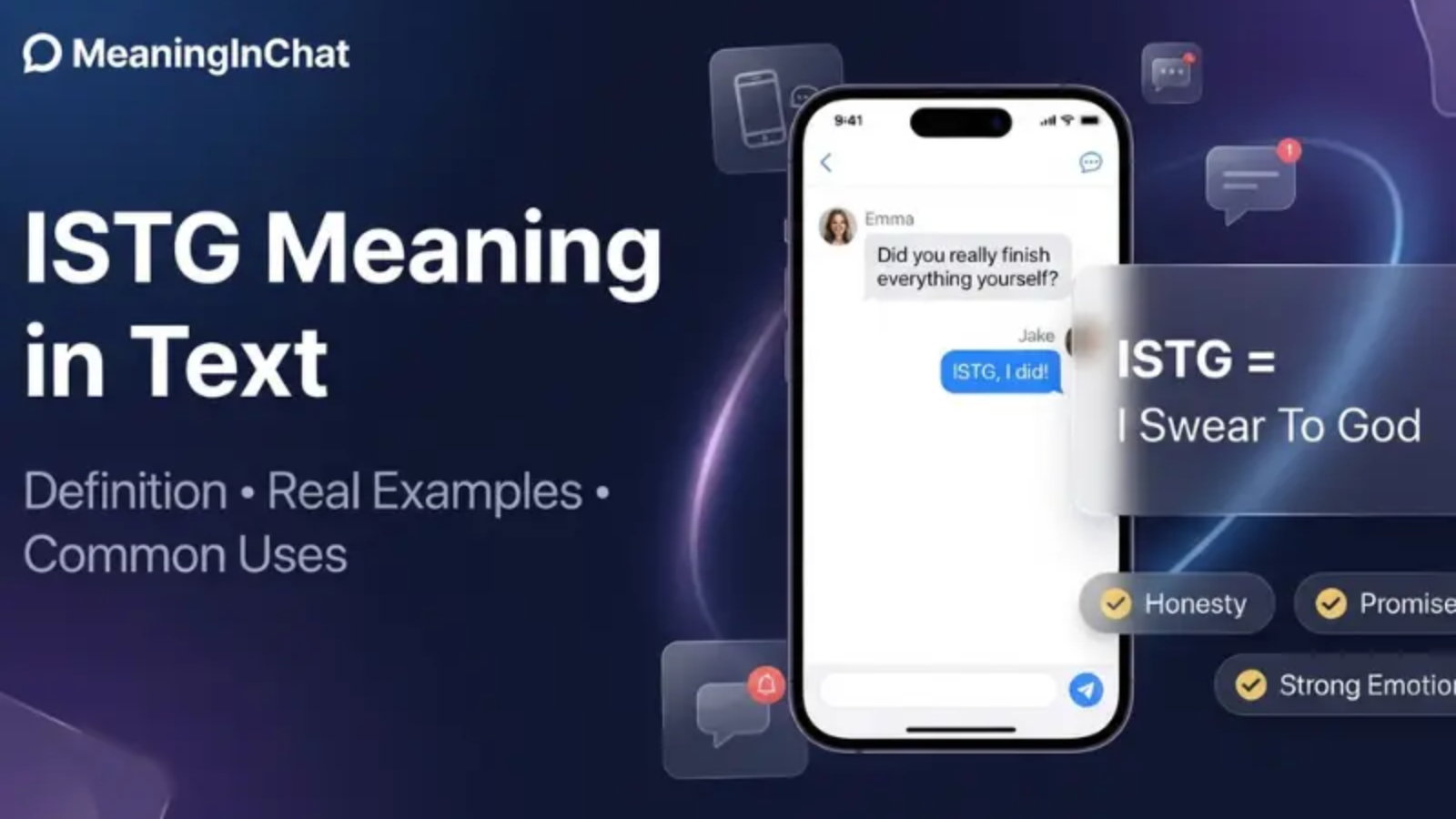
ISTG stands for “I Swear To God.” It’s commonly used in text messages and on social media to emphasize honesty, express frustration, make a promise, or react strongly to a situation. The tone depends on the conversation, but it usually shows that the speaker is being sincere or expressing strong emotions.
If you’ve come across ISTG in a text message or social media post, you may be wondering what it means. It’s a popular internet abbreviation that people use to add emphasis to what they’re saying without typing the full phrase.
In most conversations, ISTG stands for “I Swear To God.” Whether someone is insisting they’re telling the truth, making a promise, or reacting to something surprising, the meaning usually becomes clear from the context. This guide explains what it means, how people use it, and when it fits naturally into online conversations.
What Does ISTG Mean in Text?
ISTG stands for “I Swear To God.” It’s a popular internet abbreviation that people use to show they’re being completely honest, making a serious promise, expressing frustration, or reacting strongly to something. Instead of typing the full phrase, they simply write ISTG to make their message shorter while keeping the same emotional impact.
Unlike some texting abbreviations that have multiple unrelated meanings, ISTG almost always refers to “I Swear To God.” The exact tone depends on the conversation. It can sound sincere, annoyed, surprised, excited, or even playful when used between close friends.
For example:
Emma: Did you really finish the entire project by yourself?
Jake: ISTG, I didn’t get any help.
Here, Jake is emphasizing that he’s telling the truth.
Another example:
Sarah: The concert was canceled again.
Liam: ISTG, that’s the third time this month!
In this conversation, ISTG expresses frustration rather than making a promise.
Although the phrase includes the word “God,” most people use it simply as an expression of emphasis. In everyday texting, it’s usually understood as another way of saying “I’m serious,” “I promise,” or “Believe me.”
If you enjoy learning internet abbreviations, you might also like our guide on FR Meaning in Text, which explains another popular slang term used to emphasize honesty and sincerity.What Does ISTG Stand For?
Many people search what does ISTG stand for after seeing it in a message or social media post.
The abbreviation expands to:
ISTG = I Swear To God
The full phrase has been part of spoken English for many years and is often used to stress that someone is telling the truth or making a sincere statement.
As texting became more popular, people shortened the phrase into ISTG because it was quicker to type while still carrying the same emotional impact.
Today, you’ll see ISTG used in conversations involving:
- Honest statements
- Promises
- Frustration
- Strong opinions
- Emotional reactions
- Surprising situations
- Friendly jokes
Although the wording includes “God,” many people use ISTG simply as an expression of emphasis rather than a literal religious statement.
Common Ways ISTG Is Used
People use ISTG in many different situations, but its purpose is almost always the same—to add emphasis to what they’re saying. Whether someone is defending themselves, making a promise, or reacting to surprising news, the abbreviation helps make the message sound more sincere or emotional.
| Situation | Example | What It Means |
|---|---|---|
| Telling the truth | ISTG, I didn’t touch your phone. | Emphasizes honesty |
| Making a promise | ISTG, I’ll pay you back tomorrow. | Gives reassurance |
| Expressing frustration | ISTG, this traffic never ends. | Shows annoyance |
| Reacting to surprising news | ISTG, I wasn’t expecting that! | Expresses surprise |
| Friendly joking | ISTG, you’re the funniest person I know 😂 | Adds playful emphasis |
Telling the Truth
One of the most common reasons people use ISTG is to convince someone that they’re being honest.
Example:
Alex: Did you eat the last slice of pizza?
Ben: ISTG, it wasn’t me.
Making a Promise
People also use ISTG when they want to reassure someone that they’ll keep their word.
Example:
Emma: Don’t forget to send me the notes.
Sophia: ISTG, I’ll send them tonight.
Expressing Frustration
Sometimes ISTG shows annoyance when something keeps going wrong.
Example:
ISTG, my internet disconnects every time I join a meeting.
Reacting to Something Unexpected
The abbreviation can also make a surprising reaction sound stronger.
Example:
ISTG, I thought that was the ending!
Using It Playfully
Friends often use ISTG in a humorous way instead of sounding completely serious.
Example:
ISTG, if you keep sending me memes, I’ll never get any work done. 😂
Although the tone changes from one conversation to another, the abbreviation always adds emphasis and emotion. Reading the messages around it is usually enough to understand exactly what the sender means.
If you enjoy learning common texting abbreviations, you might also like our guide on WSG Meaning in Text, another popular slang term frequently used in casual online conversations.Why Do People Use ISTG?
One reason ISTG has remained popular is that it instantly adds emotion to a message without requiring a long explanation.
Instead of writing:
- I’m completely serious.
- I’m telling the truth.
- I promise.
- I really mean it.
People simply type:
ISTG
The abbreviation helps readers recognize that the speaker feels strongly about what they’re saying.
For example, someone waiting for a delayed flight might text:
ISTG, this is the longest airport line I’ve ever seen.
A student could write:
ISTG, I studied all weekend for this exam.
In both situations, ISTG strengthens the message and makes the speaker’s feelings more obvious.
Where Did ISTG Come From?
The phrase “I Swear To God” has been part of everyday English for many years. People have traditionally used it to emphasize that they’re telling the truth, making a sincere promise, or expressing strong emotions. As texting and instant messaging became more popular, the phrase was shortened to ISTG to make conversations faster while keeping the same meaning.
Today, ISTG is widely recognized across messaging apps and social media platforms such as Snapchat, Instagram, TikTok, WhatsApp, Discord, and X (formerly Twitter). Its popularity has continued because it’s quick to type, easy to understand, and adds emotion to a message without requiring a long explanation.
Unlike many internet abbreviations that fade over time, ISTG has remained common because it can express honesty, surprise, frustration, or playful exaggeration in just four letters.
If you’re curious about how other popular internet abbreviations evolved, you might also enjoy our guide on OTP Meaning in Text, which explains another widely used slang term with multiple meanings.When Should You Use ISTG?
ISTG works best in casual conversations where you want to emphasize your feelings or make your message sound more sincere. People often use it while chatting with friends, replying to social media posts, or reacting to something surprising. Since it’s an informal abbreviation, it’s not suitable for professional emails, academic writing, or business communication.
Here are some of the most common situations where ISTG sounds natural:
| Situation | Should You Use ISTG? | Example |
|---|---|---|
| Texting friends | ✅ Yes | ISTG, I’ll be there in five minutes. |
| Snapchat or Instagram chats | ✅ Yes | ISTG 😂, that was hilarious! |
| WhatsApp conversations | ✅ Yes | ISTG, I completely forgot. |
| TikTok comments | ✅ Yes | ISTG, this video made my day! |
| Business emails | ❌ No | Write the full sentence instead. |
| School assignments | ❌ No | Avoid internet slang in formal writing. |
Best Times to Use ISTG
- When you’re emphasizing that you’re telling the truth.
- When you’re making a sincere promise.
- When you’re reacting to something unexpected.
- When you’re expressing frustration or excitement.
- When you’re joking with close friends.
Although ISTG makes conversations feel more expressive, using it too often can reduce its impact. Save it for moments when you genuinely want to add emphasis rather than including it in every message.
If you enjoy learning how internet slang is used in everyday conversations, you may also like our guide on MO Meaning in Text, which explains another abbreviation that’s common in chats and social media.When ISTG Fits Best
| Situation | Use ISTG? | Example |
| Texting friends | ✅ Yes | ISTG, I’ll be there soon. |
| Snapchat chats | ✅ Yes | ISTG 😂 |
| Instagram DMs | ✅ Yes | ISTG, that’s amazing. |
| WhatsApp groups | ✅ Yes | ISTG, I didn’t know that. |
| Business emails | ❌ No | Use complete sentences instead. |
| Formal reports | ❌ No | Avoid internet abbreviations. |
Real Examples of ISTG in Everyday Conversations
The easiest way to understand ISTG is by seeing it in real conversations. These examples show how the abbreviation changes its tone depending on the situation while still emphasizing honesty or strong emotions.
Telling the Truth
Emma: Did you delete my photos?
Jake: ISTG, I didn’t even touch your phone.
Here, ISTG reassures Emma that Jake is being truthful.
Making a Promise
Sophia: Don’t forget to call me after work.
Liam: ISTG, I’ll call as soon as I get home.
In this conversation, ISTG strengthens Liam’s promise.
Expressing Frustration
Noah: How’s your day going?
Olivia: ISTG, everything that could go wrong has gone wrong today.
The abbreviation emphasizes Olivia’s frustration and makes the message feel more emotional.
Reacting to Something Surprising
Mia: I just won two concert tickets!
Ava: ISTG, that’s amazing! Congratulations!
Here, ISTG expresses excitement and surprise rather than honesty.
Playful Humor
Ethan: I only watched one episode.
Lucas: ISTG, you always say that and end up watching the whole season. 😂
In this example, the abbreviation is used jokingly between friends, creating a lighthearted tone.
These conversations show why ISTG has remained popular in texting. The abbreviation adapts easily to different emotions, making messages feel more natural and expressive without adding extra words.
If you enjoy learning internet slang through real-life examples, check out our guide on ONM Meaning in Text, where we explain another commonly used abbreviation with practical conversations.Is ISTG Always Serious?
Not always. Although ISTG often expresses honesty or a serious promise, it doesn’t always carry a serious tone. In many conversations, people use it jokingly, sarcastically, or to exaggerate a situation for comedic effect. The intended meaning depends on the context, punctuation, emojis, and the relationship between the people chatting.
For example, if someone says:
“ISTG, this is the best burger I’ve ever had!”
They’re simply expressing excitement, not making a literal promise.
Likewise, a friend might text:
“ISTG, if you send me one more dog video, I’m going to waste my entire afternoon watching them. 😂”
The message is clearly playful and isn’t meant to be taken seriously.
On the other hand, ISTG can sound much more sincere during an important conversation.
Example:
“ISTG, I had nothing to do with what happened.”
Here, the speaker is emphasizing that they’re telling the truth.
The easiest way to understand the tone is to read the surrounding messages. Emojis, punctuation, and the topic of the conversation usually make it clear whether ISTG is expressing honesty, frustration, excitement, or playful exaggeration.
If you’re learning common internet slang, you might also enjoy our guide on WYL Meaning in Text, another abbreviation whose meaning depends heavily on context.How ISTG Is Used Across Different Social Media Platforms
Although ISTG carries the same core meaning across the internet, the way people use it can vary slightly depending on the platform. As of 2026, it’s still a popular abbreviation because it quickly adds emotion, emphasis, or sincerity to a message without requiring a long explanation.
| Platform | How ISTG Is Commonly Used |
|---|---|
| Text Messages | Emphasizing honesty, promises, or frustration in personal conversations. |
| Snapchat | Replying to Snaps or chats with strong reactions or playful exaggeration. |
| Used in DMs, comments, and story replies to express surprise, excitement, or sincerity. | |
| TikTok | Found in comments reacting to relatable, funny, or shocking videos. |
| Discord | Casual conversations while gaming or chatting with online communities. |
| X (Twitter) | Quick reactions to trending topics, opinions, or viral posts. |
No matter where you see it, ISTG is almost always used to make a message feel stronger or more believable. Instead of typing the full phrase, people rely on the abbreviation to keep conversations fast while still expressing emotion.
As internet slang continues to evolve, ISTG remains widely recognized because it’s simple, memorable, and fits naturally into everyday online communication.
If you’re exploring more social media abbreviations, you may also enjoy our guide on SFS Meaning in Text, which explains another term frequently seen on platforms like Snapchat and Instagram.IISTG vs Similar Texting Abbreviations
Internet slang often serves different purposes, even when the abbreviations seem similar. While ISTG emphasizes honesty or strong emotions, other terms are used to express agreement, opinions, or sincerity in different ways. Knowing the difference helps you choose the right abbreviation for the situation.
| Abbreviation | Meaning | When It’s Used |
|---|---|---|
| ISTG | I Swear To God | Emphasizing honesty, promises, or strong emotions |
| TBH | To Be Honest | Sharing an honest opinion or personal thought |
| FR | For Real | Showing agreement or emphasizing that something is true |
| NGL | Not Gonna Lie | Introducing an honest confession or opinion |
| IKR | I Know, Right? | Agreeing enthusiastically with someone else’s statement |
ISTG vs TBH
Although both abbreviations relate to honesty, they aren’t interchangeable. ISTG adds emphasis and emotion, while TBH simply introduces an honest opinion.
Example:
TBH, I didn’t enjoy the movie.
ISTG, I watched the entire thing!
ISTG vs FR
FR is commonly used to agree with someone or emphasize that something is true. ISTG, on the other hand, usually strengthens the speaker’s own statement or promise.
Example:
Alex: That exam was impossible.
Ben: FR!
Alex: ISTG, I’ve never seen questions like that before.
ISTG vs NGL
People use NGL before admitting something honestly, while ISTG makes a statement sound more convincing or emotionally charged.
Example:
NGL, I expected a better ending.
ISTG, I almost walked out of the theater.
ISTG vs IKR
IKR is simply a way to agree with someone else’s opinion. Unlike ISTG, it doesn’t express a promise or emphasize honesty.
Example:
Emma: This weather changes every five minutes.
Sophia: IKR!
Understanding these differences makes it easier to choose the right abbreviation and avoid using one where another fits better.
If you’d like to learn more, check out our guides on TBH Meaning in Text, FR Meaning in Text, NGL Meaning in Text, and IKR Meaning in Text for detailed explanations and real conversation examples.Common Mistakes People Make When Using ISTG
Although ISTG is easy to understand once you know what it stands for, people sometimes use or interpret it incorrectly. Avoiding these common mistakes will help you use the abbreviation naturally and understand it correctly in different conversations.
Assuming It Always Sounds Serious
Many people think ISTG is only used when someone is making a serious promise. In reality, it’s often used jokingly, sarcastically, or to exaggerate a reaction. Always consider the context before deciding how the message is intended.
Using It in Professional Communication
ISTG is informal internet slang, so it doesn’t belong in business emails, academic assignments, or professional messages. In formal situations, it’s better to write the full sentence instead of using abbreviations.
Ignoring the Conversation Around It
The same abbreviation can express honesty, frustration, excitement, or humor. Reading only ISTG without looking at the surrounding messages can lead to misunderstanding the sender’s tone.
Assuming Every Abbreviation Means the Same Thing
Some people confuse ISTG with abbreviations like TBH, FR, or NGL because they all relate to honesty in different ways. Each one has its own purpose, so choosing the right abbreviation depends on what you’re trying to express.
By paying attention to context and using ISTG only in casual conversations, you’ll understand it more naturally and avoid the most common mistakes people make online.
📚 See Also
If you’re learning internet slang, these related guides can help you understand other popular abbreviations used in text messages, social media, and online conversations.
- FR Meaning in Text — Discover how FR is used to emphasize honesty or agreement in everyday conversations.
- TBH Meaning in Text — Learn when people use TBH to share honest opinions and personal thoughts.
- NGL Meaning in Text — Find out how NGL introduces honest confessions and candid statements online.
- IKR Meaning in Text — See why IKR is a popular way to show agreement in texting and social media.
- WSG Meaning in Text — Learn what WSG means and how it’s commonly used to start casual conversations.
- WTV Meaning in Text — Explore the different meanings of WTV and when people use it in online chats.
FAQs
Can ISTG be used sarcastically?
Yes. Although ISTG often expresses honesty or a serious promise, it can also be used sarcastically or humorously. The conversation, emojis, and tone usually make it clear whether the sender is joking or being sincere.
Is ISTG considered rude?
No. ISTG isn’t considered rude on its own. However, if it’s used during an argument or with an angry tone, it may come across as confrontational. Between friends, it’s usually seen as a casual way to add emphasis.
Is ISTG popular in 2026?
Yes. As of 2026, ISTG remains widely used in text messages and on platforms like Snapchat, Instagram, TikTok, Discord, WhatsApp, and X. It’s still a common abbreviation because it’s short, expressive, and easy to recognize.
Should I use ISTG in professional emails?
No. ISTG is meant for casual conversations and social media. In professional or academic writing, it’s better to write your message in full instead of using internet abbreviations.
Does ISTG always mean “I Swear To God”?
Almost always. In modern texting and online conversations, ISTG is universally understood as “I Swear To God.” Unlike many abbreviations, it rarely has alternative meanings.
What are some abbreviations similar to ISTG?
Common alternatives include TBH (To Be Honest), FR (For Real), NGL (Not Gonna Lie), and IKR (I Know, Right?). While they all appear in casual conversations, each has a different purpose and isn’t a direct replacement for ISTG.
If you’re expanding your internet slang vocabulary, you might also enjoy our guides on TBH Meaning in Text and FR Meaning in Text, which explain two of the most commonly used abbreviations in online conversations.Conclusion
ISTG is one of those internet abbreviations that’s easy to understand once you’ve seen it used in real conversations. Whether someone is emphasizing that they’re telling the truth, making a promise, reacting to surprising news, or expressing frustration, the abbreviation adds emotion without making a message longer.
If you’re ever unsure what ISTG means, look at the surrounding conversation, the sender’s tone, and any emojis they use. Those details usually reveal whether the message is serious, playful, or sarcastic. As online slang continues to evolve, ISTG remains a popular part of everyday texting because it’s simple, expressive, and widely recognized.
If you’re interested in learning more texting abbreviations, be sure to explore our guides on WSG Meaning in Text and TBH Meaning in Text to expand your internet slang vocabulary