
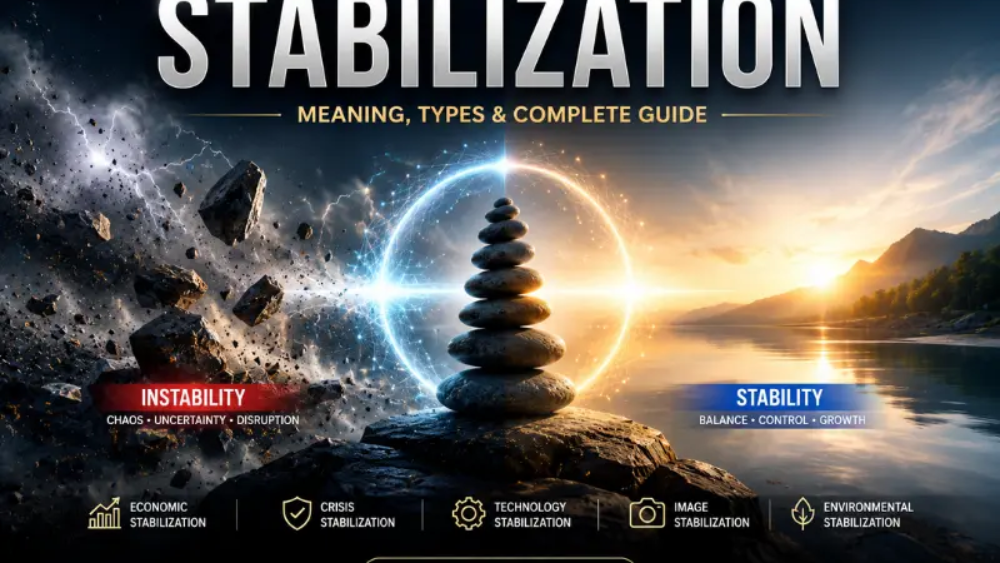
The word stabilization appears in many different areas of life. You may see it when reading about the economy, currency, technology, engineering, health, business, environmental systems, or crisis recovery.
Although the context changes, the central idea remains similar: stabilization is the process of making something stable or maintaining it in a steady condition.
Merriam-Webster defines stabilization as the act or process of stabilizing, or the condition of being stabilized. It also uses the term for limiting fluctuations in areas such as business activity, prices, employment, and foreign exchange.
Cambridge similarly explains stabilization as the condition of something becoming fixed or no longer changing significantly. In business and economics, the word can describe an economy or system becoming able to operate regularly without unexpected changes.
This guide explains what stabilization means, where it is used, how it works, and why it matters.
What Is Stabilization?
Stabilization means bringing something into a more stable, controlled, balanced, or predictable condition.
It can involve:
- Reducing unwanted fluctuations
- Preventing further deterioration
- Restoring normal operation
- Maintaining a steady condition
- Strengthening a system
- Creating conditions for long-term recovery
The exact meaning depends on the subject.
For example:
Economic stabilization focuses on reducing excessive economic volatility.
Currency stabilization aims to reduce major changes in exchange rates.
Image stabilization helps reduce unwanted camera movement.
Crisis stabilization focuses on restoring security and basic conditions after serious disruption.
So, stabilization is not limited to one industry. It is a broad concept used whenever stability needs to be created or maintained.
Stabilization Meaning in Simple Words
In simple English:
Stabilization means making something steady and preventing it from changing or moving unpredictably.
Imagine a table that keeps shaking. If you adjust its legs until it stops moving, you have stabilized the table.
The same basic idea can apply to much larger systems.
If prices change rapidly, economic policies may attempt stabilization.
If a camera shakes during recording, stabilization technology can reduce the unwanted movement.
If a community has experienced severe disruption, stabilization efforts may focus on restoring security and essential services.
The method changes, but the objective is similar: greater stability.
Stabilization Definition
The standard dictionary definition centers on the process or state of becoming stable.
Merriam-Webster gives several meanings, including the process of stabilizing and the limitation of fluctuations in business activity, prices, or employment. It also includes a foreign-exchange meaning involving keeping a currency quotation within a narrow range.
Cambridge describes stabilization as the condition of something being fixed or not changing, while its Business English definition connects the term with economies, systems, prices, rates, and financial stability.
This explains why the word appears in such different contexts.
Stabilization Pronunciation
The American English pronunciation is approximately:
stabilization — /ˌsteɪ.bə.ləˈzeɪ.ʃən/
The word is related to stabilize.
In British English, you may also encounter the spelling:
stabilisation
The meaning remains essentially the same.
Stabilization vs Stability
These two words are closely connected but are not identical.
Stability
Stability describes a condition in which something remains steady or does not change unexpectedly.
Stabilization
Stabilization describes the process of creating, restoring, or maintaining that stable condition.
A simple example:
Stability = the stable condition.
Stabilization = the process of becoming stable.
This distinction is useful when reading technical, economic, or policy-related information.
Stabilization vs Stabilisation
You may notice two spellings:
- Stabilization
- Stabilisation
Stabilization is commonly used in American English.
Stabilisation is commonly used in British English.
They refer to the same concept.
The difference is primarily a spelling convention rather than a difference in meaning.
Types of Stabilization
Because stabilization is used across many fields, its meaning can change depending on context.
Economic Stabilization
Economic stabilization refers to efforts designed to reduce excessive fluctuations and create more predictable economic conditions.
It can involve areas such as:
- Inflation
- Employment
- Economic growth
- Government spending
- Interest rates
- Consumer demand
- Business activity
Merriam-Webster specifically includes limiting fluctuations in business activity, prices, and employment within its definition of stabilization.
The goal is generally not to stop an economy from changing completely.
Instead, the goal is to prevent extreme instability that can make planning difficult for households, businesses, and governments.
Price Stabilization
Price stabilization focuses on reducing sharp or unwanted movements in prices.
This concept can appear in discussions about:
- Food prices
- Commodity markets
- Energy
- Financial markets
- Consumer goods
A stabilization policy may attempt to reduce excessive volatility rather than permanently freeze prices.
The exact approach depends on the market and the economic policy being used.
Currency Stabilization
Currency stabilization involves efforts to reduce excessive fluctuations in the value or exchange rate of a currency.
Merriam-Webster includes maintaining a foreign-exchange quotation within a relatively narrow range as one meaning of stabilization.
Currency stability can matter because large exchange-rate changes may affect:
- Import costs
- Export competitiveness
- Business planning
- Consumer prices
- International payments
Different countries use different monetary and economic approaches to address currency volatility.
Financial Stabilization
Financial stabilization focuses on maintaining the orderly operation of financial systems.
It can involve efforts related to:
- Banks
- Financial markets
- Credit
- Liquidity
- Investor confidence
- Systemic risk
The objective is to reduce the possibility that financial instability spreads across interconnected institutions or markets.
Crisis Stabilization
Crisis stabilization is used when a serious disruption threatens normal social, political, or economic conditions.
In the humanitarian and development context, the United Nations Development Programme describes stabilization as a political process addressing security threats to a state, its territory, and its population. UNDP also describes stabilization programs as context-driven and connected to security, basic services, livelihoods, and restoring normalcy.
This demonstrates that stabilization can be a foundation for longer-term recovery.
Image Stabilization
In photography and video, stabilization has a completely different practical application.
Image stabilization is designed to reduce unwanted camera movement.
Depending on the technology, stabilization may be achieved through:
- Optical mechanisms
- Sensor movement
- Electronic processing
- Software-based correction
- Combinations of these methods
The goal is to produce a steadier image or video.
This is why terms such as image stabilization, optical image stabilization, and electronic stabilization are common in camera and smartphone specifications.
Structural Stabilization
In engineering and construction, stabilization can mean making a structure, object, or system more secure and resistant to unwanted movement.
Examples may include:
- Reinforcing structures
- Supporting unstable components
- Improving foundations
- Reducing unwanted vibration
- Strengthening damaged systems
The exact method depends on the engineering problem.
Environmental Stabilization
Environmental systems can also undergo stabilization.
An ecosystem may move toward a more balanced condition after experiencing disruption.
In ecological terminology, Merriam-Webster includes a specialized meaning related to the maximum adjustment between organisms and their environment characteristic of an ecological climax community.
This is a more specialized use of the word and differs from everyday meanings.
How Does Stabilization Work?
There is no universal stabilization method because every system has different causes of instability.
However, a general stabilization process often follows several stages.
Identify the Instability
First, determine what is changing or failing to remain steady.
For example:
- Prices are fluctuating
- A camera is shaking
- A structure is moving
- A system is experiencing disruption
Find the Cause
The next step is identifying why instability is occurring.
Without understanding the cause, attempts to stabilize something may only address the symptoms.
Choose an Appropriate Intervention
The solution depends on the situation.
A financial problem requires different measures from a structural problem or technological one.
Reduce the Major Sources of Instability
The next objective is to reduce the factors causing excessive movement, volatility, or disruption.
Monitor the Result
Stabilization is not necessarily finished once conditions improve.
The system needs to be monitored to determine whether stability is maintained.
Move Toward Long-Term Stability
In many situations, stabilization is an intermediate stage rather than the final goal.
Once immediate instability is reduced, longer-term improvements can begin.
Why Is Stabilization Important?
Stability makes planning easier.
When conditions change unpredictably, people and organizations may struggle to make decisions.
Stabilization can help create:
Predictability
Businesses and institutions can plan more effectively when major fluctuations are reduced.
Confidence
Stable conditions can make people more confident about future decisions.
Continuity
Organizations can continue operating when disruptive changes are controlled.
Recovery
In crisis situations, stabilization can create conditions in which longer-term recovery becomes possible.
Risk Reduction
Reducing excessive volatility can lower certain forms of operational or financial risk.
Examples of Stabilization in Everyday Life
You do not need to work in economics or engineering to encounter the concept.
Camera
You record a video while walking. The footage contains unwanted movement. Image stabilization reduces some of that movement.
Business
A company experiences unpredictable demand. Management adjusts inventory, staffing, and planning processes to make operations more predictable.
Currency
A country’s currency experiences substantial fluctuations. Economic authorities may introduce policies intended to reduce excessive volatility.
Construction
A temporary support system is added to reduce unwanted movement in a structure while permanent work is completed.
Crisis Recovery
After major disruption, authorities and development organizations may work to restore security, essential services, livelihoods, and functioning institutions.
These examples look very different, but they share the same basic concept: reducing instability and creating a more workable condition.
Benefits of Stabilization
The benefits depend on the context, but common advantages include:
- Greater predictability
- Reduced volatility
- Improved planning
- Better operational continuity
- Increased confidence
- Reduced disruption
- Stronger foundations for recovery
- Improved control over changing conditions
However, stabilization does not automatically solve every underlying problem.
A system can become temporarily stable while deeper issues remain unresolved.
That is why stabilization often needs to be followed by long-term improvement.
Limitations of Stabilization
Stability is not always the same as progress.
For example, a system may remain stable while still performing poorly.
This creates an important distinction:
Stabilization prevents or reduces instability.
Improvement increases performance or quality.
A successful long-term strategy may need both.
Another limitation is that some stabilization measures can involve trade-offs. An intervention that reduces volatility in one area may create costs or limitations somewhere else.
Therefore, stabilization should be designed around the specific problem rather than treated as a universal solution.
Stabilization in Business
Businesses often need stability before they can focus on growth.
A company experiencing constant operational problems may first need to stabilize:
- Cash flow
- Staffing
- Supply chains
- Customer service
- Production
- Internal processes
- Project schedules
Once these areas become more predictable, management can focus more effectively on expansion and innovation.
This is why stabilization can be considered a foundation for sustainable growth.
Stabilization in Technology
Technology uses the concept in several ways.
A software system might need stabilization after a major update.
A development team may enter a stabilization phase where it focuses on:
- Fixing bugs
- Improving reliability
- Testing changes
- Resolving compatibility problems
- Preparing a stable release
Hardware can also require stabilization when vibration, movement, temperature, or other conditions need to be controlled.
In this context, stabilization generally means making a system more reliable and predictable.
Stabilization Is Not the Same as Stopping Change
One common misunderstanding is that stabilization means making something completely static.
That is not necessarily true.
A stable system can continue changing.
For example, an economy can grow while remaining relatively stable. A camera can move while image stabilization reduces unwanted shake. A business can evolve while maintaining predictable operations.
The goal is generally controlled and manageable change, not necessarily zero change.
What Is the Opposite of Stabilization?
Depending on the context, possible contrasting ideas include:
- Destabilization
- Volatility
- Instability
- Disruption
- Fluctuation
Destabilization is particularly relevant when something moves away from a stable condition.
The appropriate opposite depends on the field being discussed.
Synonyms for Stabilization
Common related words include:
- Stabilizing
- Steadying
- Strengthening
- Consolidation
- Reinforcement
- Balancing
- Securing
These words are not perfect replacements in every context.
For example, “consolidation” may be appropriate in business, while “steadying” may work better in everyday language.
See Also:
- Management Guide EWMagWork: Team & Workflow Tips
- Technology News & Industry Updates: August 2026
- Latest Technology Trends: in 2026 10 Tech Trends to Watch
FAQs
What does stabilization mean?
Stabilization means the process of making something stable or maintaining it in a stable condition. It can refer to economic, financial, technological, structural, environmental, or crisis-related situations.
What is a simple example of stabilization?
Reducing unwanted camera movement while recording a video is a simple example of stabilization. Economic policies designed to reduce excessive price fluctuations are another example.
What is the difference between stability and stabilization?
Stability is a condition of being steady, while stabilization is the process of creating or restoring that condition.
What is economic stabilization?
Economic stabilization refers to efforts aimed at reducing excessive economic fluctuations and creating more predictable conditions for economic activity.
What is currency stabilization?
Currency stabilization refers to efforts to keep exchange-rate movements within a more manageable range. Merriam-Webster includes maintaining a foreign-exchange quotation within a narrow range as a specialized meaning of the term.
What is crisis stabilization?
Crisis stabilization is the process of restoring safer and more functional conditions after serious disruption. In its development and conflict work, UNDP connects stabilization with security, basic services, livelihoods, local authority, and recovery.
Is stabilization always permanent?
No. Stabilization can be temporary or ongoing. A system may become stable for a period and later experience new instability.
Is stabilization the same as recovery?
Not exactly. Stabilization generally focuses on reducing immediate instability, while recovery usually involves broader and longer-term rebuilding or improvement.
Conclusion
Stabilization is a broad term with one central idea: creating or maintaining a stable condition.
Its meaning changes according to context. In economics, it can involve reducing excessive fluctuations in prices, employment, business activity, or currency markets. In technology, it can mean improving reliability or reducing unwanted movement. In photography, it helps control camera shake. In crisis settings, stabilization can help restore security, services, livelihoods, and normalcy.The easiest way to remember the word is:
Stability is the condition. Stabilization is the process of getting there or keeping it that way.
Once you understand this basic distinction, the term becomes much easier to recognize across economics, business, technology, engineering, environmental studies, and everyday English.
