
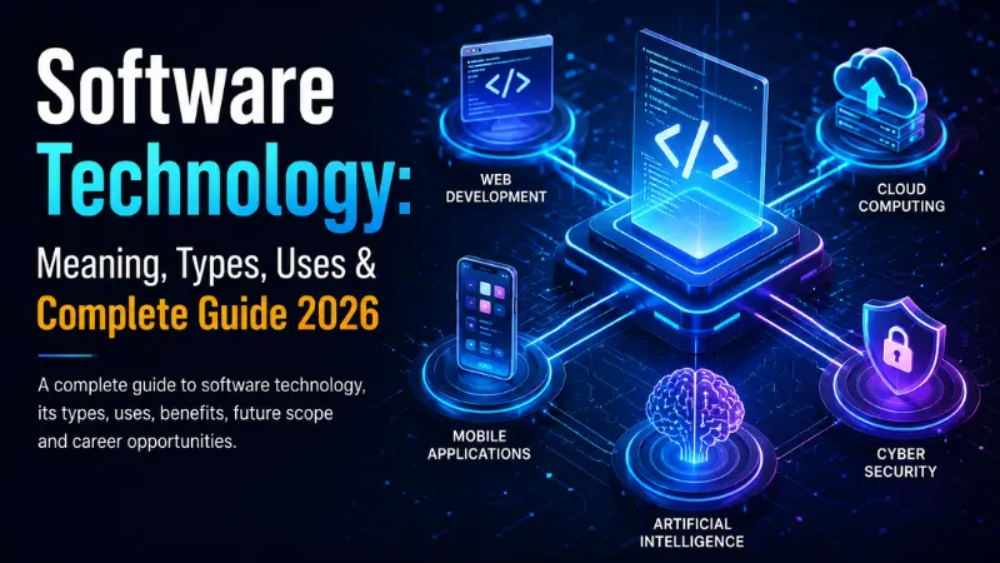
Software technology refers to the tools, methods, programming languages, platforms, and systems used to create, operate, maintain, and improve software.
In simple words, it is the technology behind the digital applications and systems people use every day. Mobile apps, websites, banking systems, cloud platforms, business software, games, artificial intelligence tools, and operating systems all depend on different forms of software technology.
It is a broad field rather than one particular application or programming language. It combines software development practices with technologies such as databases, APIs, cloud computing, cybersecurity, artificial intelligence, automation, and user-interface development.
The term is sometimes confused with software engineering. Although the two areas overlap significantly, software technology is a broader description of the technologies and technical systems used to build and run software, while software engineering focuses more heavily on the systematic processes used to design, develop, test, deploy, and maintain software.
Software Technology in Simple Terms
Imagine ordering food through a mobile application.
Several software technologies may work together behind the scenes:
- A mobile interface lets you select your food.
- A backend processes your request.
- A database stores account and order information.
- An API connects different services.
- Payment technology handles the transaction.
- Cloud infrastructure helps keep the service available.
- Security systems protect sensitive information.
- Analytics tools help the company understand usage.
The customer sees one application, but many software technologies can be working together to make it function.
That is why software technology is better understood as an ecosystem of technical tools and systems rather than a single technology.
Why Is Software Technology Important?
Modern organizations depend heavily on software.
A bank can use software to process transactions. A hospital can use digital systems to manage records. A retailer can operate an online store. A school can provide online learning. A logistics company can track deliveries.
Software technology allows organizations to automate repetitive tasks, process information, communicate with customers, analyze data, and build digital products.
It also makes it possible to scale services. A well-designed software system can potentially serve thousands or millions of users without requiring every task to be performed manually.
Main Types of Software Technology
Software technology covers a large number of categories. The exact classification can vary, but the following areas represent some of the most important ones.
System Software
System software provides the foundation on which other programs operate.
Examples include operating systems, device drivers, system utilities, and other software responsible for managing computer resources.
Windows, Linux, Android, and other operating systems are familiar examples of this category.
Application Software
Application software is designed to help users perform specific tasks.
Examples include:
- Word processors
- Web browsers
- Accounting applications
- Video-editing software
- Communication apps
- Educational platforms
- Business management systems
Most software products people interact with directly belong to this category.
Web Technology
Web software powers websites and web applications.
A modern web application can involve several layers:
Frontend → API/Backend → Database
The frontend is what users see and interact with. The backend handles business logic, while the database stores and retrieves information.
Technologies such as HTML, CSS, JavaScript, server-side frameworks, databases, and APIs can work together to create these systems.
Mobile Technology
Mobile software is designed for smartphones and tablets.
Android and iOS applications can provide services ranging from banking and shopping to entertainment and communication.
Developers may build applications specifically for one operating system or use cross-platform technologies to share parts of the development process between platforms.
Cloud Software Technology
Cloud computing has changed how software is developed and delivered.
Instead of running everything on a local computer or company-owned server, applications can use remote computing resources accessed through the internet.
Cloud-based software can provide scalable storage, computing power, databases, application hosting, analytics, and other services.
This model is widely used by modern businesses because resources can be adjusted according to demand.
Database Technology
Most useful software systems need to store information.
Database technology allows applications to save, organize, search, update, and retrieve data.
Databases can store information such as:
- Customer accounts
- Product details
- Orders
- Financial records
- Messages
- Website content
- Application settings
Relational databases and NoSQL systems are two broad approaches used for different technical requirements.
Artificial Intelligence and Machine Learning
AI has become an increasingly important part of software technology.
AI-based software can process large datasets, recognize patterns, generate content, classify information, assist users, and support decision-making.
Machine learning systems can learn patterns from data and use those patterns to produce predictions or classifications.
Generative AI adds another dimension by allowing software to generate text, images, audio, code, and other content.
Cybersecurity Technology
Software must also be protected against unauthorized access, malicious activity, data theft, and other threats.
Cybersecurity technologies can include authentication systems, encryption, access controls, vulnerability management, monitoring, secure development practices, and threat detection.
Security is not simply an optional feature added at the end of development. Modern software projects increasingly need security considerations throughout the development lifecycle.
Core Components of Software Technology
Several technical components commonly work together in software systems.
Programming Languages
Programming languages provide instructions that computers can execute.
Popular languages include Python, JavaScript, Java, C#, C++, Go, Swift, and many others.
Different languages are suitable for different environments and project requirements.
For example, Python is widely used for automation, data work, backend development, and AI-related applications, while JavaScript is fundamental to modern web development.
Frameworks and Libraries
Developers rarely build every function from scratch.
Frameworks provide structures and conventions for developing applications, while libraries provide reusable functionality.
They can speed up development and help teams maintain consistency across projects.
APIs
An API, or Application Programming Interface, allows different software systems to communicate.
For example, a shopping application may use an API to communicate with a payment service.
APIs are essential to modern software ecosystems because individual applications increasingly depend on multiple external and internal services.
Development Tools
Software development also depends on tools for writing, testing, debugging, managing, and deploying code.
Examples include code editors, integrated development environments, version-control systems, testing frameworks, container platforms, and deployment tools.
How Software Technology Works Together
A modern application is rarely built from one technology.
Consider an online shopping platform.
A customer opens the website through a browser. The frontend displays products and collects user actions. The backend processes requests. An API communicates with payment or shipping services. A database stores customer and order information. Cloud infrastructure hosts parts of the system. Security technologies protect accounts and transactions.
All these components work together as one digital service.
This interconnected architecture is one reason software technology has become such an important field.
Software Technology vs Software Engineering
The terms are related but should not automatically be treated as identical.
Software technology focuses broadly on the technologies, tools, platforms, systems, and technical approaches used to create and operate software.
Software engineering is concerned with applying systematic engineering principles to software development, including requirements, architecture, coding, testing, maintenance, project management, and quality assurance.
A simple way to remember the distinction is:
Software technology = the technologies and tools
Software engineering = the disciplined process of building and maintaining software
In real-world development, however, the two areas overlap considerably.
Software Development Life Cycle
Software technology is usually applied through a development process.
A common software development lifecycle includes the following stages.
Requirements
The team determines what the software needs to accomplish and who will use it.
Planning
Developers and stakeholders decide on technologies, architecture, resources, timelines, and priorities.
Design
The system’s structure and user experience are planned.
Development
Programmers build the application using appropriate languages, frameworks, databases, and tools.
Testing
The software is tested to identify defects, security issues, usability problems, and unexpected behavior.
Deployment
The finished software is released into its intended environment.
Maintenance
After release, software may receive bug fixes, security updates, performance improvements, and new features.
This cycle can repeat continuously as software evolves.
Real World Uses of Software Technology
Software technology appears in almost every modern industry.
Banking
Banks use software for online accounts, payments, fraud detection, customer service, financial analysis, and transaction processing.
Healthcare
Healthcare organizations use digital systems for records, scheduling, diagnostics, communication, and administrative operations.
Education
Schools and universities use software for learning management, online classes, assessments, student records, and communication.
E Commerce
Online stores rely on software for product catalogs, shopping carts, payments, inventory, customer accounts, recommendations, and delivery tracking.
Transportation
Software supports navigation, fleet management, ticketing, logistics, traffic analysis, and vehicle-related systems.
Entertainment
Streaming platforms, games, social networks, digital media applications, and content-creation tools all depend on software technologies.
Manufacturing
Factories can use software for automation, monitoring, inventory, production planning, quality control, and predictive maintenance.
Benefits of Software Technology
Automation
Software can perform repetitive tasks quickly and consistently.
Efficiency
Digital workflows can reduce manual work and make information easier to access.
Scalability
Cloud and distributed technologies can allow services to grow as user demand increases.
Accessibility
Online applications can make services available from different locations and devices.
Data Driven Decisions
Software can collect and analyze information to support business decisions.
Innovation
New software technologies can create entirely new products, services, and business models.
Challenges of Software Technology
Software development also has significant challenges.
Security Risks
Connected systems can be targeted by cyberattacks and unauthorized access.
Complexity
Large software systems may contain thousands or millions of lines of code and numerous interconnected services.
Maintenance
Software needs regular updates as technologies, security requirements, devices, and user expectations change.
Compatibility
Different devices, operating systems, databases, and services may need to work together.
Technical Debt
Short-term development decisions can create additional maintenance work later if software is not properly designed or maintained.
Privacy
Applications that collect personal information need appropriate safeguards and responsible data practices.
Skills Needed in Software Technology
People entering this field can develop different combinations of technical and professional skills.
Programming
Learning at least one programming language provides a foundation for understanding software development.
Problem Solving
Software work involves breaking complex problems into smaller, manageable parts.
Databases
Understanding how information is stored and retrieved is useful for many development roles.
Web or Mobile Development
Depending on career goals, developers can specialize in websites, web applications, Android, iOS, or cross-platform development.
Cloud Computing
Knowledge of cloud infrastructure is increasingly useful for modern software roles.
Cybersecurity
Security principles can benefit developers working with connected applications and sensitive data.
Communication
Software projects involve designers, developers, managers, clients, and users. Technical ability alone is not enough for effective teamwork.
Software Technology Careers
The field offers many career paths.
Potential roles include:
- Software developer
- Web developer
- Mobile developer
- Backend developer
- Frontend developer
- Full-stack developer
- Database specialist
- Cloud engineer
- DevOps engineer
- QA engineer
- Cybersecurity professional
- AI or machine-learning specialist
- Systems analyst
- Software architect
The best career direction depends on a person’s interests and the type of systems they want to build.
Software Technology in Pakistan
Software technology has become an important part of Pakistan’s growing digital economy.
Technology parks, software companies, universities, startups, freelance developers, and IT service providers contribute to the country’s software ecosystem.
The Pakistan Software Export Board’s Software Technology Parks initiative, for example, provides technology-focused infrastructure intended to support IT businesses, freelancers, startups, and related digital activity.
Universities also offer programs covering software development, programming, web technologies, artificial intelligence, databases, and related computing disciplines.
This creates opportunities for students and professionals who want to build careers in software and digital technology.
Future of Software Technology
The software industry continues to evolve quickly.
Several areas are likely to remain important:
AI Assisted Development
AI tools are increasingly being used to assist with coding, testing, documentation, debugging, and research.
Cloud Native Applications
More organizations are building applications around scalable cloud infrastructure and distributed services.
Edge Computing
Some applications require data processing closer to the device rather than sending everything to a distant data center.
Automation
Software automation is expanding across business operations, manufacturing, customer service, analytics, and development workflows.
Stronger Security
As more systems become connected, secure software development and identity protection will become increasingly important.
Intelligent Applications
Software is moving toward applications that can interpret data, personalize experiences, and assist users with increasingly complex tasks.
The future is therefore unlikely to be defined by one programming language or one development platform. Instead, software technology will continue to evolve as different technologies become interconnected.
How to Start Learning Software Technology
Beginners do not need to learn everything at once.
A practical path can look like this:
Learn basic computer and programming concepts.
Choose one beginner-friendly programming language.
Build small projects.
Learn databases and APIs.
Explore web or mobile development.
Learn version control and software testing.
Study cloud technologies and cybersecurity basics.
Build larger projects that demonstrate your skills.
The most effective learning method is usually a combination of theory and hands-on practice.
See Also:
- Tikcotech: Meaning, Features, Uses & Complete Guide 2026
- QuantumRun: Foresight Platform, Features & Complete Guide
- Freaky Font: Meaning, Styles, Uses & Complete Guide 2026
FAQs
What is software technology?
Software technology is the collection of tools, programming languages, platforms, methods, and systems used to create, operate, maintain, and improve software.
Is software technology the same as software engineering?
No. They overlap, but software technology is a broader term for the technologies used in software, while software engineering focuses on systematic development and maintenance practices.
What are examples of software technology?
Examples include programming languages, databases, APIs, cloud computing, web technologies, mobile platforms, AI, machine learning, cybersecurity tools, and development frameworks.
Is software technology a good career field?
It can offer many career opportunities because software is used across industries. The best path depends on your interests, technical skills, and specialization.
Which programming language should a beginner learn?
There is no universal answer. Python can be a friendly starting point for many beginners, while JavaScript is particularly useful for people interested in web development.
Does software technology include AI?
Yes. Artificial intelligence and machine learning are important areas within the modern software technology ecosystem.
Why is software technology important for businesses?
It enables automation, digital services, data processing, communication, customer experiences, analytics, and many other business functions.
Conclusion
Software technology is the foundation behind much of the modern digital world. From mobile applications and websites to cloud platforms, AI systems, banking infrastructure, and business software, countless digital services depend on a combination of software technologies working together.
The field is much broader than programming alone. It includes databases, APIs, cloud infrastructure, cybersecurity, development tools, artificial intelligence, testing, deployment, and ongoing maintenance.
For beginners, the size of the field can initially seem overwhelming. The best approach is to start with fundamentals, choose a specific direction, build practical projects, and gradually expand into related technologies.
For businesses, software technology provides the infrastructure needed to automate operations, deliver digital services, analyze information, and develop new products.
As AI, cloud computing, automation, and connected systems continue to develop, software technology will remain a major driver of digital transformation.
In simple terms: software technology is the collection of technologies that turns digital ideas into working software.
