
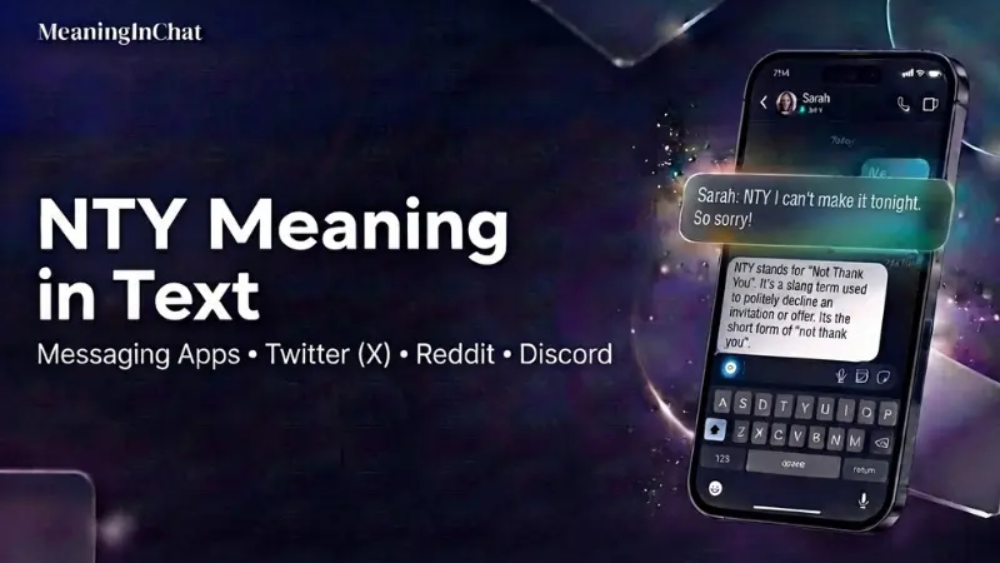
NTY means “No, Thank You.” It’s a polite texting abbreviation used to decline an offer, invitation, or suggestion without sounding rude. You’ll commonly see it in text messages, WhatsApp, Snapchat, Instagram, Discord, TikTok, and other online chats. If someone asks, “What does NTY mean in text?”, the answer is simply “No, Thank You.”
Texting has made conversations faster than ever, and abbreviations have become a normal part of everyday communication. Instead of typing full sentences, people often use short forms like LOL, BRB, TBH, and IMO to save time. One abbreviation that often confuses people is NTY, especially when they receive it as a reply.
In this guide, you’ll learn what NTY means in text, what it stands for, when to use it, real chat examples, common mistakes, and other possible meanings. By the end, you’ll know exactly how to understand and use NTY naturally in online conversations.
Want to learn more common texting abbreviations? Read our OFC Meaning in Text guide to see how it’s used in everyday chats.
What Does NTY Mean in Text?
The most common meaning of NTY in texting is “No, Thank You.” People use it to politely refuse an offer, invitation, suggestion, or request without typing the full phrase. It’s a quick response that keeps conversations friendly while making it clear that the answer is no.
Unlike a simple “No,” which can sometimes sound blunt, NTY adds a sense of appreciation. That’s why it’s widely used in text messages, social media, and messaging apps where short replies are common.
Here are a few examples:
Friend: Want to grab lunch later?
You: NTY, I already ate.
Classmate: Need help with your homework?
You: NTY, I finished it already.
Seller: Interested in buying this?
You: NTY.
In each example, the sender politely declines without sounding unfriendly.
Check out our WTV Meaning in Text article to learn another popular internet slang abbreviation.
NTY Meaning at a Glance
| Abbreviation | Full Form | Meaning | Tone | Common Use |
| NTY | No, Thank You | A polite way to decline something | Friendly | Text messages, WhatsApp, Snapchat, Instagram, Discord |
What Does NTY Stand For?
If you’re wondering what NTY stands for, the answer is simple:
- N = No
- T = Thank
- Y = You
Together, they form “No, Thank You.”
The abbreviation has become popular because it combines a refusal with good manners. Instead of giving a short “No,” adding “Thank You” makes the response feel more respectful.
For example:
Friend: Want another slice of pizza?
You: NTY, I’m full.
Coworker: Coffee before the meeting?
You: NTY, I just had one.
Because it’s short, polite, and easy to understand, NTY is now a common reply across texting apps and social media platforms.
Why Do People Use NTY Instead of Writing “No, Thank You”?
NTY has become popular because it’s fast, polite, and fits the casual style of online conversations. Rather than typing the full phrase every time, people can send three letters that communicate the same message.
One of the biggest advantages is that it softens rejection. Replying with only “No” can sometimes feel cold, while NTY sounds much friendlier because it includes “Thank You.”
People also use NTY because it:
- Saves time while texting.
- Sounds polite and respectful.
- Keeps conversations short and natural.
- Works well in group chats and social media.
- Is widely understood by regular internet users.
No vs. NTY
| Reply | How It Sounds |
| No | Direct and sometimes blunt |
| No, thank you | Polite and respectful |
| NTY | Short, friendly, and casual |
When Should You Use NTY?
NTY works best in informal conversations where abbreviations are common. It’s ideal when you want to politely decline something without writing a long response.
You can use it when someone offers:
- Food or drinks
- An invitation
- A game request
- A product or service
- Help or advice
- A social plan
Examples
Friend: Want to watch a movie tonight?
You: NTY, maybe next weekend.
Teammate: Join another match?
You: NTY, I need a break.
Sibling: Want some ice cream?
You: NTY, I’m already full.
In each case, NTY politely declines the offer while keeping the conversation positive.
Learn what HRU Meaning in Text stands for and how people use it in casual conversations.
Is NTY Rude?
No. NTY is generally considered a polite abbreviation because it includes the words “Thank You.” Most people use it to decline an offer without hurting the other person’s feelings.
However, the tone depends on the situation. If someone makes a thoughtful offer, replying with only “NTY” may feel a little brief. Adding a few extra words makes your response warmer.
For example:
- NTY, I appreciate the offer!
- NTY, maybe next time.
- NTY, but thanks for asking.
- NTY 😊
These replies sound more friendly while still keeping the message short.
Other Meanings of NTY
In everyday texting, NTY almost always means “No, Thank You.” Although the same letters may have different meanings in certain companies or technical fields, those uses are uncommon.
If you see NTY in a text message, social media comment, or online chat, it’s safe to assume the sender means “No, Thank You.”
Possible Meanings of NTY
| Meaning | Where It’s Used | Common? |
| No, Thank You | Text messages, social media, messaging apps | ⭐ Most Common |
| Internal company acronym | Business or workplace documents | Rare |
| Organization or project initials | Schools or organizations | Rare |
| Technical abbreviation | Industry-specific discussions | Very Rare |
The easiest way to understand NTY is by looking at the conversation. If someone is politely declining an invitation, request, or offer, it almost certainly means “No, Thank You.”
NTY vs. No Thanks
Both expressions have the same meaning, but they are used a little differently.
| NTY | No Thanks |
| Abbreviation | Full phrase |
| Faster to type | Slightly more natural in writing |
| Best for texting | Works in both texting and spoken conversations |
| Very casual | Casual but slightly more formal |
For example:
Friend: Want to order pizza?
You: NTY.
or
You: No thanks.
Both replies are polite, but NTY is more common in fast-moving online conversations.
Explore SN Meaning in Text to discover another abbreviation commonly seen in text messages.
Similar Texting Abbreviations
If you’re learning the meaning of NTY, you may also come across other common texting abbreviations. Knowing these shortcuts makes it easier to understand online conversations.
| Abbreviation | Meaning |
| LOL | Laughing Out Loud |
| BRB | Be Right Back |
| TBH | To Be Honest |
| IMO | In My Opinion |
| IDK | I Don’t Know |
| TY | Thank You |
| TYSM | Thank You So Much |
| YW | You’re Welcome |
| NP | No Problem |
| IKR | I Know, Right? |
These abbreviations are commonly used together in text messages and social media chats.
Common Mistakes People Make With NTY
Although NTY is simple to understand, people sometimes use it incorrectly or misunderstand its meaning.
One common mistake is thinking NTY sounds rude. In reality, it means “No, Thank You,” making it much more polite than replying with just “No.”
Another mistake is using NTY in professional emails or formal communication. While it’s perfectly fine in casual chats, writing the full phrase “No, thank you” is more appropriate in business or academic settings.
Some people also assume NTY has many different meanings. In everyday texting, that’s rarely the case. Almost always, it simply stands for “No, Thank You.”
You may also enjoy our SFS Meaning in Text guide to understand another popular social media abbreviation.
📚 See Also
Looking for more texting abbreviations? Explore these related guides to learn the meanings of popular internet slang used in text messages and social media.
- OFC Meaning in Text — Learn what OFC means and when people use it in everyday conversations.
- WTV Meaning in Text — Discover the different meanings of WTV in texting and social media.
- SN Meaning in Text — Find out what SN stands for and how it’s used in online chats.
- HRU Meaning in Text — See what HRU means and how people use it to check in with friends.
- SFS Meaning in Text — Explore the meaning of SFS and how it’s used on social media.
- LMK Meaning in Text — Learn what LMK stands for and when to use it in text messages.
FAQs
What does NTY mean in text?
NTY means “No, Thank You.” It’s a polite abbreviation used to decline an offer, invitation, or request.
What does NTY stand for?
NTY stands for “No, Thank You.” Each letter represents one word in the phrase.
Is NTY rude?
No. NTY is generally considered a polite way to say no because it includes “Thank You.”
Where is NTY commonly used?
You’ll often see NTY in text messages, WhatsApp, Snapchat, Instagram, Discord, TikTok, and other messaging apps.
Should I use NTY in work emails?
No. In professional communication, it’s better to write the complete phrase “No, thank you” instead of using the abbreviation.
Can NTY have another meaning?
In casual texting, NTY almost always means “No, Thank You.” Other meanings are rare and usually limited to specific industries or organizations.
Conclusion
NTY is a simple but useful texting abbreviation that stands for “No, Thank You.” It’s a polite way to decline an offer, invitation, or suggestion while keeping the conversation friendly. Because it’s short and respectful, NTY has become a common response across text messages, WhatsApp, Snapchat, Instagram, Discord, and other social media platforms.
While NTY works well in casual conversations, it’s best to use the full phrase “No, thank you” in formal or professional settings. Understanding when and how to use NTY will help you communicate naturally and avoid misunderstandings in online chats.
