
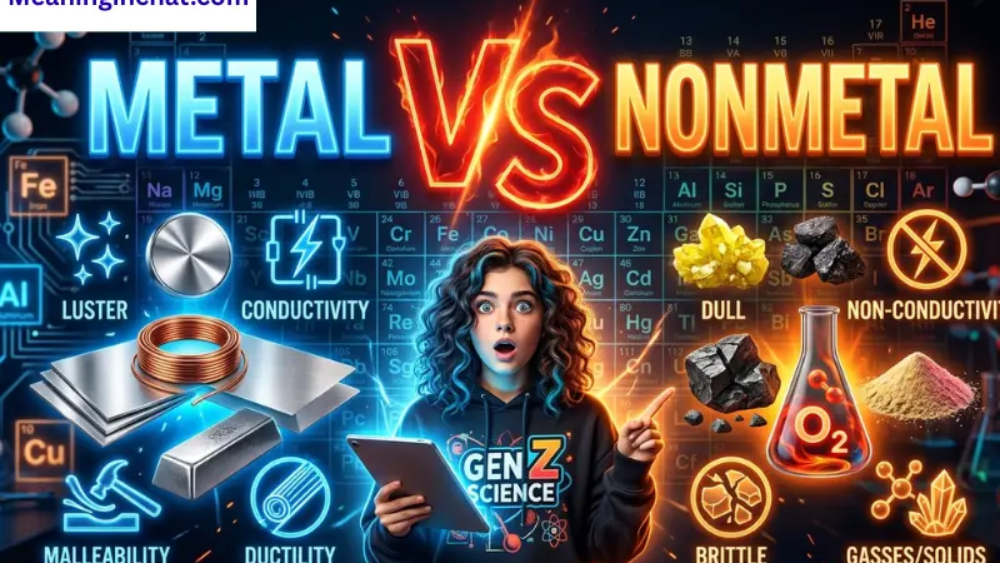
The main difference between metal vs nonmetal is that metals are usually shiny, strong, good conductors of heat and electricity, and can be shaped easily, while nonmetals are generally dull, weaker, and poor conductors.
Metals usually lose electrons during chemical reactions, while nonmetals usually gain or share electrons. Examples of metals include iron, copper, aluminum, and gold. Examples of nonmetals include oxygen, carbon, sulfur, and chlorine.
In simple words:
Metals = strong, shiny, conductive elements
Nonmetals = mostly dull, non-conductive elements
The difference between metal vs nonmetal is one of the most important topics in chemistry because elements are divided into different groups based on their physical and chemical properties. Everything around us, from buildings and vehicles to air and living organisms, contains elements that belong to either metals, nonmetals, or related categories.
People often search for metal or nonmetal when trying to identify whether a specific element belongs to the metallic or nonmetallic group. The classification helps scientists predict how elements behave, how they react with other substances, and where they can be used in everyday life.
Metals are commonly associated with strength, durability, and electrical conductivity. They are widely used in construction, electronics, transportation, and manufacturing. Nonmetals, on the other hand, play essential roles in life, medicine, agriculture, and chemical processes.
This complete comparison explains the major differences between metals and nonmetals, their properties, examples, uses, and common confusion points.
Metal vs Nonmetal – Basic Difference Table
| Property | Metals | Nonmetals |
| Appearance | Usually shiny | Usually dull |
| Conductivity | Good conductor | Poor conductor |
| Strength | Generally strong | Usually weaker |
| Malleability | Can be shaped into sheets | Usually brittle |
| Electrons | Lose electrons | Gain or share electrons |
| State at room temperature | Mostly solids | Solids, liquids, and gases |
| Examples | Iron, copper, gold | Oxygen, sulfur, carbon |
What Are Metals?
Metals are elements that usually have properties such as shine, strength, and the ability to conduct electricity and heat. They are found on the left side and middle portion of the periodic table.
Most metals have tightly packed atoms that create a strong structure. This structure allows them to resist breaking and makes them useful for tools, machines, buildings, and many industrial products.
Common metals include:
- Iron
- Copper
- Aluminum
- Silver
- Gold
- Zinc
Metals are important because they can be shaped without breaking. This property allows manufacturers to create wires, sheets, pipes, and different structures.
For example, copper is used in electrical wiring because electricity can move through it easily. Aluminum is used in airplanes and packaging because it is lightweight but strong.
What Are Nonmetals?
Nonmetals are elements that generally do not have metallic properties. They are located mostly on the right side of the periodic table.
Unlike metals, many nonmetals do not conduct electricity or heat well. Some exist as gases at room temperature, while others are solids or liquids.
Examples of nonmetals include:
- Oxygen
- Nitrogen
- Carbon
- Sulfur
- Chlorine
Nonmetals are essential for life and nature. Oxygen supports breathing, carbon forms the basis of living organisms, and nitrogen is important for plant growth.
Although nonmetals are often described as weaker than metals, they have unique chemical properties that make them extremely valuable.
Physical Properties: Metal vs Nonmetal
Physical properties are characteristics that can be observed without changing the substance into another material.
Metals and nonmetals show major differences in their physical behavior.
1. Appearance
Most metals have a shiny surface known as metallic luster.
Examples:
- Gold has a bright yellow shine.
- Silver has a reflective surface.
- Aluminum appears shiny when polished.
Nonmetals usually have a dull appearance.
Examples:
- Sulfur is yellow and dull.
- Carbon can appear black.
- Phosphorus has a non-metallic appearance.
2. Conductivity
One of the biggest differences in nonmetal vs metal comparison is electrical conductivity.
Metals allow electricity and heat to pass through easily because their electrons can move freely.
Copper wires inside homes are a common example.
Most nonmetals do not conduct electricity effectively.
However, graphite (a form of carbon) is a special exception because it can conduct electricity.
Physical Properties Comparison Table
| Feature | Metal | Nonmetal |
| Shine | High luster | Usually dull |
| Heat conduction | Excellent | Poor |
| Electricity flow | High | Low |
| Density | Usually high | Usually low |
| Texture | Hard and strong | Soft or brittle |
| Melting point | Often high | Usually lower |
Chemical Properties of Metals and Nonmetals
Chemical properties describe how elements react with other substances.
Metals and nonmetals behave differently during chemical reactions because of their electron arrangement.
Metals During Reactions
Metals usually lose electrons and form positive ions called cations.
Example:
Sodium loses one electron and becomes sodium ion.
This tendency makes metals reactive in many chemical reactions.
Some metals react strongly with water or acids, while others remain stable.
Nonmetals During Reactions
Nonmetals usually gain electrons or share electrons with other elements.
They form negative ions called anions when they gain electrons.
For example, chlorine gains an electron to become chloride.
Nonmetals often form compounds by combining with metals or other nonmetals.
Electron Behavior Comparison
| Element Type | Electron Action | Ion Formed |
| Metal | Loses electrons | Positive ion |
| Nonmetal | Gains electrons | Negative ion |
| Metal + Nonmetal | Electron transfer | Ionic compound |
| Nonmetal + Nonmetal | Sharing electrons | Covalent compound |
Metals and Nonmetals in Everyday Life
Both metals and nonmetals are everywhere around us.
Uses of Metals
Metals are used in:
- Buildings
- Cars
- Electronics
- Machines
- Jewelry
- Tools
Iron is widely used in construction because of its strength. Copper is important in electrical systems. Gold and silver are used in jewelry because they resist corrosion.
Uses of Nonmetals
Nonmetals are used in:
- Medicines
- Fertilizers
- Fuels
- Food production
- Water treatment
Oxygen is used in hospitals. Nitrogen is used in fertilizers. Carbon is found in fuels and biological materials.
Is It Metal vs Nonmetal? How to Identify an Element
A common question is its it metal vs nonmetal when looking at an element. The easiest way to identify an element is by checking its position on the periodic table and observing its properties.
General rules:
- Left side elements → mostly metals
- Right side elements → mostly nonmetals
- Middle region → transition metals
You can also check:
- Conductivity
- Shine
- Hardness
- Reaction behavior
A shiny element that conducts electricity is likely a metal. A dull element that does not conduct electricity is more likely a nonmetal.
Common Mistakes About Metals and Nonmetals
Mistake 1: Thinking All Metals Are Hard
Not every metal is extremely hard.
Some metals like sodium and potassium are soft enough to cut with a knife.
Mistake 2: Thinking All Nonmetals Are Gases
Some nonmetals are solids.
Examples:
- Carbon
- Sulfur
- Phosphorus
Mistake 3: Assuming Metals Always Conduct Electricity
Most metals do, but some exceptions exist.
The ability depends on the structure and movement of electrons.
Mistake 4: Confusing Appearance With Category
A shiny surface does not always guarantee an element is a metal because some nonmetals may appear unusual.
Chemical behavior is also important.
Metals vs Nonmetals Examples
| Element | Category | Common Use |
| Iron | Metal | Buildings and tools |
| Copper | Metal | Electrical wires |
| Aluminum | Metal | Aircraft and cans |
| Oxygen | Nonmetal | Breathing and medical use |
| Carbon | Nonmetal | Fuels and living organisms |
| Sulfur | Nonmetal | Chemicals and fertilizers |
Similarities Between Metals and Nonmetals
Although they have many differences, metals and nonmetals share some similarities.
Both:
- Are chemical elements
- Contain atoms
- Can form compounds
- Participate in chemical reactions
- Exist naturally
The difference comes from their structure and behavior.
Metal or Nonmetal: Which Is More Useful?
Neither category is more useful than the other because both have different purposes.
Metals provide:
- Strength
- Durability
- Electrical conductivity
Nonmetals provide:
- Biological support
- Chemical reactions
- Essential materials
Modern life depends on both groups working together.
Final Comparison Table
| Category | Metals | Nonmetals |
| Location | Left side of periodic table | Right side of periodic table |
| Electrons | Lose electrons | Gain/share electrons |
| Conductivity | High | Low |
| Appearance | Shiny | Usually dull |
| Shape | Flexible | Brittle |
| Examples | Iron, copper, gold | Oxygen, carbon, sulfur |
See Also:
FAQs
What is the difference between metal and nonmetal?
Metals are usually shiny, strong, and good conductors, while nonmetals are usually dull and poor conductors.
Is carbon a metal or nonmetal?
Carbon is a nonmetal.
Which is better: metal or nonmetal?
Neither is better. Both have different uses and importance.
Are all metals solid?
Most metals are solid at room temperature, but mercury is a liquid metal.
Can nonmetals conduct electricity?
Most cannot, but graphite can conduct electricity.
What is the easiest way to identify metals?
Check their shine, conductivity, and position on the periodic table.
Conclusion
The comparison of metal vs nonmetal shows two major groups of elements with different characteristics. Metals are usually strong, shiny, and excellent conductors, while nonmetals often have different physical and chemical behaviors.
The difference between metal or nonmetal becomes clear by looking at properties like conductivity, appearance, electron behavior, and reactions.
Both metals and nonmetals are necessary for modern life. From buildings and technology to food and medicine, these elements work together to create the materials and systems we use every day.
