
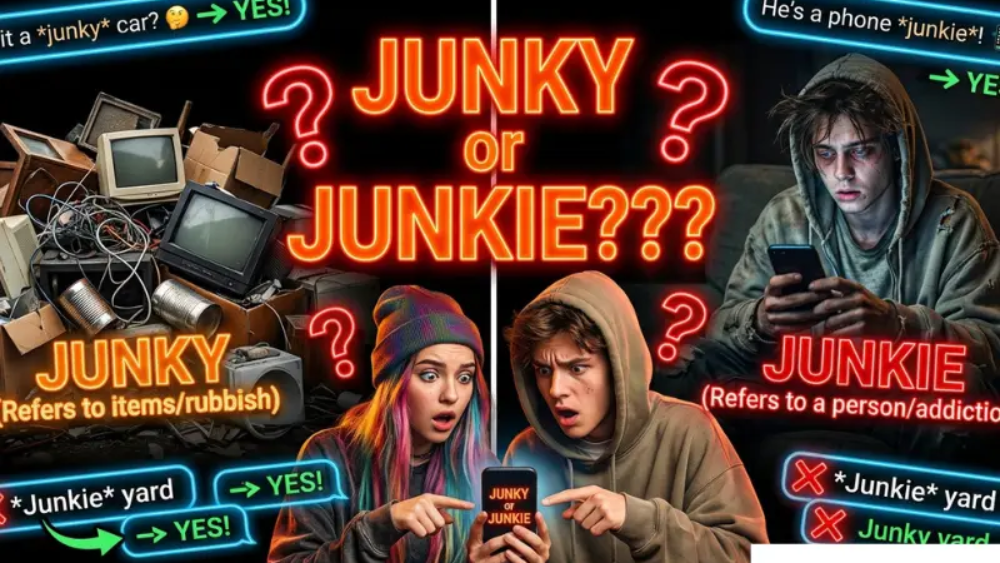
The correct word depends on the meaning you want to express.
Junkie usually refers to a person who is addicted to something, especially drugs, or someone who is extremely interested in a particular activity.
Junky means something low-quality, useless, cheap, or filled with junk.
So:
✔ Junkie = addicted person or enthusiastic fan
✔ Junky = poor quality, worthless, or junk-like
The confusion between junky or junkie is common because both words look and sound almost identical. Many people use them interchangeably while writing online, texting friends, or creating content, but these two words have different meanings and should be used in different situations.
The difference between junky vs junkie mainly depends on what you are describing. If you are talking about a person who has a strong addiction or obsession with something, the word junkie is usually correct. If you are describing an object, product, place, or thing that feels cheap, broken, or full of unnecessary items, junky is the better choice.
This guide explains the meaning of both words, their history, examples, common mistakes, and how to choose the right spelling in everyday communication.
Junky vs Junkie – Main Difference
| Feature | Junky | Junkie |
| Correct usage | Yes | Yes |
| Refers to | Things or qualities | People or strong interests |
| Meaning | Cheap, poor-quality, messy | Addicted person or obsessed fan |
| Used for objects | Yes | No |
| Used for people | Rare | Yes |
| Formal meaning | Low value | Addiction/enthusiasm |
What Does Junky Mean?
The word junky is an adjective that describes something that appears cheap, poorly made, old, useless, or full of unnecessary items.
It comes from the word “junk,” which means unwanted objects, waste materials, or things with little value.
When someone calls something junky, they are usually talking about its quality, appearance, or condition.
Examples of Junky in Sentences
- This old computer looks junky and needs repairs.
- My room became junky after moving houses.
- That website design feels outdated and junky.
- I bought a cheap junky toy from the market.
In these examples, junky describes the condition or quality of something.
What Does Junkie Mean?
The word junkie is usually a noun that refers to a person.
Traditionally, it described someone addicted to drugs, especially illegal substances. Over time, the meaning expanded and is now commonly used for people who are extremely interested in something.
For example, someone who loves coffee may call themselves a “coffee junkie,” meaning they are highly enthusiastic about coffee.
Examples of Junkie in Sentences
- He was a video game junkie during college.
- My brother is a fitness junkie.
- She is a movie junkie and watches films every weekend.
- The term originally referred to someone with a serious addiction.
The context decides whether the word sounds negative or casual.
Junkie or Junky – Why People Mix Them Up
The confusion between junkie or junky happens because both words come from the same root word: “junk.”
They also have almost the same pronunciation, making them difficult to separate in speech.
Many people assume the “-ie” and “-y” endings are just spelling variations, but they create different meanings.
A simple way to remember:
- Junkie → person
- Junky → thing
Its It Junky or Junkie – Correct Usage Explained
Many people search for its it junky or junkie when they are unsure which spelling fits their sentence.
The correct choice depends on the subject.
Examples:
✔ Is this phone junky?
✔ Is he a gaming junkie?
Incorrect:
❌ Is this phone a junkie?
❌ Is he a junky? (when talking about addiction)
The sentence meaning changes completely depending on the spelling.
Junky vs Junkie in Everyday Conversations
Both words appear in casual communication, but they are used differently.
| Situation | Correct Word | Example |
| Old broken item | Junky | This laptop is junky |
| Food lover | Junkie | She is a chocolate junkie |
| Messy place | Junky | The garage looks junky |
| Sports fan | Junkie | He is a football junkie |
| Addiction reference | Junkie | Drug junkie |
The Origin of Junky and Junkie
Both words developed from “junk,” but their meanings evolved differently.
“Junk” originally referred to old materials, discarded items, or useless things. Later, “junkie” became associated with people connected to addiction.
Over time, the word expanded into informal expressions like:
- news junkie
- fitness junkie
- travel junkie
- coffee junkie
Today, many people use junkie in a casual way to describe strong enthusiasm.
Common Mistakes People Make
Mistake 1: Using Junkie for Objects
Incorrect:
- This phone is a junkie.
Correct:
- This phone is junky.
A phone cannot have an addiction, so junkie does not fit.
Mistake 2: Using Junky for People
Incorrect:
- He is a music junky.
Correct:
- He is a music junkie.
When describing someone’s passion, junkie is preferred.
Mistake 3: Thinking Both Words Mean the Same
Although they look similar, their meanings are different.
Junky describes quality.
Junkie describes a person.
Junkie as a Positive or Negative Word
The meaning of junkie depends heavily on context.
It can sound negative:
- drug junkie
It can sound playful:
- coffee junkie
- fitness junkie
- travel junkie
Because of this, writers should consider the audience before using it.
Junky Meaning in Modern Language
Today, junky is commonly used to describe things that feel:
- Cheap
- Poorly designed
- Messy
- Low-quality
- Unreliable
Examples:
- junky software
- junky furniture
- junky gadgets
It is informal and usually used in casual conversations.
Junkie Meaning in Modern Language
Modern English uses junkie in many ways beyond addiction.
Common examples:
| Type | Meaning |
| Coffee junkie | Loves coffee |
| Fitness junkie | Loves exercise |
| Movie junkie | Watches many movies |
| Tech junkie | Loves technology |
| News junkie | Follows news constantly |
Junky vs Junkie Examples
| Sentence | Correct Word | Reason |
| This chair looks old and cheap | Junky | Describes object |
| She loves movies | Junkie | Describes person |
| My computer feels slow | Junky | Quality issue |
| He loves gaming | Junkie | Strong interest |
How to Remember the Difference Easily
A simple memory trick:
JunkY = QualitY
Both talk about the condition or quality of something.
JunkIE = Person
It refers to someone with an addiction or strong interest.
This small trick helps avoid mistakes in writing.
Junky or Junkie in Online Writing
People frequently confuse these words in comments, social media posts, and messages.
Examples:
Wrong:
- I am a coffee junky.
Better:
- I am a coffee junkie.
Wrong:
- This app is junkie.
Better:
- This app is junky.
Small spelling changes create different meanings.
See Also:
FAQs
Is junky or junkie correct?
Both are correct words, but they have different meanings. Junky describes things, while junkie describes people.
What is the difference between junky vs junkie?
Junky means cheap, messy, or low-quality. Junkie means an addicted person or someone extremely interested in something.
Is junkie always a negative word?
No. It can be negative in addiction-related contexts but casual and positive for hobbies or interests.
Can I call a person junky?
Usually no. Use junkie when talking about a person’s obsession or addiction.
Is a junky object the same as junk?
Not exactly. Junky means something has a low-quality or messy appearance.
Conclusion
The difference between junky or junkie is easy to remember once you know what each word describes. Use junky when talking about things that are cheap, old, messy, unreliable, or low-quality. Use junkie when referring to a person who has an addiction or a strong passion for something.
Whether you are comparing junky vs junkie or deciding between junkie or junky in a sentence, the simple rule is: junky describes things, while junkie describes people. Keeping this difference in mind helps you avoid common spelling mistakes and choose the correct word every time.
