
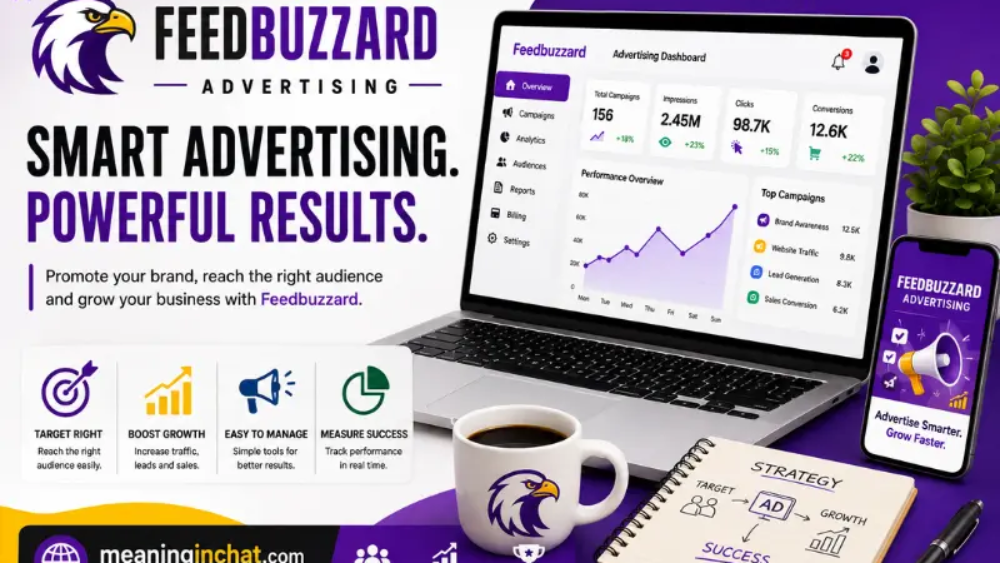
Feedbuzzard advertising is presented as a way for businesses and marketers to promote content or products through FeedBuzzard’s online audience. FeedBuzzard’s own recent advertising guide describes native cards, banners, videos, sponsored articles, audience targeting, campaign budgets, conversion tracking, and real-time reporting.
However, there is an important distinction between what FeedBuzzard publishes about its advertising offering and independently verified advertising infrastructure. Public information does not provide enough evidence to treat every claimed feature, price, or performance figure as independently confirmed.
Feedbuzzard advertising has become a search term for marketers looking for alternative ways to reach online audiences. FeedBuzzard describes itself as a site serving English-speaking web readers and publishing news, technology information, practical tools, and other content. Its current website also contains a dedicated guide explaining how businesses can advertise on the platform.
The advertising material published by FeedBuzzard describes several campaign options, including native advertisements, banner placements, video spots, and sponsored articles. It also claims support for targeting by geography, interests, devices, keywords, and audience data.
That sounds similar to a conventional digital advertising network, but advertisers should look beyond feature lists before committing money. Publicly available information about FeedBuzzard’s advertising infrastructure, independent campaign results, and verified pricing is still relatively limited. This means the platform is best approached as an advertising opportunity that should be tested carefully rather than assumed to perform like an established network.
What Is Feedbuzzard Advertising?
FeedBuzzard advertising refers to promotional opportunities associated with the FeedBuzzard website and the advertising system described in its own materials.
FeedBuzzard says its audience includes English-speaking users in countries such as the United States, United Kingdom, Canada, and Australia. Its advertising guide also describes interest-based audiences covering areas such as technology, finance, and lifestyle.
The platform’s current content mix includes technology, gaming, finance, AI tools, business, and other digital topics, giving advertisers several potential contextual environments for their campaigns.
The main advertising concepts described by FeedBuzzard are:
- Native advertising
- Banner advertising
- Video advertising
- Sponsored articles
- Audience targeting
- Campaign analytics
- Conversion tracking
- Budget controls
Feedbuzzard Advertising Formats
One of the more useful parts of the platform’s advertising documentation is its description of different creative formats. FeedBuzzard says advertisers can use native cards, banners, video spots, and sponsored articles.
Native Ads
Native cards are designed to fit naturally within content feeds. This format can be useful when an advertiser wants promotional content to look more integrated with the surrounding editorial experience.
The advantage is that the advertisement can potentially attract users who are already browsing related content.
Banner Ads
Banner advertising provides a more traditional display format. Advertisers can use graphical creative to promote a product, service, website, or campaign.
FeedBuzzard’s advertising guide states that image creatives can use JPG or PNG files, while video advertisements can use MP4 with H.264 encoding. It also says its asset manager provides specific size and file-weight requirements.
Video Ads
Video gives advertisers another way to demonstrate a product or communicate a message visually.
According to FeedBuzzard’s published guide, MP4 video using H.264 is supported. The exact current technical specifications should still be confirmed inside the advertising interface before preparing final creative assets.
Sponsored Articles
Sponsored articles are particularly relevant to companies that want to explain a product rather than simply display a short advertisement.
This format can provide more space for product information, use cases, demonstrations, or brand storytelling.
Feedbuzzard Advertising Targeting
Targeting is one of the main features claimed by FeedBuzzard.
Its advertising guide lists several targeting options:
| Targeting Type | Purpose |
| Geographic | Reach users in selected countries or regions |
| Demographic | Target particular audience groups |
| Interest | Reach users based on content interests |
| Keyword | Focus campaigns around selected topics |
| Device | Target specific device categories |
| Operating System | Narrow campaigns by OS |
| Lookalike | Find audiences similar to existing users |
| Custom Audiences | Use advertiser-provided audience lists |
FeedBuzzard specifically mentions English-speaking markets including the US, UK, Canada, and Australia.
This can be useful for businesses that don’t want to run the same campaign globally. A company targeting US consumers, for example, can build a campaign around that market instead of paying for impressions in regions that are irrelevant to its product.
Feedbuzzard Advertising Pricing
Pricing is one area where advertisers should be especially careful.
FeedBuzzard’s own guide says the platform supports CPM, CPI, and CPC pricing models, along with daily budgets and campaign caps.
However, I could not verify a current official public rate card establishing fixed prices for every campaign type and country.
Some third-party articles claim specific starting prices and minimum deposits. For example, one 2026 article claims CPC auctions can start at $0.001 per click and that a $50 minimum deposit is required. Those figures come from a third-party publication, not from a clearly verified official FeedBuzzard pricing page.
Therefore, these figures should not be treated as confirmed current pricing without checking the actual advertiser interface or obtaining a direct quote.
How to Advertise on Feedbuzzard
FeedBuzzard’s own 2026 advertising guide describes a straightforward campaign process.
The process is described as:
- Create a FeedBuzzard account.
- Verify billing information.
- Select a campaign objective.
- Choose the desired audience.
- Set geographic targeting.
- Select an advertising format.
- Upload creative assets.
- Set the budget and pricing model.
- Add conversion tracking.
- Review the advertisement.
- Submit the campaign for approval.
- Monitor performance after launch.
FeedBuzzard recommends beginning with a conservative budget and evaluating performance before increasing spend.
Does Feedbuzzard Offer Conversion Tracking?
Yes, FeedBuzzard’s advertising guide says advertisers can integrate conversion tracking pixels or server-side events.
Conversion tracking matters because clicks alone don’t tell an advertiser whether a campaign is successful.
For example, an advertiser might receive 1,000 clicks but only two purchases. Another campaign could receive 300 clicks and generate 20 sales. Without conversion data, the first campaign might incorrectly look more successful simply because it generated more traffic.
FeedBuzzard’s stated tracking capabilities are therefore more useful for advertisers focused on measurable outcomes rather than impressions alone.
Feedbuzzard Advertising Reporting
FeedBuzzard says advertisers receive reporting that can be used to monitor campaign performance and make adjustments. Its guide specifically emphasizes real-time reporting and campaign optimization.
Useful advertising metrics would include:
- Impressions
- Clicks
- Click-through rate
- Cost per click
- Conversions
- Conversion rate
- Cost per acquisition
- Return on advertising spend
The exact reporting dashboard and available metrics should be confirmed before purchasing a campaign.
Who Is Feedbuzzard Advertising For?
FeedBuzzard’s own material identifies small businesses, publishers, direct-to-consumer brands, agencies, and in-house marketing teams as potential users.
The platform may be particularly relevant to businesses that want to test English-speaking markets without immediately committing a large budget to major advertising networks.
It could also interest publishers or brands promoting content in technology, finance, lifestyle, gaming, or related areas because FeedBuzzard’s current editorial mix covers several of these subjects.
Pros and Cons
| Pros | Cons |
| Multiple ad formats | Public pricing is not clearly documented |
| English-speaking audience focus | Limited independent performance evidence |
| Geographic and interest targeting claims | Third-party pricing claims vary |
| CPC, CPM, and CPI models are described | Advertising infrastructure is not extensively documented |
| Conversion tracking is described | Advertisers should verify current specifications |
| Sponsored-content option | Not comparable in scale to major ad networks |
Is Feedbuzzard Advertising Worth Trying?
Feedbuzzard advertising may be worth testing with a controlled budget, particularly for advertisers interested in English-speaking audiences and alternative content-based placements.
The strongest reason to test rather than immediately scale is the difference between the platform’s own advertising claims and the amount of independent evidence available publicly.
A small campaign can provide practical information about:
- Traffic quality
- Audience relevance
- Conversion rates
- Cost per acquisition
- Creative performance
- Geographic performance
If the results are strong, the advertiser can gradually increase spending.
Feedbuzzard vs Major Advertising Networks
FeedBuzzard should not automatically be considered a replacement for large advertising ecosystems such as Google Ads or Meta Ads.
| Factor | FeedBuzzard | Google Ads | Meta Ads |
| Main Environment | Content/feed placements | Search, display, YouTube, etc. | Social platforms |
| Targeting | Geographic, interest, keyword and audience options claimed | Extensive | Extensive |
| Ad Formats | Native, banner, video, sponsored content | Search, display, video and more | Image, video, carousel and more |
| Public Scale | Smaller/emerging | Very large | Very large |
| Pricing Transparency | Limited public rate information | Auction-based | Auction-based |
| Best Use | Experimental/content-focused reach | Search intent and broad digital reach | Social audience targeting |
The comparison does not mean FeedBuzzard will outperform larger networks. Its potential value is as an additional channel that an advertiser can test alongside established platforms.
What Advertisers Should Verify
Before spending money on Feedbuzzard advertising, confirm the following directly:
Current pricing: Ask for the actual CPC, CPM, or other applicable rates.
Minimum budget: Confirm whether there is a minimum deposit or campaign spend.
Audience data: Request information about traffic sources, geographic distribution, and audience quality.
Tracking: Verify exactly how pixels, server-side events, and conversions are recorded.
Refund policy: Understand what happens to unused advertising funds.
Ad approval: Check prohibited categories and creative requirements.
Reporting: Confirm which performance metrics are included in campaign reports.
These checks are more useful than relying on generic claims about high engagement or guaranteed ROI.
See Also:
- Wollwirrware: Everything You Need to Know in 2026
- Software Keepho5ll: What It Is & How It Works
- Information About Foxtpax Software: Features & Uses
FAQs
What is Feedbuzzard advertising?
Feedbuzzard advertising refers to paid promotional opportunities associated with FeedBuzzard. Its own guide describes native cards, banners, video ads, sponsored articles, targeting, budgeting, and conversion tracking.
How much does Feedbuzzard advertising cost?
FeedBuzzard describes CPM, CPC, and CPI pricing models, but a complete current public rate card could not be independently verified. Third-party websites publish different figures, so advertisers should confirm the current price directly before paying.
What ad formats does Feedbuzzard support?
Its advertising guide lists native cards, banners, video spots, and sponsored articles.
Can I target users by country?
Yes. FeedBuzzard says advertisers can target geography and specifically highlights English-speaking markets such as the United States, United Kingdom, Canada, and Australia.
Does Feedbuzzard provide conversion tracking?
FeedBuzzard says advertisers can use conversion tracking pixels or server-side events to measure campaign outcomes.
Is Feedbuzzard advertising legitimate?
There is a real FeedBuzzard website with dedicated advertising material, but independent evidence about its advertising infrastructure and campaign performance is limited. Advertisers should verify pricing, billing, traffic sources, and terms before committing significant funds.
Is Feedbuzzard good for small businesses?
It may be worth testing for small businesses that want additional English-speaking traffic, but performance should be judged using actual conversion data rather than promotional claims.
Should I use Feedbuzzard instead of Google Ads?
Not necessarily. FeedBuzzard can be tested as an additional advertising channel, while Google Ads offers a much larger and more established advertising ecosystem. The better choice depends on actual campaign performance and audience fit.
Conclusion
Feedbuzzard advertising is presented as an emerging advertising option offering native ads, banners, videos, sponsored articles, audience targeting, multiple pricing models, and conversion tracking. FeedBuzzard’s own 2026 guide provides the clearest description of these capabilities and outlines a campaign setup process for advertisers.
The main issue is transparency. While there is substantial material describing how FeedBuzzard advertising is supposed to work, publicly verifiable information about its current pricing, independent campaign results, advertising infrastructure, and advertiser scale is much less extensive. Some third-party sites publish precise pricing figures, but those numbers should not be accepted as official without confirmation.
For that reason, the sensible approach is to start small, verify the current terms, track conversions, and judge the platform by actual results. FeedBuzzard may be useful as an additional traffic source, but advertisers should not treat unverified claims about reach, engagement, or ROI as guaranteed results.
