
Sole or Soul

Sole or Soul: Meaning, Difference, Usage & Examples Explained

Sole and soul are two different words with completely different meanings.

✔ Sole = only one, bottom part of a shoe, or a type of fish
✔ Soul = the spiritual part of a person, inner feelings, or essence

Although they sound the same, they are not interchangeable.

Examples:

  • This is the sole reason I left.
  • Music touches my soul.

The confusion between sole or soul is very common because these two words sound exactly alike but have different meanings. They are known as homophones, which means they have the same pronunciation but different spellings and definitions.

Many people mix up these words while writing because they depend on how the word sounds instead of its meaning in the sentence. This confusion often appears in conversations, messages, essays, and everyday writing.

The difference between sole vs soul becomes easy when you look at the context. If the sentence talks about something being the only one, a shoe bottom, or a type of seafood, the correct word is sole. If the sentence talks about emotions, spirit, personality, or a person’s inner self, the correct word is soul.

This guide explains the difference between soul or sole, provides examples, covers common mistakes, and helps you choose the right word in every situation.

Sole vs Soul Main Difference Table

WordMeaningCommon UsageExample
SoleOnly one or singleDecisions, objects, shoesThe sole reason
SoleBottom part of a shoeClothing/footwearShoe sole
SoleType of fishFoodFried sole fish
SoulInner spirit or essenceFeelings, personalityKind soul

What Does Sole Mean?

The word sole has several meanings, but the most common meaning is “only” or “single.”

When something is the only one of its kind, we use sole.

Examples:

  • She is the sole owner of the company.
  • This was the sole purpose of the meeting.
  • He was the sole survivor.

In these sentences, sole means there is only one person, reason, or thing.

Sole Meaning in Shoes

Another common meaning of sole is the bottom part of a shoe or footwear.

The sole is the part of a shoe that touches the ground.

Examples:

  • My shoe sole is damaged.
  • These boots have a strong rubber sole.
  • The sole of my sneaker is worn out.

This meaning has nothing to do with emotions or feelings.

Sole Meaning in Food

A less common meaning of sole refers to a type of flat fish.

Sole fish is used in many seafood dishes.

Examples:

  • We ordered grilled sole for dinner.
  • Sole fish has a mild flavor.
  • The restaurant serves fresh sole.

What Does Soul Mean?

The word soul refers to the spiritual, emotional, or inner part of a person.

It can describe:

  • Feelings
  • Personality
  • Character
  • Inner self
  • Spirit

Examples:

  • She has a beautiful soul.
  • Music speaks to my soul.
  • His kindness shows his true soul.

Unlike sole, soul is connected with emotions and personal qualities.

Soul in Everyday Language

People often use soul to describe someone’s personality or nature.

Examples:

  • He is a kind soul.
  • She has a creative soul.
  • They are old souls.

These expressions describe the person’s character, not something physical.

Soul or Sole How to Choose the Correct Word?

When deciding between soul or sole, check the meaning of the sentence.

Ask yourself:

Is it about:

✔ Being the only one? → Sole
✔ Shoes? → Sole
✔ Fish? → Sole
✔ Feelings or spirit? → Soul

Examples:

  • The sole reason was money.
    (Only reason)
  • The song touched my soul.
    (Inner feelings)

Its It Sole or Soul Correct Usage Explained

Many people search for its it sole or soul because they are unsure which spelling belongs in a sentence.

The correct question is:

✔ Is it sole or soul?

Not:

❌ Its it sole or soul?

The word is starts a question, while its shows possession.

Examples:

Correct:

  • Is it the sole reason?
  • Is it your soul speaking?

Incorrect:

  • Its it sole or soul?

Sole vs Soul in Sentences

The easiest way to separate these words is by looking at examples.

Sole Examples:

  • This is my sole responsibility.
  • She was the sole winner.
  • The shoe sole needs repair.
  • The chef prepared grilled sole fish.

Soul Examples:

  • He has a gentle soul.
  • The music moved my soul.
  • Her words came from the soul.
  • Every person has a unique soul.

Common Mistakes People Make

Mistake 1

Using Soul for “Only”

Incorrect:

❌ He was the soul person there.

Correct:

✔ He was the sole person there.

The sentence means he was the only person.

Mistake 2

Using Sole for Feelings

Incorrect:

❌ She has a beautiful sole.

Correct:

✔ She has a beautiful soul.

The sentence describes personality.

Mistake 3

Confusing Shoe Sole With Soul

Incorrect:

❌ My shoe soul is broken.

Correct:

✔ My shoe sole is broken.

Shoes have soles, not souls.

Mistake 4

Mixing Meaning in Writing

Incorrect:

❌ The soul reason was his mistake.

Correct:

✔ The sole reason was his mistake.

Sole and Soul Pronunciation

Both words are pronounced the same:

Sole = Soul

The difference appears only in spelling and meaning.

Because they sound identical, people often rely on sentence meaning to choose the right word.

Why Sole and Soul Are Confusing

These words create confusion because English contains many homophones.

Other examples include:

  • Sea / See
  • Pair / Pear
  • Right / Write
  • Flower / Flour

The pronunciation is similar, but the meanings are different.

Sole vs Soul in Different Situations

SituationCorrect WordExample
Only reasonSoleSole reason
Shoe bottomSoleShoe sole
SeafoodSoleSole fish
PersonalitySoulKind soul

The Origin of Sole

The word sole comes from older language roots connected with the idea of being alone or single.

Over time, it developed several meanings:

  • One and only
  • Bottom of footwear
  • A specific fish

These meanings are separate but share the same spelling.

The Origin of Soul

The word soul has a long history connected with ideas about life, spirit, and identity.

Across different cultures, people have used the word to describe the invisible part of a person that represents emotions, personality, or existence.

Today, soul is commonly used in both spiritual and casual expressions.

Sole or Soul in Modern Communication

In texting and online conversations, people often confuse these words because messages are typed quickly.

Examples:

Incorrect:

“I love this song, it touched my sole.”

Correct:

“I love this song, it touched my soul.”

Incorrect:

“This is my soul reason.”

Correct:

“This is my sole reason.”

Sole and Soul Expressions

Both words appear in many common phrases.

Sole Expressions:

  • Sole purpose
  • Sole owner
  • Sole decision
  • Sole survivor
  • Sole responsibility

Soul Expressions:

  • Kind soul
  • Old soul
  • Soul mate
  • Soul music
  • Soul searching

How to Remember the Difference

A simple memory trick:

Sole = Single

Both start with “S” and relate to something alone or one.

Examples:

  • Sole person
  • Sole reason
  • Sole owner

Soul = Spirit

Think about feelings and inner personality.

Examples:

  • Beautiful soul
  • Lost soul
  • Happy soul

Sole vs Soul Examples Table

SentenceCorrect WordReason
She was the only winnerSoleMeans only
The shoes need a new bottomSoleFootwear part
He has a kind personalitySoulInner nature
The song moved me deeplySoulFeelings

When to Use Sole

Use sole when talking about:

  • Something unique
  • Something alone
  • Ownership
  • Shoes
  • Fish

Examples:

  • Sole owner
  • Sole chance
  • Shoe sole
  • Sole fish

When to Use Soul

Use soul when talking about:

  • Spirit
  • Personality
  • Emotions
  • Inner feelings

Examples:

  • Gentle soul
  • Human soul
  • Soul music
  • Soul connection

See Also:

FAQs

What is the difference between sole and soul?

Sole refers to something single, a shoe bottom, or a fish. Soul refers to spirit, emotions, or inner character.

Is sole and soul pronounced the same?

Yes, both words sound the same.

Which is correct: soul or sole?

Both are correct words, but they have different meanings.

Is it sole reason or soul reason?

The correct phrase is sole reason because it means the only reason.

Is it sole or soul for a person?

Use soul when describing a person’s character or spirit.

Is its it sole or soul correct?

No. The correct phrase is “Is it sole or soul?”

Conclusion

The difference between sole or soul is based completely on meaning. Although these words sound identical, they describe completely different ideas.

Use sole when talking about something being the only one, the bottom of a shoe, or a type of fish. Use soul when talking about emotions, spirit, personality, or a person’s inner nature.

Remembering this simple difference will help you avoid common mistakes in writing and conversations.


Farther vs Further

Farther vs Further: Meaning, Difference & Usage Guide

Farther and further both refer to distance, but they are used slightly differently.

✔ Farther = physical distance
✔ Further = additional distance, progress, or figurative ideas

Examples:

  • The store is farther than I expected.
  • Let’s discuss this further.

In modern English, many people use them interchangeably, but traditional grammar rules prefer farther for measurable distance and further for abstract or additional meanings.

The confusion between Farther vs Further is one of the most common word-choice problems in English. These two words look almost identical, sound similar, and are often used in similar situations, which makes it difficult to know when to choose one over the other.

Many people ask whether there is a real difference between Farther or Further, or if both words can be used the same way. The answer depends on context. While both words can relate to distance, they developed different meanings over time.

Traditionally, farther is connected with physical distance, such as miles, steps, or locations. Further is usually connected with additional progress, development, discussion, or non-physical ideas.

For example:

  • “The mountain is farther away.”
  • “We need to investigate this further.”

The first sentence talks about actual space. The second refers to continuing an action.

This article explains the difference between Further vs Farther, gives examples, covers common mistakes, and shows how to use each word naturally.

Farther vs Further Main Difference

WordMain MeaningUsed ForExample
FartherGreater physical distanceLocations and measurable spaceThe park is farther away
FurtherAdditional or moreProgress, ideas, actionsExplain further
BothDistance in some contextsGeneral usageGo further/farther
NeitherIncorrect usageWrong sentence structureNot used

What Does Farther Mean?

Farther is mainly used to describe physical distance between two places, objects, or points.

It answers questions like:

  • How far?
  • How much distance?
  • Which location is more distant?

Examples:

  • The airport is farther from my house than the mall.
  • She walked farther than everyone else.
  • The second building is farther away.

In these examples, the distance can usually be measured.

You could use:

  • kilometers
  • miles
  • meters
  • steps

That is why farther is traditionally linked with physical movement or location.

What Does Further Mean?

Further usually means additional, more, or to a greater degree.

It is often used with:

  • ideas
  • discussions
  • progress
  • research
  • actions

Examples:

  • We need to discuss this further.
  • He wants to improve his skills further.
  • The company is looking into the issue further.

Here, there is no physical distance. The word refers to continuing or expanding somethin

Further vs Farther Usage Comparison

SituationCorrect ChoiceExample
Distance between placesFartherThe hotel is farther away
More informationFurtherGive further details
Continue discussionFurtherTalk further about it
Physical movementFartherWalk farther
Extra progressFurtherMove further ahead

Farther or Further Which One Should You Use?

The choice between Farther or Further depends on what you are describing.

Use farther when talking about actual distance:

  • The shop is farther away.
  • We traveled farther today.
  • The road goes farther north.

Use further when talking about extra amount or continuation:

  • I need further information.
  • Let’s discuss this further.
  • She continued further with her studies.

However, modern English has become more flexible. Many native speakers use “further” for both physical and non-physical distance.

Its It Farther vs Further Correct Usage Explained

Many people search for its it Farther vs Further because they are confused about how to write the question.

The correct phrase is:

✔ Is it farther or further?
✔ Is this farther away?
✔ Should we discuss this further?

The incorrect version:

❌ Its it farther vs further?

The difference:

  • Is it starts a question.
  • Its shows ownership.

Examples:

Correct:

  • Is it farther from here?
  • Should we go further?

Incorrect:

  • Its it farther from here?

The History Behind Farther and Further

The words come from the same origin. Both are connected to the idea of “far.”

Over time, English speakers started using them differently:

  • Farther became connected with physical distance.
  • Further became connected with figurative distance and progress.

This separation became popular in grammar guides, although everyday speech often mixes them.

Examples of Farther in Sentences

Here are natural examples:

  • My new school is farther than my old one.
  • Can you walk farther without stopping?
  • The bus station is farther down the road.
  • They moved farther away from the city.
  • The lake is farther than we thought.

All of these involve actual distance.

Examples of Further in Sentences

Examples:

  • We need further explanation.
  • She studied further to improve her knowledge.
  • Let’s take this conversation further.
  • The project needs further changes.
  • They are conducting further research.

These examples show progress or additional action.

Common Mistakes With Farther and Further

Many mistakes happen because the words are so similar.

Mistake 1

Using Farther for Ideas

Incorrect:

❌ We need farther information.

Correct:

✔ We need further information.

Information is not physical distance.

Mistake 2

Using Further for Physical Distance

Incorrect:

❌ The house is further than five miles away.

Traditional grammar prefers:

✔ The house is farther than five miles away.

Mistake 3

Thinking One Word Is Always Wrong

Some people believe further is always incorrect for distance.

That is not true.

Many speakers say:

“The store is further away.”

This is common in modern English.

Mistake 4

Mixing Meanings

Incorrect:

❌ We walked further details.

Correct:

✔ We walked farther.

✔ We discussed further details.

Farther vs Further in American English

American English often follows this traditional distinction:

Farther:

  • physical distance

Further:

  • additional progress

Examples:

American usage:

  • The lake is farther away.
  • Please provide further information.

However, many Americans also use further for distance in casual speech.

Farther vs Further in British English

British English also recognizes both words, but “further” is often used more broadly.

Examples:

  • The station is further away.
  • We need further discussion.

Both forms appear naturally.

Farther and Further in Everyday Conversation

In daily conversations, people often choose based on habit.

Examples:

Friend:
“How much farther?”

Meaning:
How much distance remains?

Friend:
“Can you explain further?”

Meaning:
Can you give more information?

The context usually makes the meaning clear.

Similar Words Related to Distance

English has several words connected with distance and progress.

WordMeaningExample
FarDistanceThe place is far
FartherMore distantGo farther
FurtherAdditionalExplain further
BeyondPast a pointBeyond the river

When to Use Farther

Choose farther when:

✔ Talking about travel
✔ Comparing locations
✔ Measuring distance
✔ Describing movement

Examples:

  • Drive farther.
  • Move farther away.
  • The destination is farther.

When to Use Further

Choose further when:

✔ Adding information
✔ Continuing something
✔ Developing an idea
✔ Making progress

Examples:

  • Further questions
  • Further research
  • Further discussion

Farther vs Further in Writing

In formal writing, choosing the correct word can make sentences clearer.

Examples:

Physical:

“The village is farther from the highway.”

Abstract:

“The report requires further review.”

Using the traditional difference helps readers immediately understand your meaning.

Why People Confuse These Words

There are several reasons:

Similar Appearance

The words are almost identical.

Same Root

Both come from the idea of distance.

Changing Language

English naturally changes, and people often use words differently over time.

Regional Habits

Different countries prefer different patterns.

Practical Memory Trick

A simple way to remember:

Farther = Far + Distance

Think:

Farther → Far away

Further = Further action

Think:

Further → Continue more

This makes choosing the correct word easier.

See Also:

FAQs

What is the difference between farther and further?

Farther usually means physical distance, while further means additional progress or continuation.

Is farther or further correct?

Both are correct. The choice depends on the situation.

Can further be used for distance?

Yes, many speakers use further for distance, especially in casual English.

Is it farther or further away?

Both can appear, but farther is traditionally preferred for measurable distance.

What does further mean?

Further means additional, more, or continued progress.

What does farther mean?

Farther means a greater physical distance.

Conclusion

The difference between Farther vs Further mainly depends on meaning and context. Farther is traditionally used for physical distance, while further is used for additional progress, information, or continuation.

When choosing between Farther or Further, think about whether you are talking about a place or an idea. If it is measurable distance, farther usually fits best. If it means more, extra, or continued, further is the better choice.

Both words are common in modern English, and knowing the difference helps make communication clearer.

At Least vs Atleast

At Least vs Atleast: Difference, Usage & Correct Spelling Explained

The correct spelling is “at least” (two separate words).

✔ Correct → at least
❌ Incorrect → atleast

“At least” means a minimum amount, number, or level of something. It is used when talking about the lowest possible limit or an acceptable minimum.

Examples:

  • I need at least two hours to finish this work.
  • She has at least five books.

“Atleast” is a common spelling mistake and is not accepted in standard English writing.

The confusion between at least vs atleast is very common because many people write these words together while typing quickly, especially in text messages, social media posts, and casual conversations. Since the phrase sounds like one complete word when spoken, people often assume that writing “atleast” is acceptable.

However, in standard English, “at least” is always written as two separate words. The phrase has been used for centuries to express a minimum amount, minimum number, or the smallest possible condition.

Many learners search for at least or atleast because both versions appear online. While “atleast” can be seen frequently on the internet, it is considered an incorrect spelling rather than a different word.

This guide explains the meaning of “at least,” why “atleast” is wrong, how to use the phrase correctly, and the common mistakes people make.

At Least vs Atleast – Main Difference

FeatureAt LeastAtleast
Correct spellingYesNo
Number of wordsTwo wordsOne word
MeaningMinimum amount or degreeNo official meaning
Used in formal writingYesNo
Accepted in dictionariesYesNo

What Does “At Least” Mean?

The phrase at least means the smallest possible amount, number, or level that is true or acceptable.

It is used when something is equal to or greater than a specific value.

Examples:

  • I need at least ten minutes.
  • There were at least fifty people at the event.
  • She earns at least enough money to pay her bills.

In each sentence, “at least” shows a minimum limit.

For example:

“I need at least ten dollars.”

This means ten dollars or more is acceptable.

Why Is “Atleast” Incorrect?

The word atleast is simply a combination people create by joining two separate words.

English has many phrases that look like they belong together when spoken but remain separate in writing.

Examples:

  • at least ✔
  • in front ✔
  • a lot ✔
  • as well ✔

“Atleast” is not a standard English word and should not be used in professional, academic, or formal writing.

At Least or Atleast – Which One Should You Use?

The correct choice is always:

✔ at least

You should use it when you want to describe:

  • Minimum quantity
  • Minimum requirement
  • Lowest possible amount
  • Basic expectation

Examples:

Correct:

  • You need at least three examples.
  • I will stay for at least one week.

Incorrect:

  • You need atleast three examples. ❌
  • I will stay atleast one week. ❌

Its It At Least vs Atleast – Correct Usage Explained

Many people search for its it at least vs atleast because they are confused about how the phrase appears in a question.

The correct form is:

✔ Is it at least enough?
✔ Is it at least possible?

The incorrect form:

❌ Is it atleast enough?

Also remember:

  • It’s means “it is”
  • Its shows possession
  • Is it is used for questions

Examples:

Correct:

  • Is it at least five miles away?
  • Is it at least good enough?

Incorrect:

  • Its it atleast correct?

How to Use “At Least” in Sentences

“At least” can be used in many different situations.

Talking About Numbers

Examples:

  • The room can hold at least twenty people.
  • I have at least three options.

Here it shows a minimum count.

Talking About Time

Examples:

  • The movie lasts at least two hours.
  • Wait at least ten minutes before calling.

It explains the shortest expected duration.

Talking About Quality

Examples:

  • The food was at least enjoyable.
  • The result was at least acceptable.

Here it means something meets a minimum standard.

At Least in Everyday Conversations

People use “at least” frequently in daily speech.

Examples:

  • At least we tried.
  • At least you are safe.
  • At least it didn’t rain.
  • At least I finished the work.

In these examples, “at least” highlights a positive point in a situation.

For example:

“The trip was difficult, but at least we learned something.”

This means there was one good thing despite problems.

Common Mistakes With At Least

Mistake 1: Writing Atleast as One Word

Incorrect:

❌ I need atleast five minutes.

Correct:

✔ I need at least five minutes.

This is the most common mistake.

Mistake 2: Confusing At Least With Minimum

While both can show a lower limit, they are used differently.

Example:

  • Minimum age: 18 years
  • At least 18 years old

Both express a similar idea.

Mistake 3: Using “At Least” Without Meaning

Incorrect:

❌ I bought at least.

Correct:

✔ I bought at least three items.

The phrase usually needs a number, amount, or comparison.

Mistake 4: Using It in the Wrong Place

Incorrect:

❌ At least finished she the project.

Correct:

✔ She at least finished the project.

Atleast vs At Least Examples

IncorrectCorrect
atleast one dayat least one day
atleast 10 peopleat least 10 people
atleast tryat least try
atleast onceat least once

Different Meanings of At Least

The phrase “at least” can have slightly different uses depending on the sentence.

Minimum Amount

Example:

“I have at least five dollars.”

Meaning: five dollars or more.

Positive Side

Example:

“The weather was bad, but at least we had fun.”

Meaning: one good thing happened.

Correction or Clarification

Example:

“There were ten people, at least.”

Meaning: the speaker believes the number may be higher.

At Least vs Similar Expressions

Several phrases can replace “at least,” depending on the meaning.

PhraseMeaningExample
At leastMinimumAt least five minutes
MinimumLowest amountMinimum five people
No less thanNot belowNo less than ten
At minimumSmallest possibleAt minimum one hour

Why People Write Atleast

The incorrect spelling appears often because:

Fast Typing

People combine words while messaging.

Pronunciation

When spoken quickly, “at least” sounds connected.

Online Habits

Repeated mistakes spread through casual writing.

Autocorrect Issues

Some keyboards may not highlight the mistake.

Even though it is common, “atleast” remains incorrect.

At Least in Formal Writing

In formal writing, always use:

✔ at least

Examples:

  • Applicants must have at least two years of experience.
  • The project requires at least five members.

Avoid:

❌ atleast

Professional documents, school assignments, and official communication should follow standard spelling rules.

At Least in Different Contexts

Education

  • Students need at least 80% attendance.

Work

  • Employees need at least one year of experience.

Shopping

  • Buy at least two products.

Travel

  • Stay for at least three days.

Daily Life

  • Drink at least enough water every day.

Grammar Explanation Behind “At Least”

“At least” is a phrase made of:

  • At → a preposition
  • Least → a word showing the smallest amount

Together, they create an expression meaning minimum or lowest acceptable level.

Similar phrases include:

  • at most
  • at first
  • at once

These phrases remain separate words.

At Least vs At Most

People sometimes confuse these two expressions.

PhraseMeaningExample
At leastMinimumAt least five people
At mostMaximumAt most five people

Example:

“At least five people came.”

Means:

Five or more people came.

“At most five people came.”

Means:

Five or fewer people came.

Real-Life Sentence Examples

Here are common examples:

  • I need at least one more day.
  • She waited at least an hour.
  • There were at least ten questions.
  • He has at least some experience.
  • At least you apologized.
  • We should try at least once.

See Also:

FAQs

Is atleast one word?

No, “atleast” is not correct. The correct spelling is “at least.”

Which is correct: at least or atleast?

“At least” is correct.

Why do people write atleast?

People write it because the phrase sounds like one word when spoken.

Is at least formal English?

Yes, “at least” is used in both casual and formal writing.

Is it at least vs atleast correct?

The correct phrase is “Is it at least,” not “Is it atleast.”

Can at least be used at the beginning of a sentence?

Yes.

Example:

“At least we finished the task.”

Conclusion

The difference between at least vs atleast is simple: “at least” is correct, while “atleast” is a spelling mistake.

The phrase “at least” is used to describe a minimum amount, number, or acceptable level. It appears in everyday conversations, professional writing, education, and many other situations.

When choosing between at least or atleast, always write the phrase as two separate words. Using the correct form keeps your communication clear and accurate.

Steer vs Stear

Steer vs Stear: Difference, Meaning & Correct Spelling

The correct word is steer, while stear is usually a misspelling or a confusion with another word.

✔ Steer = to guide, control, direct, or a castrated male cattle animal
❌ Stear = not a standard English word in normal usage

Examples:

  • You need to steer the car carefully.
  • The farmer raised a steer on the farm.

The confusion between steer vs stear happens because both words sound similar when spoken.

The difference between steer vs stear is a common spelling confusion that appears in writing, texting, and everyday communication. Many people search for steer or stear because the two words look almost identical, and their pronunciation can make it difficult to know which one is correct.

English has many words that sound similar but have completely different spellings and meanings. In this case, steer is a real and commonly used word with several meanings, while stear is generally considered an incorrect spelling.

The word steer can describe controlling something, such as a vehicle or conversation, or it can refer to a type of cattle. Because it has multiple meanings, learning the correct usage helps avoid mistakes in writing.

This complete guide explains the meaning of steer, why people confuse it with stear, how to use it correctly, and the differences between these two spellings.

Steer vs Stear  Main Difference

FeatureSteerStear
Correct spellingYesNo (common mistake)
Dictionary wordYesNo in standard English
MeaningGuide, control, direct, cattle animalUsually incorrect spelling
PronunciationSame soundSame mistaken pronunciation
Common usageEveryday EnglishRare/informal mistake

What Does Steer Mean?

The word steer has more than one meaning depending on the context.

The most common meaning is to guide or control the direction of something.

For example:

  • Steer the car to the left.
  • She steered the conversation toward a new topic.
  • He steered the boat through the river.

In these examples, steer means to direct movement or influence something.

Another meaning of steer is a young male cattle animal that has been castrated.

Example:

  • The farmer bought a steer for the farm.

So, the word can describe both an action and an animal.

What Does Stear Mean?

The word stear is not normally accepted as a correct English word.

Most of the time, people write stear when they mean:

  • steer (guide/control)
  • steer (cattle animal)

The mistake usually happens because the pronunciation sounds the same.

Incorrect examples:

  • I will stear the car. ❌
  • The farmer has a stear. ❌

Correct:

  • I will steer the car. ✔
  • The farmer has a steer. ✔

Stear vs Steer – Why Are They Confused?

The confusion between stear vs steer happens because English spelling does not always match pronunciation.

When people hear the word spoken, they may guess the spelling based on sound. Since “steer” and “stear” would sound similar, some people naturally choose the wrong letters.

Other reasons include:

Similar Looking Words

Many English words contain different vowel combinations that create similar sounds.

Examples:

  • steer
  • near
  • clear
  • fear

This can make spelling confusing.

Fast Typing

In online conversations, people often type quickly and may not check spelling carefully.

Learning Through Sound

Some learners write words the way they hear them, which can create spelling mistakes.

Its It Steer vs Stear – Correct Usage Explained

Many people search for its it steer vs stear because they are unsure about the correct question structure.

The correct sentence is:

✔ Is it steer vs stear?
✔ Is it steer or stear?

Incorrect:

❌ Its it steer vs stear?

The difference is:

  • Is it is used for asking a question.
  • Its shows ownership.

Examples:

Correct:

  • Is it steer or stear?
  • Is this word spelled steer?

Incorrect:

  • Its it steer or stear?

Steer as a Verb Meaning Guide or Control

The most common use of steer is as a verb.

It means to control the direction of something.

Examples:

  • She learned how to steer a bicycle.
  • He steered the boat away from rocks.
  • The driver steered the vehicle carefully.

It can also mean guiding an idea or situation.

Examples:

  • He steered the meeting toward the main issue.
  • The discussion was steered in another direction.

Steer as a Noun Meaning Animal

The word steer is also a noun used in farming and agriculture.

A steer is a male cattle animal that is usually raised for beef production.

Examples:

  • The ranch has several steers.
  • The farmer feeds the steer daily.

This meaning is different from the action of controlling something.

Steer Usage Examples

SituationCorrect Sentence
DrivingSteer the car carefully
BoatingHe steered the boat
ConversationShe steered the topic
FarmingThe farmer owns a steer

Common Mistakes People Make

Although steer is simple, several mistakes appear frequently.

Mistake 1: Writing Stear Instead of Steer

Incorrect:

  • Please stear the wheel. ❌

Correct:

  • Please steer the wheel. ✔

Mistake 2: Confusing Steer With Steering

Some people use the wrong form.

Correct forms:

  • steer (base form)
  • steered (past)
  • steering (continuous)

Examples:

  • I steer the car.
  • I steered the car.
  • I am steering the car.

Mistake 3: Using Steer When Talking About Steering Equipment

The word steer describes the action, not always the object.

Example:

  • He can steer the bike. ✔

Not:

  • The steer is broken. ❌

Mistake 4: Mixing Animal and Action Meanings

The meaning depends on context.

Example:

“The farmer bought a steer.”

Here it means cattle.

“He will steer the truck.”

Here it means control.

Steer vs Steering vs Steered

The word changes depending on tense.

FormExample
SteerI steer the boat
SteersShe steers the car
SteeredHe steered away
SteeringThey are steering carefully

These forms all come from the same word.

Similar Words to Steer

Several words have similar meanings to steer.

Examples:

  • Guide
  • Direct
  • Control
  • Lead
  • Navigate
  • Manage

Sentence examples:

  • She guided the team.
  • He directed the project.
  • They navigated the road.

However, steer often suggests changing direction or controlling movement.

Steer in Everyday Communication

The word appears in many daily situations.

Driving:

“Steer left at the next turn.”

Advice:

“I will steer you in the right direction.”

Conversation:

“He steered the discussion away from problems.”

Business:

“The manager steered the company toward growth.”

The word is flexible and used in many contexts.

Steer or Stear – Which One Should You Use?

The correct choice is always:

✔ Steer

Use it when you mean:

  • Control
  • Guide
  • Direct
  • Cattle animal

Avoid:

❌ Stear

because it is not the standard spelling.

Pronunciation of Steer

The word steer is pronounced like:

“steer”

It sounds similar to:

  • near
  • fear
  • clear

The pronunciation is one reason people confuse the spelling.

Steer in Different Contexts

ContextMeaning
DrivingControl direction
Water travelGuide a boat
ConversationGuide discussion
AgricultureMale cattle animal
AdviceDirect someone

Why Correct Spelling Matters

Using the correct spelling makes communication clearer. A small spelling difference can change whether a word looks professional or confusing.

Since “stear” is not normally recognized as a correct word, using “steer” prevents misunderstandings.

Correct spelling helps readers quickly understand the intended meaning without stopping to guess.

See Also:

FAQs

Is steer or stear correct?

The correct spelling is steer. Stear is generally a spelling mistake.

What does steer mean?

Steer means to guide, control, direct, or it can refer to a type of cattle animal.

Is stear a real word?

No, stear is not commonly accepted as a standard English word.

Why do people write stear?

People write stear because it sounds the same as steer when spoken.

Is it steer vs stear or stear vs steer?

Both phrases are understandable, but steer is the correct word.

Can steer be used for people?

Yes. You can say someone steered a person toward an idea or decision.

Example:

  • She steered him toward a better choice.

Conclusion

The difference between steer vs stear is simple: steer is the correct English word, while stear is usually a spelling mistake.

The word steer has two main meanings. It can describe controlling or guiding something, such as a car, boat, conversation, or situation. It can also refer to a cattle animal used in farming.

When deciding between steer or stear, always choose steer. The correct spelling keeps your writing clear and avoids confusion.

Apologize or Apologies

Apologize or Apologies: Difference, Usage & Correct Choice

“Apologize” and “apologies” are both correct words, but they are used differently.

✔ Apologize = to say sorry (verb)
✔ Apologies = expressions of regret or sorry (noun)

Examples:

  • I apologize for being late.
  • My apologies for the mistake.

In simple words, apologize is an action, while apologies is the message or expression of regret.

The confusion between apologize or apologies is very common because both words are connected to saying sorry. People often use them in emails, conversations, messages, and professional communication, but they are not interchangeable in every sentence.

Many writers search for apologize vs apologies because they want to know which word sounds more natural. Although both words express regret, they have different grammatical roles. One describes the act of admitting a mistake, while the other refers to the apology itself.

For example, when someone says “I apologize,” they are performing the action of saying sorry. When someone says “My apologies,” they are offering an expression of regret.

This article explains the difference between apologies or apologize, shows correct examples, explains common mistakes, and helps you choose the right word for different situations.

Apologize vs Apologies – Main Difference

WordTypeMeaningExample
ApologizeVerbTo say sorryI apologize for the delay
ApologiesNounExpression of regretMy apologies for the delay
ApologizedPast verbSaid sorry beforeShe apologized yesterday
ApologizingAction formSaying sorryHe is apologizing now

What Does Apologize Mean?

Apologize is a verb that means to express regret, admit a mistake, or say sorry for something.

It describes an action someone does.

Examples:

  • I apologize for the confusion.
  • She apologized for arriving late.
  • We apologize for the inconvenience.
  • He needs to apologize for his behavior.

The word is commonly used when a person wants to directly take responsibility for something.

What Does Apologies Mean?

Apologies is a noun that refers to a statement or expression of regret.

It is often used as a polite way to say sorry.

Examples:

  • My apologies for the mistake.
  • Please accept my apologies.
  • Our apologies for the delay.

Unlike “apologize,” it does not describe the action. It represents the apology itself.

Apologies or Apologize – Which One Should You Use?

The choice between apologies or apologize depends on sentence structure.

Use apologize when a subject performs the action.

Examples:

  • I apologize.
  • We apologize.
  • They apologize.

Use apologies when talking about the apology as a thing.

Examples:

  • My apologies.
  • Our apologies.
  • Accept my apologies.

Its It Apologize or Apologies – Correct Usage Explained

Many people search for its it apologize or apologies because they are confused about the correct question format.

The correct forms are:

✔ Is it apologize or apologies?
✔ Should I say apologize or apologies?
✔ Which one is correct: apologize or apologies?

The incorrect form:

❌ Its it apologize or apologies?

The difference:

  • Is it is used to ask a question.
  • Its shows ownership.

Examples:

Correct:

  • Is it better to say “I apologize” or “my apologies”?

Incorrect:

  • Its it better to say apologize or apologies?

When to Use Apologize

Use apologize when you want to directly say sorry.

Common situations:

  • Mistakes
  • Delays
  • Misunderstandings
  • Accidents
  • Disagreements

Examples:

Personal Conversation

  • I apologize for forgetting your birthday.
  • I apologize, I misunderstood your message.

Professional Communication

  • We apologize for the late response.
  • I apologize for the inconvenience caused.

The word works well when the person speaking accepts responsibility.

When to Use Apologies

Use apologies when you want to offer a polite expression of regret.

Examples:

  • My apologies for the mistake.
  • Please accept my apologies.
  • Our apologies for any trouble.

This form is often used in:

  • Emails
  • Customer service messages
  • Formal replies
  • Workplace communication

Apologize vs Apologies in Sentences

Both words can express the same feeling but appear differently.

Using Apologize:

  • I apologize for my mistake.
  • She apologized to her friend.
  • They apologize for the delay.

Using Apologies:

  • My apologies for my mistake.
  • She offered her apologies.
  • They sent their apologies.

The meaning is similar, but the grammar changes.

Common Mistakes People Make

Mistake 1: Using Apologies as a Verb

Incorrect:

❌ I apologies for the error.

Correct:

✔ I apologize for the error.

“Apologies” cannot replace the verb.

Mistake 2: Using Apologize Alone as a Noun

Incorrect:

❌ My apologize.

Correct:

✔ My apologies.

The noun form is “apology” or “apologies.”

Mistake 3: Forgetting “For”

Many sentences need “for” after apologize.

Correct:

✔ I apologize for being late.

Incorrect:

❌ I apologize being late.

Mistake 4: Confusing Apology and Apologies

Apology = one expression of regret.

Apologies = multiple expressions or polite phrase.

Examples:

  • I gave an apology.
  • My apologies.

Apologize and Apologies in Formal Writing

Both words are common in professional communication.

However, the choice depends on tone.

Formal Examples:

  • We apologize for the inconvenience.
  • Please accept our apologies for the delay.

Both sound polite and respectful.

Companies often use “we apologize” because it directly communicates responsibility.

Difference Between Apology and Apologies

Many people confuse these related words.

WordMeaningExample
ApologyA statement saying sorryHe gave an apology
ApologiesExpressions of regretMy apologies
ApologizeAction of saying sorryI apologize
ApologizedPast actionShe apologized

How to Say Sorry Correctly

There are several ways to express regret:

Casual:

  • Sorry
  • My bad
  • I apologize

Polite:

  • My apologies
  • Please forgive me
  • I apologize for the mistake

Formal:

  • We sincerely apologize.
  • Please accept our apologies.

The best choice depends on the situation.

Apologize vs Apologies in Emails

Emails often require polite language, especially at work.

Examples:

Using Apologize:

“Dear customer, we apologize for the delay.”

Using Apologies:

“Our apologies for the inconvenience.”

Both are acceptable.

The first focuses on the action, while the second focuses on the expression.

Why People Confuse These Words

The confusion happens because both words have the same emotional meaning.

People hear both forms used in similar situations:

  • Sorry
  • I apologize
  • My apologies

Since they all communicate regret, it is easy to mix them.

Another reason is that casual speech often removes grammar details.

Someone might say:

“Apologies!”

as a short version of:

“My apologies.”

Apologize or Apologies in Different Situations

SituationBetter Choice
Saying sorry directlyApologize
Writing a formal emailBoth
Short polite responseApologies
Accepting responsibilityApologize
Customer messageBoth

Examples From Daily Life

Example 1: Being Late

Correct:

  • I apologize for being late.
  • My apologies for being late.

Both work.

Example 2: Making a Mistake

Correct:

  • I apologize for the error.
  • Please accept my apologies.

Both express regret.

Example 3: Professional Reply

Correct:

  • We apologize for the inconvenience.
  • Our apologies for the inconvenience.

Both sound polite.

Apologize vs Apologies Around the World

English speakers use these words globally, but style can vary.

In everyday American English:

  • I apologize
  • My apologies

are both common.

In British English:

  • My apologies
  • I apologize

are also widely used.

The difference is not about location; it is mainly grammar and sentence structure.

Similar Words Related to Saying Sorry

WordMeaning
RegretFeeling sorry
ApologyExpression of regret
ApologizeSay sorry
ForgiveStop blaming someone

These words are connected but not identical.

How to Remember the Difference

A simple trick:

Apologize = Action

Think:

“I apologize.”

Someone is doing something.

Apologies = Expression

Think:

“My apologies.”

Someone is giving a message.

This makes choosing the correct word easier.

See Also:

FAQs

Is it apologize or apologies?

Both are correct, but they have different uses. Apologize is a verb, while apologies is a noun.

Should I say my apologize or my apologies?

The correct phrase is “my apologies.”

Is “I apologies” correct?

No. The correct phrase is “I apologize.”

Can I use apologies in an email?

Yes. “My apologies” and “our apologies” are common in polite emails.

What is the difference between apologize vs apologies?

Apologize means saying sorry, while apologies means the expression of regret.

Is it “its it apologize or apologies”?

No. The correct question is “Is it apologize or apologies?”

Conclusion

The difference between apologize or apologies is mainly based on grammar. Both words express regret, but they serve different purposes.

Use apologize when someone is performing the action of saying sorry. Use apologies when offering a polite expression of regret.

Whether you are writing an email, sending a message, or speaking in daily life, choosing the correct form makes your communication clearer and more natural.

Remember:

I apologize = I say sorry
My apologies = My expression of regret

Alterior or Ulterior

Alterior or Ulterior: Meaning, Difference, Correct Usage

The correct word is ulterior.
Alterior is not considered a standard English word and is usually a spelling mistake.

✔ Ulterior = hidden, secret, or additional motive
❌ Alterior = incorrect spelling

Example:

  • She had an ulterior motive behind her kindness.
  • He was not honest about his ulterior intentions.

The confusion between alterior or ulterior is common because both words look and sound similar. Many people type alterior when they actually mean ulterior, especially while writing quickly or hearing the word in conversation.

The word ulterior is a real English word used to describe something hidden, secret, or existing beyond what is immediately shown. It is often used when talking about motives, reasons, plans, or intentions that are not openly revealed.

On the other hand, alterior is not accepted as a standard English word. It appears mostly because people mix up the spelling or assume that the prefix “alter” creates a valid word.

This guide explains the difference between alterior vs ulterior, shows correct examples, explains common mistakes, and helps you use the right word in daily communication.

Alterior vs Ulterior – Main Difference

FeatureUlteriorAlterior
Correct English wordYesNo
MeaningHidden or secret reasonNo standard meaning
Common usageMotives, intentions, plansUsually a spelling mistake
Dictionary recognitionAcceptedNot accepted
Recommended useAlways useAvoid

What Does Ulterior Mean?

The word ulterior means something hidden, secret, or not immediately visible.

It is commonly used when a person has another reason behind their actions that they do not openly share.

The most common phrase is:

Ulterior motive

An ulterior motive means a hidden reason for doing something.

Examples:

  • He offered help, but people suspected an ulterior motive.
  • She had an ulterior reason for asking that question.
  • The company’s decision had an ulterior purpose.

The word does not always mean something negative, but it often appears in situations where people question someone’s true intentions.

What Does Alterior Mean?

Alterior is generally considered an incorrect form of “ulterior.”

Although it appears online and in casual writing, it does not have an established meaning in standard English.

People usually write alterior because:

  • They confuse the first letter
  • They connect it with the word “alter”
  • They hear the pronunciation incorrectly

Examples of incorrect usage:

  • He had an alterior motive ❌
  • She showed an alterior intention ❌

Correct:

  • He had an ulterior motive ✔
  • She showed an ulterior intention ✔

Ulterior or Alterior  Which One Should You Use?

When choosing between ulterior or alterior, always use ulterior.

The correct spelling starts with:

U → ulterior

Not:

A → alterior

The word comes from Latin roots related to “beyond” or “further,” which connects to the idea of something hidden or beyond what is visible.

Its It Alterior or Ulterior – Correct Usage Explained

Many people search for its it alterior or ulterior because they are unsure how to ask the question correctly.

The correct sentence is:

✔ Is it ulterior or alterior?
✔ Is the word ulterior?

Incorrect:

❌ Its it alterior or ulterior?

The difference:

  • Is it is used to ask a question.
  • Its shows possession.

Examples:

Correct:

  • Is it an ulterior motive?
  • Is this an ulterior reason?

Incorrect:

  • Its an ulterior motive? ❌

Why People Confuse Alterior and Ulterior

The confusion happens for several reasons.

Similar Sound

Both words have a similar pronunciation, making it easy to mix them up.

Spelling Patterns

Many English words begin with “al,” so people assume alterior follows a normal pattern.

Connection With “Alter”

People sometimes think alterior comes from “alter,” meaning change.

However, “ulterior” has a different origin and meaning.

Online Mistakes

Incorrect spellings can spread quickly through comments, posts, and casual writing.

Ulterior Meaning in Different Contexts

The word “ulterior” can appear in different situations.

Personal Relationships

It can describe hidden intentions.

Example:

  • He was friendly, but she wondered if he had an ulterior motive.

Business

It can describe secret goals.

Example:

  • The agreement may have an ulterior purpose.

Conversations

It can describe a hidden reason behind a question.

Example:

  • Why are you asking? Do you have an ulterior reason?

Common Phrases With Ulterior

PhraseMeaningExample
Ulterior motiveHidden reasonHe had an ulterior motive
Ulterior intentionSecret planHer ulterior intention was unclear
Ulterior purposeHidden goalThe action had an ulterior purpose
Ulterior reasonUnspoken causeThere was an ulterior reason

Ulterior vs Alterior in Sentences

Incorrect SentenceCorrect Sentence
He has an alterior motiveHe has an ulterior motive
She had alterior plansShe had ulterior plans
There was an alterior reasonThere was an ulterior reason
His alterior goal was unknownHis ulterior goal was unknown

Common Mistakes People Make

Mistake 1: Adding “A” Instead of “U”

Incorrect:

  • Alterior motive

Correct:

  • Ulterior motive

This is the most common error.

Mistake 2: Thinking Both Words Are Opposites

Some people think:

  • Alterior = one meaning
  • Ulterior = another meaning

But that is not the case.

Only ulterior is a recognized word.

Mistake 3: Connecting It With Alter

The word “alter” means to change, but “ulterior” does not come from that idea.

Examples:

  • Alter = change
  • Ulterior = hidden/further

They are unrelated.

Ulterior and Similar Words

There are many words close in meaning to ulterior.

WordMeaning
HiddenNot visible
SecretNot revealed
ConcealedKept away
UnspokenNot said openly
UnderlyingExisting beneath the surface

Example:

“She had an ulterior motive.”

Similar:

“She had a hidden reason.”

How to Remember the Correct Spelling

A simple trick:

Think:

Ulterior = Unknown reason

Both begin with “U.”

When you see the word related to hidden intentions, choose:

✔ Ulterior

Avoid:

❌ Alterior

Ulterior in Everyday Communication

People often use ulterior when they suspect someone’s real reason.

Examples:

  • Why are you being so nice? Do you have an ulterior motive?
  • His offer sounded generous, but some people suspected an ulterior purpose.
  • There may be an ulterior reason behind the decision.

The word is especially common when discussing trust, behavior, and intentions.

Is Ulterior Always Negative?

Not always.

Although it often suggests suspicion, it simply means something hidden or not immediately shown.

Negative example:

  • He helped only because of an ulterior motive.

Neutral example:

  • The project had an ulterior purpose that was revealed later.

The context decides the feeling.

Alterior vs Ulterior Pronunciation

Because the pronunciation is similar, people often make spelling mistakes.

Ulterior is pronounced like:

“uhl-TEER-ee-er”

The first sound begins with “ul,” not “al.”

Hearing the word carefully can help avoid the common spelling error.

Why Ulterior Is More Common

Ulterior appears frequently in:

  • Books
  • News writing
  • Conversations
  • Professional communication
  • Movies and shows

Alterior mostly appears as an accidental spelling variation.

Examples From Daily Life

Correct usage:

  • I think he has an ulterior motive.
  • She questioned his ulterior intentions.
  • The offer had an ulterior purpose.
  • They discovered the ulterior reason later.

Incorrect:

  • I think he has an alterior motive.
  • She had alterior intentions.

See Also:

FAQs

Is alterior a real word?

No, alterior is not a standard English word. It is usually a misspelling of ulterior.

What is correct: alterior or ulterior?

The correct word is ulterior.

What does ulterior mean?

Ulterior means hidden, secret, or beyond what is immediately shown.

Is an ulterior motive always bad?

Not always. It depends on the situation and context.

Is it alterior or ulterior?

It is ulterior. The correct phrase is “Is it ulterior or alterior?”

Why do people write alterior?

People often confuse the spelling because the two words sound similar.

Conclusion

The difference between alterior vs ulterior is simple: ulterior is correct, while alterior is not a standard English word.

Whenever you want to describe a hidden reason, secret plan, or motivation behind an action, use ulterior. The phrase ulterior motive is the most common example and appears frequently in everyday conversations.

Remember that ulterior starts with “U” and refers to something hidden or beyond the surface. Avoid using alterior unless you are discussing a spelling mistake itself.

Spelt or Spelled

Spelt or Spelled: Meaning, Difference, Usage & Correct Choice Explained

Spelt or Spelled: Difference, Meaning & Correct Usage

Both spelt and spelled are correct forms of the verb “spell,” but their usage depends on the type of English being used.

✔ Spelled = more common in American English
✔ Spelt = commonly used in British English

Both mean the same thing: writing or saying the letters of a word in the correct order.

Example:

  • She spelled her name correctly.
  • She spelt her name correctly.

Both sentences are correct.

The confusion between spelt or spelled is very common among English learners and writers because both words appear frequently in books, conversations, articles, and online communication. Many people wonder whether one form is incorrect or whether they should always choose one over the other.

The truth is that spelt vs spelled is not a matter of right or wrong. Both words come from the verb spell, and both describe the same action: forming a word by writing or saying its letters in the correct sequence.

The main difference comes from regional English preferences. In American English, people usually prefer spelled, while British English often uses spelt. However, you may see both forms in different countries because English changes depending on location, education, and writing style.

This guide explains the difference between spelled or spelt, shows examples, explains common mistakes, and helps you choose the right word for every situation.

Spelt vs Spelled Main Difference

FeatureSpelledSpelt
MeaningCorrectly wrote letters of a wordCorrectly wrote letters of a word
Verb formPast tense of spellPast tense of spell
Common inAmerican EnglishBritish English
Formal writingWidely acceptedWidely accepted
Correct wordYesYes

What Does Spelled Mean?

Spelled is the past tense and past participle form of the verb spell.

It means someone wrote, typed, or said the letters of a word in the correct order.

Examples:

  • I spelled your name correctly.
  • He spelled the word wrong.
  • The teacher spelled the difficult word on the board.
  • She has spelled every answer correctly.

The word spelled is the most common choice in American English and appears frequently in schools, workplaces, books, and everyday communication.

What Does Spelt Mean?

Spelt is another past tense form of the verb spell.

It carries exactly the same meaning as spelled but is more common in British English.

Examples:

  • I spelt your name incorrectly.
  • She spelt the word perfectly.
  • The student spelt all the words correctly.
  • Have you spelt your address correctly?

People in the United Kingdom, Australia, New Zealand, and some other regions often use “spelt” naturally.

Spelled or Spelt Which One Should You Use?

The choice between spelled or spelt depends mainly on your audience and the style of English you are following.

If you are writing for an American audience, spelled is usually the better choice.

If you are writing for a British audience, spelt may sound more natural.

However, both forms are accepted, and choosing one consistently makes your writing look cleaner.

Why Are There Two Forms?

English has many words with different versions because the language developed through different regions.

American and British English sometimes use different spellings and word forms.

Examples:

American EnglishBritish English
SpelledSpelt
LearnedLearnt
BurnedBurnt
DreamedDreamt

These differences do not change the meaning. They are simply variations in English usage.

Its It Spelt or Spelled Correct Usage Explained

Many people search for its it spelt or spelled because they are unsure how to write the question correctly.

The correct phrase is:

✔ Is it spelt or spelled?
✔ Is this word spelled correctly?
✔ How is this word spelt?

The incorrect version:

❌ Its it spelt or spelled?

The reason is simple:

  • Is it creates a question.
  • Its shows possession.

Examples:

Correct:

  • Is it spelled with one “L”?
  • Is it spelt correctly?

Incorrect:

  • Its it spelled correctly?

Spelled and Spelt in Sentences

Both words can be used in the same situations.

Using Spelled:

  • My teacher spelled the word slowly.
  • The name was spelled incorrectly.
  • I spelled everything right.

Using Spelt:

  • My teacher spelt the word slowly.
  • The name was spelt incorrectly.
  • I spelt everything right.

The meaning remains unchanged.

Common Mistakes People Make

Although the difference is simple, several mistakes happen often.

Mistake 1

Thinking Spelt Is Wrong

Some people believe “spelt” is incorrect because they mostly see “spelled.”

That is not true.

Example:

✔ He spelt the word correctly.
✔ He spelled the word correctly.

Both work.

Mistake 2

Mixing English Styles

A common mistake is mixing American and British forms in the same writing.

Example:

  • He learned the rule and spelt the word.

This is not grammatically wrong, but consistent style looks better.

Mistake 3

Confusing Spelt With the Grain

The word “spelt” also refers to a type of ancient wheat.

Example:

  • Spelt bread is made from spelt grain.

This is a different meaning.

Mistake 4

Using Incorrect Sentence Structure

Incorrect:

❌ Its it spelt correctly?

Correct:

✔ Is it spelt correctly?

Spelt vs Spelled in Different Countries

CountryCommon Preference
United StatesSpelled
United KingdomSpelt
CanadaBoth used
AustraliaSpelt
IndiaBoth appear

English speakers may choose differently depending on their education and location.

When to Use Spelled

Use spelled when:

  • Writing American English
  • Communicating with US audiences
  • Following American style guides
  • Writing general international content

Examples:

  • The company name was spelled incorrectly.
  • Please check how you spelled this word.
  • Her surname was spelled differently.

When to Use Spelt

Use spelt when:

  • Writing British English
  • Following UK writing conventions
  • Communicating with British readers

Examples:

  • The word was spelt wrong.
  • Have you spelt my name correctly?
  • The answer was spelt differently.

Spelling Rules Related to Spell

The verb spell has different forms depending on tense.

FormWord
PresentSpell
PastSpelled / Spelt
Present participleSpelling
Third personSpells

Examples:

  • I spell my name.
  • She spells her name.
  • He spelled his name.
  • They are spelling words.

Why People Confuse These Words

The confusion happens because both words are correct and look similar.

Other reasons include:

Different Teachers

Students may learn British or American English depending on their school.

Different Online Sources

Websites, apps, and books use different versions.

Global Communication

People communicate internationally, so different English styles mix together.

Everyday Examples

Here are examples showing natural usage:

Conversation:

Person A:
“How is your name spelled?”

Person B:
“It’s spelled with an A.”

British version:

Person A:
“How is your name spelt?”

Person B:
“It’s spelt with an A.”

Both are correct.

Spelled or Spelt in Professional Writing

In formal writing, either form can work, but consistency matters.

A document using American English should generally use:

  • spelled
  • learned
  • burned

A document using British English may use:

  • spelt
  • learnt
  • burnt

The important thing is keeping the same style throughout.

Similar Words With Two Forms

English has many verbs that follow this pattern.

American FormBritish Form
SpelledSpelt
LearnedLearnt
BurnedBurnt
DreamedDreamt

These differences are part of normal language variation.

See Also:

FAQs

Is spelt or spelled correct?

Both are correct. Spelled is more common in American English, while spelt is common in British English.

Is spelt a real word?

Yes, spelt is a correct past tense form of spell.

Should I use spelled or spelt?

Use the version that matches your preferred English style.

Is it spelled wrong or spelt wrong?

Both are correct.

American:
“It is spelled wrong.”

British:
“It is spelt wrong.”

Is “its it spelt or spelled” correct?

No. The correct phrase is “Is it spelt or spelled?”

Are spelled and spelt pronounced differently?

No. They are usually pronounced the same.

Conclusion

The difference between spelt or spelled is mainly about regional English preference, not correctness. Both words are accepted forms of the verb spell, and both describe writing or saying letters in the correct order.

American English usually prefers spelled, while British English commonly uses spelt. When choosing between spelt vs spelled, consider your audience and keep your writing style consistent.

Whether you write “spelled” or “spelt,” your message will have the same meaning.

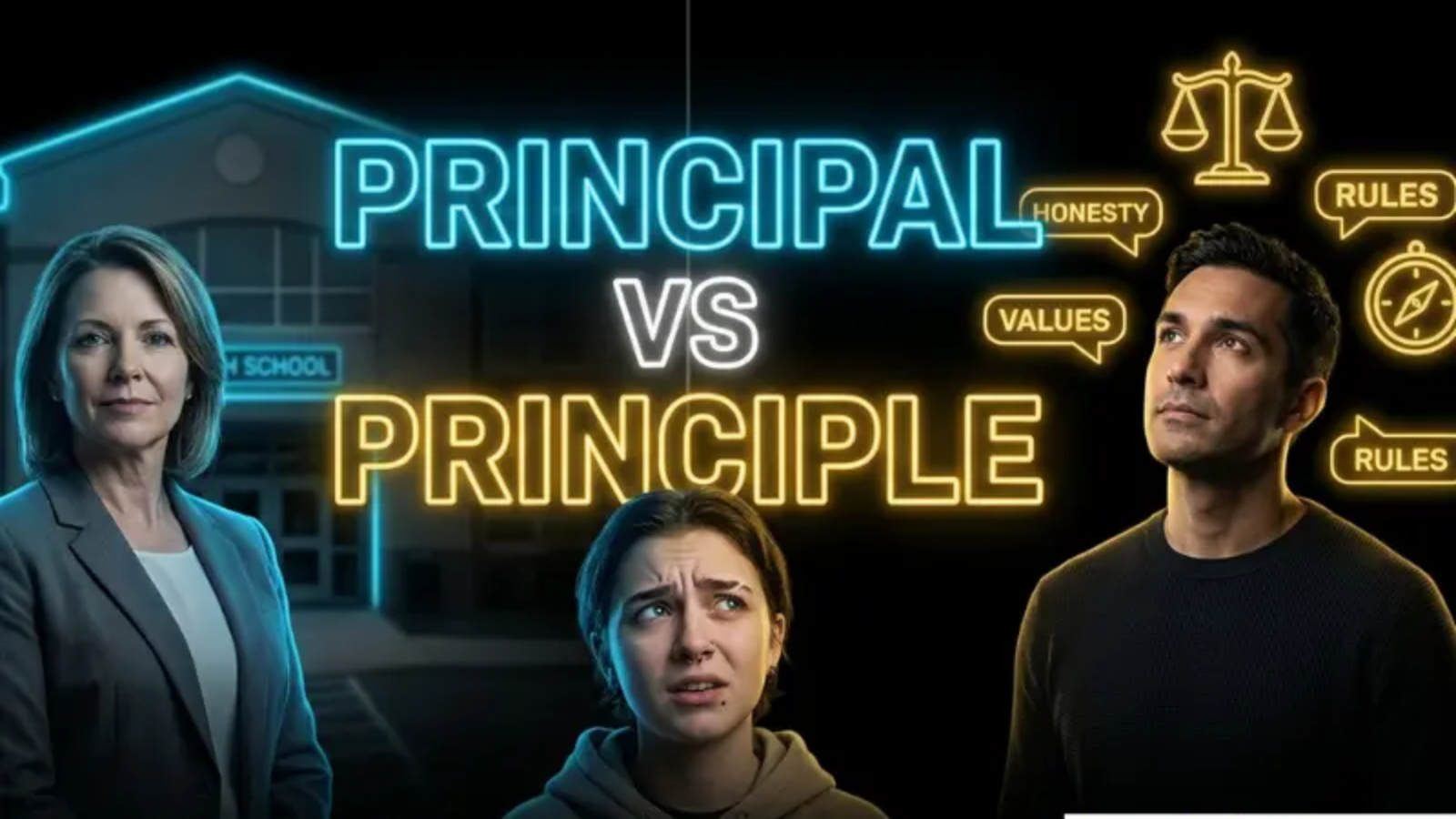
Principal vs Principle

Principal vs Principle: Difference, Meaning & Examples

Principal and principle sound the same, but they have completely different meanings.

✔ Principal = the most important person or thing, or the head of a school/company
✔ Principle = a rule, belief, value, or basic idea that guides actions

A simple trick:

Principal = Person or Primary
Principle = Rule or Reason

The confusion between principal vs principle is one of the most common spelling and grammar mistakes in English. These two words sound identical when spoken, but their meanings, uses, and roles in sentences are different.

Many people search for principal or principle because they are unsure which spelling belongs in a sentence. Since both words have similar pronunciation, it is easy to mix them up while writing emails, essays, messages, or professional documents.

The word principal usually refers to something that is first in importance, a main person, or someone who holds a leading position. For example, a school principal is the person who manages a school. The word principle, however, refers to a belief, rule, standard, or idea that influences decisions and behavior.

This article explains the difference between principle vs principal, shows examples, covers common mistakes, and provides simple ways to remember which word to use.

Principal vs Principle Main Difference Table

WordMeaningPart of SpeechExample
PrincipalMain, most important, leaderNoun / AdjectiveThe principal called a meeting
PrincipleRule, belief, standardNounHonesty is an important principle
Principal amountOriginal money or investmentNounPay the principal amount first
Basic principleFundamental ideaNounThis principle guides our work

What Does Principal Mean?

The word principal has several meanings depending on the situation. It can be used as both a noun and an adjective.

The main idea behind principal is something or someone that is first, highest, or most important.

Principal as a Person

The most common example is a school principal.

A principal is the person responsible for managing a school, making decisions, supporting teachers, and maintaining discipline.

Examples:

  • The principal announced the holiday schedule.
  • The school principal met with parents.
  • The new principal improved the school environment.

Principal as “Main” or “Primary”

Principal can also describe something that has the greatest importance.

Examples:

  • The principal reason for the delay was bad weather.
  • The company’s principal goal is customer satisfaction.
  • The principal issue needs immediate attention.

In these sentences, principal means main or most important.

What Does Principle Mean?

A principle is a rule, belief, value, or idea that guides someone’s choices or actions.

It often relates to morals, ethics, science, or basic concepts.

Examples:

  • Honesty is an important principle.
  • The company follows strict safety principles.
  • Gravity is a scientific principle.

A principle is not a person. It is an idea or guideline.

Principal or Principle How to Choose the Right Word?

Choosing between principal or principle becomes easier when you focus on the meaning.

Ask yourself:

Are you talking about a person, leader, or main thing?

Use:

Principal

Examples:

  • school principal
  • principal reason
  • principal amount

Are you talking about a rule, belief, or idea?

Use:

Principle

Examples:

  • moral principle
  • scientific principle
  • personal principle

Principle vs Principal Memory Trick

A simple way to remember:

Principal has “pal” at the end → a principal can be a person you know.

Example:

School principal = a person

Principle has “le” ending → think of a rule or belief.

Example:

Honesty principle = a value

Another useful trick:

Principal = Primary
Both start with “pri” and relate to importance.

Principle = Policy
Both relate to rules.

Principal vs Principle in Sentences

Correct examples:

  • The principal of the school gave a speech.
  • Hard work is a valuable principle.
  • The principal reason for success was dedication.
  • The organization follows ethical principles.

Incorrect examples:

  • Honesty is a principal. ❌
  • The school principle called me. ❌

Correct:

  • Honesty is a principle. ✔
  • The school principal called me. ✔

Its It Principal vs Principle Correct Usage Explained

Many people search for its it principal vs principle because they are unsure about the correct sentence structure.

The phrase should be:

✔ Principal vs principle
✔ Is it principal or principle?

Not:

❌ Its it principal vs principle

The confusion happens because “its” and “it’s” are often mixed up.

Examples:

Correct:

  • Is it principal or principle?
  • I don’t know if this is a principal issue or a principle issue.

Incorrect:

  • Its it principal or principle? ❌

Principal Uses in Different Contexts

The word principal appears in many areas.

Education

In schools, a principal is the head administrator.

Examples:

  • The principal spoke to students.
  • The principal organized the event.

Business

Principal can describe an important person or company.

Examples:

  • The principal partner attended the meeting.
  • The principal investor supported the project.

Finance

Principal means the original amount of money borrowed or invested.

Examples:

  • The loan principal must be repaid.
  • Interest is calculated on the principal amount.

General Meaning

Principal means the most important.

Examples:

  • The principal cause was identified.
  • The principal objective was clear.

Principle Uses in Different Contexts

The word principle appears in many fields.

Moral Principles

These are beliefs about right and wrong.

Examples:

  • Respect is a basic principle.
  • She follows strong moral principles.

Scientific Principles

These are rules that explain how things work.

Examples:

  • Physics principles explain motion.
  • The principle of gravity affects objects.

Personal Principles

These are individual beliefs.

Examples:

  • He lives by his principles.
  • My principle is to always be honest.

Common Mistakes People Make

Mistake 1

Using Principle for School Leader

Wrong:

The school principle called the students. ❌

Right:

The school principal called the students. ✔

Mistake 2

Using Principal for Beliefs

Wrong:

Honesty is my principal. ❌

Right:

Honesty is my principle. ✔

Mistake 3

Confusing Principal Amount

Wrong:

I paid the principle on my loan. ❌

Right:

I paid the principal on my loan. ✔

Mistake 4

Thinking Both Spellings Are Interchangeable

Although they sound the same, principal and principle cannot replace each other.

The meaning changes completely.

Principal vs Principle Examples 

SentenceCorrect WordReason
The school ___ spoke todayPrincipalPerson
Honesty is a strong ___PrincipleBelief
The ___ amount increasedPrincipalFinance
This is the main ___ issuePrincipalImportant thing

Why Principal and Principle Are Confusing

The main reason for confusion is pronunciation.

Both words are pronounced almost the same:

Principal → /ˈprɪnsəpəl/
Principle → /ˈprɪnsəpəl/

Because they sound identical, writers depend on memory and meaning instead of pronunciation.

These words are called homophones, meaning they sound alike but have different meanings and spellings.

Homophones Similar to Principal and Principle

English has many words that sound the same but mean different things.

Examples:

WordsMeanings
Principal / PrincipleLeader or main vs rule
Flower / FlourPlant vs cooking ingredient
Right / WriteCorrect vs create text
Sea / SeeOcean vs view

Learning these pairs improves writing accuracy.

Principal vs Principle in Professional Writing

In formal writing, using the correct word matters because the wrong spelling can change the message.

Examples:

Business:

“The principal objective of the company is growth.”

Not:

“The principle objective…”

Personal values:

“We follow the principle of fairness.”

Not:

“We follow the principal of fairness.”

How to Remember the Difference Forever

Use this simple formula:

Principal = Person + Primary

Examples:

  • principal teacher
  • principal reason
  • principal amount

Principle = Practice + Philosophy

Examples:

  • life principle
  • moral principle
  • scientific principle

Whenever you see the word, connect it with its meaning.

Principal or Principle in Everyday Communication

In normal conversations, both words appear frequently.

Examples:

  • My school principal helped me.
  • I believe in this principle.
  • The principal problem is time.
  • This principle applies everywhere.

The difference depends completely on context.

See Also:

FAQs

What is the difference between principal and principle?

Principal refers to a leader, main thing, or original amount. Principle refers to a rule, belief, or guiding idea.

Is it principal or principle?

It depends on the meaning. A person or main thing uses principal. A rule or belief uses principle.

Can principal and principle be used interchangeably?

No. They sound similar but have different meanings.

Is a school head called a principal or principle?

A school head is called a principal.

What does principle mean in life?

A life principle is a belief or value that guides your actions.

How do I remember principal vs principle?

Remember: Principal = Primary/person. Principle = Policy/rule.

Conclusion

The difference between principal vs principle is simple once you connect each word with its meaning. Principal refers to something important, a leader, or an original amount, while principle refers to a rule, belief, or guiding idea.

The easiest way to avoid mistakes is to remember that a principal can be a person, while a principle is an idea. Whether you are writing about schools, business, finance, or personal values, choosing the correct word keeps your message clear.

Meet vs Meat

Meet vs Meat: Meaning, Difference, Usage & Examples Explained

Meet and meat are two different words with different meanings, even though they sound the same.

✔ Meet = to come together, see someone, or fulfill a requirement
✔ Meat = animal flesh used as food

These words are called homophones because they have the same pronunciation but different spellings and meanings.

The confusion between meet vs meat is one of the most common spelling problems in English. These two words sound exactly alike when spoken, but they are used in completely different situations. Many people mix them up while writing because pronunciation alone cannot show which spelling is correct.

The word meet is connected with people, events, appointments, introductions, and requirements. The word meat is related to food, cooking, animals, and nutrition. Although they look almost identical, replacing one with the other can completely change the meaning of a sentence.

For example:

“I will meet my friend tomorrow.”

This means you will see or spend time with your friend.

“I will eat meat tomorrow.”

This means you will eat animal-based food.

The difference between these words becomes easier when you focus on their meanings instead of their pronunciation. This guide explains meet or meat, the difference between meat vs meet, common mistakes, sentence examples, and simple ways to remember the correct spelling.

Meet vs Meat Main Difference

WordMeaningTypeExample
MeetTo see someone or come togetherVerbI will meet my teacher
MeatFood from animalsNounI cooked meat for dinner
MeetTo satisfy a conditionVerbThis product meets the rules
MeatProtein food sourceNounMeat contains nutrients

What Does Meet Mean?

The word meet is a verb that means to come into contact with someone, gather together, or encounter something.

It is commonly used when talking about:

  • Meeting people
  • Appointments
  • Events
  • Introductions
  • Requirements

Examples of Meet:

  • I will meet my cousin this weekend.
  • Nice to meet you.
  • We need to meet before the project starts.
  • This job must meet certain requirements.

The word can also describe reaching a goal or standard.

Example:

“The product meets quality expectations.”

This does not mean the product physically sees something. It means it satisfies a condition.

What Does Meat Mean?

The word meat is a noun that refers to animal flesh used as food.

It usually describes foods such as:

  • Beef
  • Chicken
  • Lamb
  • Fish (in some contexts)
  • Pork

Examples of Meat:

  • I don’t eat meat.
  • The restaurant serves fresh meat.
  • She bought chicken meat from the market.
  • This recipe requires cooked meat.

Unlike meet, this word is connected to cooking, meals, and food.

Meet or Meat Why Are They Confusing?

Many learners confuse meet or meat because both words have the same pronunciation.

When spoken aloud:

Meet → sounds like → meat

The listener cannot know the spelling unless they see the written word or understand the context.

This is why homophones create difficulty in English.

Other examples of similar words include:

  • See / sea
  • Right / write
  • Pair / pear
  • Flower / flour

The sound is the same, but the meaning changes.

Meat vs Meet in Sentences

The easiest way to recognize these words is to look at the sentence.

Meet Examples:

  • I want to meet my new neighbor.
  • They will meet at the office.
  • We finally met after many years.
  • The company must meet customer needs.

Meat Examples:

  • We bought fresh meat.
  • This dish contains meat.
  • The butcher sells different types of meat.
  • Some people avoid eating meat.

The surrounding words usually make the meaning clear.

Meet vs Meat Grammar Difference

Another important difference is their grammatical role.

Meet

Meet is usually a verb.

Examples:

  • I meet people.
  • She meets her friends.
  • They met yesterday.

It describes an action.

Meat

Meat is a noun.

Examples:

  • The meat is fresh.
  • I bought meat.
  • The meat tastes good.

It describes a thing.

Common Mistakes With Meet and Meat

Many writing mistakes happen because people choose the word based only on sound.

Mistake 1

Using Meat for People

Incorrect:

“I will meat my friend.”

Correct:

“I will meet my friend.”

The sentence is about seeing someone, not food.

Mistake 2

Using Meet for Food

Incorrect:

“I bought meet from the store.”

Correct:

“I bought meat from the store.”

The sentence is about food.

Mistake 3

Confusing Past Forms

Meet changes in the past:

Present:

  • meet

Past:

  • met

Meat does not change because it is a noun.

Examples:

✔ I met him yesterday.
✔ We ate meat yesterday.

Its It Meet vs Meat Correct Usage Explained

Many people search for its it meet vs meat because they want to compare these two words or ask which one is correct.

The phrase itself is not a complete sentence.

The correct forms depend on the meaning.

Examples:

✔ Is it meet or meat?
✔ Which word is correct: meet vs meat?
✔ Did you say meet or meat?

Incorrect:

❌ Its it meet vs meat

The word “it’s” means “it is,” while “its” shows possession. They are different from “is it.”

Meet and Meat Pronunciation

Both words are pronounced:

/miːt/

They have:

  • Same sound
  • Different spelling
  • Different meaning

This makes them a classic example of English homophones.

When speaking, context helps listeners know which word you mean.

Example:

“I’m going to meet someone.”

Nobody thinks you mean food because “someone” connects with people.

“I’m buying meat.”

Nobody thinks you are buying a meeting because “buying” connects with products.

Meet vs Meat Usage Table

SituationCorrect WordExample
Seeing a personMeetI will meet Sarah
Food discussionMeatWe cooked meat
Business appointmentMeetLet’s meet tomorrow
Cooking recipeMeatAdd meat to the dish

How to Remember Meet and Meat Easily

A simple memory trick can help:

Meet has two “e” letters.

Think:

“Meet = two people coming together.”

Two people = two e’s.

Meat contains “ea” like many food words.

Think:

“Meat = something you eat.”

This connection makes the spelling easier to remember.

Meet in Different Contexts

The word meet has several uses.

Meeting People

Example:

“I met my friend yesterday.”

Formal Meetings

Example:

“The team will meet on Monday.”

Requirements

Example:

“This product meets safety standards.”

Challenges

Example:

“She met the challenge successfully.”

Meat in Different Contexts

Meat is mostly related to food but appears in several situations.

Cooking

Example:

“The recipe needs meat.”

Nutrition

Example:

“Some diets include meat for protein.”

Food Industry

Example:

“The company sells processed meat.”

Animals

Example:

“The animal provides meat.”

Meet vs Meat Examples for Daily Life

Here are practical examples:

  • I need to meet my doctor tomorrow.
  • They serve fresh meat here.
  • Nice to meet you.
  • I don’t prefer eating meat.
  • We should meet after work.
  • The soup contains meat.

Similar Sounding Words Like Meet and Meat

English has many words that sound identical but have different meanings.

Word PairMeaning Difference
Meet / MeatMeeting vs food
Sea / SeeOcean vs look
Buy / ByePurchase vs goodbye
Pair / PearTwo items vs fruit

Learning these pairs improves spelling and communication.

Why Context Matters

Because pronunciation cannot separate meet and meat, context becomes important.

For example:

“I want to meet you.”

The word “you” tells us it means seeing a person.

“I want to eat meat.”

The word “eat” tells us it means food.

The surrounding words guide the meaning.

See Also:

FAQs

What is the difference between meet and meat?

Meet means to see someone or fulfill a requirement, while meat means animal food.

Is meet or meat pronounced the same?

Yes, both words have the same pronunciation.

Which is correct: meat vs meet?

Both are correct words, but they have different meanings.

Can meet be used as a noun?

Yes, “meet” can sometimes be a noun, especially for events like sports meets.

Example:

“The school held an athletic meet.”

Is meat always from animals?

In common usage, meat refers to animal-based food, although some people use the term differently in special contexts.

How do I remember meet and meat?

Remember: meet is about people coming together, and meat is something you eat.

Conclusion

The difference between meet vs meat is simple once you focus on meaning. Both words sound identical, but they belong to different categories and are used in different situations.

Meet relates to people, gatherings, appointments, and requirements, while meat refers to food and animal products. Remembering the context will help you choose the correct spelling every time.

Whether someone asks meet or meat, the answer depends on what they are talking about. One word connects people, while the other connects to food.

Adjuster or Adjustor

Adjuster or Adjustor: Meaning, Difference & Usage Guide

Adjuster and adjustor are both correct spellings, and they usually have the same meaning.

Both words describe a person who examines, evaluates, or makes adjustments, especially in insurance and claims.

✔ Adjuster = more common spelling
✔ Adjustor = accepted alternative spelling

In most modern writing, adjuster is preferred because it appears more frequently, but adjustor is not wrong.

The confusion between adjuster or adjustor is common because both words look almost identical and sound the same when spoken. Many people wonder whether one spelling is correct and the other is a mistake. Unlike many word pairs where one option is wrong, this pair is different because both forms are accepted in English.

The word adjuster is widely used when referring to someone who reviews insurance claims, checks damages, investigates accidents, or evaluates situations to determine a fair outcome. The spelling adjustor carries the same meaning and is often seen in certain industries, companies, or regional writing styles.

People often search for adjuster vs adjustor because they want to know which version they should use in professional writing, conversations, or documents. The answer depends mostly on preference and common usage rather than correctness.

This article explains the difference between these two spellings, their meanings, examples, history, and how to choose the right word.

Adjuster vs Adjustor Main Difference 

WordMeaningCommon UsageExample
AdjusterA person who evaluates or changes somethingInsurance, claims, general useThe insurance adjuster checked the damage
AdjustorSame meaning as adjusterAlternative spellingThe adjustor reviewed the report
AdjustmentThe act of making changesGeneral situationsThe adjustment was completed
AdjustTo modify or changeVerb formPlease adjust the settings

What Does Adjuster Mean?

An adjuster is someone who examines information, reviews details, and determines an appropriate decision or change.

The word is commonly associated with the insurance industry. An insurance adjuster investigates claims after events such as:

  • Car accidents
  • Property damage
  • Natural disasters
  • Theft
  • Injuries

Their job is to collect facts, inspect damage, review documents, and help decide how a claim should be handled.

Examples of Adjuster:

  • The insurance adjuster visited the damaged house.
  • A claims adjuster reviewed the accident report.
  • The adjuster estimated the repair costs.

Outside insurance, adjuster can also describe tools or devices that make changes.

Examples:

  • A chair adjuster changes the height.
  • A belt adjuster modifies the fit.

What Does Adjustor Mean?

Adjustor has the same meaning as adjuster. It refers to someone who adjusts, evaluates, or modifies something.

The difference is only spelling.

The “-or” ending appears in many English words, while “-er” is also commonly used. Over time, both forms developed and remained in use.

Examples of Adjustor:

  • The claims adjustor inspected the vehicle.
  • The company assigned an adjustor to the case.
  • The adjustor calculated the loss amount.

Although correct, adjustor appears less often than adjuster in everyday writing.

Adjustor or Adjuster Which Spelling Should You Use?

When choosing between adjustor or adjuster, both are acceptable, but adjuster is usually the safer choice because it is more common.

Use adjuster when:

  • Writing general articles
  • Communicating professionally
  • Talking about insurance claims
  • Writing everyday messages

Use adjustor when:

  • A company uses that spelling
  • A specific industry prefers it
  • You are matching existing terminology

The meaning does not change.

Why Are There Two Spellings?

The English language often has multiple spellings for the same word due to history, regional differences, and word formation patterns.

Many occupations use either:

  • “-er” ending
  • “-or” ending

Examples:

EndingExamples
-erteacher, worker, adjuster
-oractor, creator, adjustor

Both patterns exist naturally in English.

Adjuster or Adjustor in Insurance

The insurance field is where this word appears most often.

An insurance adjuster works with:

  • Policyholders
  • Insurance companies
  • Repair services
  • Accident reports
  • Damage evaluations

After a claim is submitted, the adjuster reviews the situation and determines the amount of coverage.

Example:

A homeowner experiences water damage. The insurance adjuster visits the property, takes notes, reviews the policy, and helps decide the claim amount.

In this context, adjuster is the most common spelling.

Adjuster vs Adjustor in Professional Writing

Both forms can appear in professional documents, but usage trends often favor adjuster.

Examples:

✔ Claims adjuster
✔ Insurance adjuster
✔ Property adjuster

Less common:

✔ Claims adjustor
✔ Insurance adjustor

Neither is incorrect.

Is It Adjuster vs Adjustor or Adjustor vs Adjuster?

People often search for adjuster vs adjustor and adjustor or adjuster when comparing these spellings.

Both phrases describe the same comparison.

The order does not affect the meaning:

  • Adjuster vs adjustor
  • Adjustor vs adjuster

Both simply compare the two forms.

However, adjuster is usually placed first because it is the more common spelling.

Its It Adjuster or Adjustor Correct Phrase Explained

The phrase its it adjuster or adjustor usually appears when someone is searching for the correct spelling.

The correct question format is:

✔ Is it adjuster or adjustor?
✔ Which one is correct: adjuster or adjustor?

Incorrect:

❌ Its it adjuster or adjustor?

The reason is simple:

  • “Is it” asks a question
  • “Its” shows possession

Common Mistakes People Make

Mistake 1T

hinking Adjustor Is Wrong

Many people believe adjustor is incorrect.

That is not true.

Both spellings are accepted.

Mistake 2

Using Adjustor Everywhere

Although adjustor is correct, it may look unusual to some readers because adjuster is more familiar.

Mistake 3

Confusing Adjuster With Adjustment

Adjuster:

A person who makes evaluations.

Adjustment:

A change or modification.

Example:

  • The adjuster made an adjustment.

Adjuster and Adjustor Examples

SituationCorrect WordExample
Insurance claimAdjusterThe adjuster checked the accident
Damage reportAdjusterThe adjuster reviewed the loss
Alternative spellingAdjustorThe adjustor completed the inspection
Device changesAdjusterThe seat adjuster is broken

Different Types of Adjusters

The word adjuster appears in several professional areas.

Insurance Adjuster

Reviews claims and damages.

Example:

“The insurance adjuster inspected the vehicle.”

Claims Adjuster

Handles customer claims.

Example:

“The claims adjuster contacted the customer.”

Public Adjuster

Works on behalf of the policyholder.

Example:

“The homeowner hired a public adjuster.”

Independent Adjuster

Works independently and may handle claims for different companies.

Related Words and Similar Terms

Several words are connected with adjuster:

Adjust

Meaning: To change or modify.

Example:

“Adjust the settings.”

Adjustment

Meaning: A change made.

Example:

“The adjustment improved the system.”

Adjustable

Meaning: Able to be changed.

Example:

“This chair is adjustable.”

Adjuster vs Adjustor Usage Comparison

FeatureAdjusterAdjustor
Correct spellingYesYes
Same meaningYesYes
Common usageVery commonLess common
Insurance fieldCommonUsed sometimes
Recommended choiceYesAcceptable

Regional Differences

English changes slightly across countries.

Some regions may prefer certain spellings because of local writing habits.

However:

  • American English commonly uses adjuster
  • International English uses both

There is no major meaning difference between them.

When to Use Adjuster

Choose adjuster when:

✔ Writing for a general audience
✔ Talking about insurance
✔ Creating professional content
✔ Wanting the most familiar spelling

Examples:

  • Contact the insurance adjuster.
  • The adjuster approved the claim.

When to Use Adjustor

Choose adjustor when:

✔ Following a company’s preferred spelling
✔ Matching existing documents
✔ Referring to a source using that spelling

Examples:

  • The adjustor completed the evaluation.
  • The adjustor signed the report.

See Also:

FAQs

Is adjuster or adjustor correct?

Both are correct spellings with the same meaning.

Which spelling is more common?

Adjuster is more common in modern English.

Are adjuster and adjustor different jobs?

No. They describe the same type of role.

Should I write adjuster or adjustor?

Use adjuster in most situations because it is more familiar.

Is it adjuster vs adjustor or adjustor or adjuster?

Both phrases are used when comparing the two spellings.

Conclusion

The difference between adjuster or adjustor is not about right or wrong spelling. Both words are accepted and carry the same meaning. The main difference is popularity and usage.

Adjuster is the spelling most people see in everyday writing, especially in insurance, claims, and professional communication. Adjustor is still valid but appears less frequently.

When you need a simple choice, use adjuster. When you see adjustor, remember that it is also a correct spelling with the same meaning.