
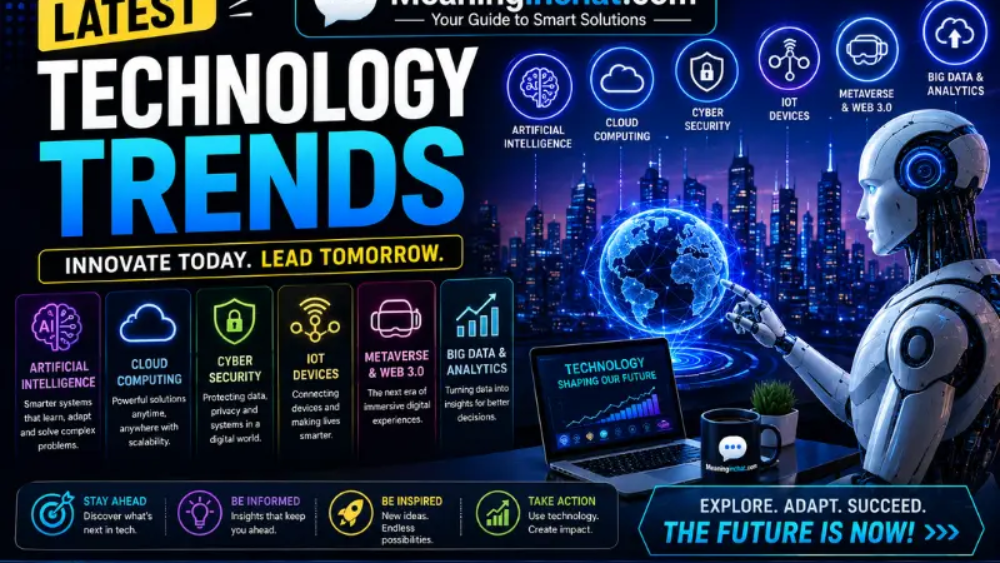
Technology in 2026 is moving beyond better apps and faster devices. AI agents, physical AI, robotics, AI-specific computing, cybersecurity, quantum technologies, and AI-native software are becoming some of the most important technology trends to watch. Gartner’s 2026 strategic trends include multiagent systems, physical AI, AI-native development platforms, AI supercomputing, confidential computing and AI security, while IEEE expects AI agents to become increasingly standard in business environments.
What makes this year different is the shift from technology that simply responds to people toward systems that can increasingly act, coordinate, predict, and operate in the physical world. At the same time, security and specialized computing are becoming just as important as raw AI capability.
So, instead of treating every futuristic invention as an immediate breakthrough, here’s a closer look at the technologies that have real momentum in 2026 and where they’re heading.
AI Agents Are Moving From Chat to Action
Generative AI started by answering questions and creating content. The next stage is increasingly about AI agents that can complete tasks.
An AI agent can be designed to plan a sequence of actions, use software tools, retrieve information, make decisions within defined boundaries, and hand results back to a person or another system.
That’s a significant difference from asking a chatbot:
“Write me an email.”
An agent-based system might instead receive:
“Find the latest sales figures, identify customers whose orders are delayed, prepare follow-up emails, and put them in my review queue.”
The human still controls the process, but the software handles more of the individual steps.
IEEE predicted that AI agents would become standard in business environments and help eliminate repetitive work. Gartner has also placed multiagent systems among its major 2026 strategic trends.
Where AI agents are being used
Common applications include:
- Customer support
- Software development
- Research
- Sales operations
- Data analysis
- Scheduling
- Business process automation
- IT support
- Document processing
The interesting question isn’t simply whether AI can generate an answer anymore. It’s how much of a workflow it can safely complete on its own.
Physical AI and Smarter Robots
One of the biggest changes in technology is AI moving outside the screen.
Physical AI refers broadly to intelligent systems that can perceive and interact with the physical environment. That includes robots, autonomous machines, drones and other systems capable of acting in the real world.
Gartner lists physical AI as a major 2026 strategic trend, while Forrester says AI is increasingly moving beyond digital workflows into robots, vehicles and physical environments.
This is why robotics has become such a major technology story.
Today’s development isn’t limited to humanoid robots. Companies are working on systems for:
- Manufacturing
- Warehouse operations
- Healthcare
- Agriculture
- Inspection
- Delivery
- Logistics
- Home assistance
A major challenge remains reliable physical interaction.
A robot can recognize an object visually but still struggle to understand exactly how hard it should grip that object. New tactile sensing technologies are attempting to solve that problem by giving machines a more sophisticated sense of pressure, force and movement.
AI-Native Software Development
Software development is changing because developers increasingly have AI inside the development process itself.
Instead of using AI only to generate a few lines of code, AI-native development platforms can assist with larger parts of the software lifecycle.
That can include:
- Generating code
- Debugging
- Testing
- Documentation
- Code review
- Application design
- Database work
- Development workflows
Gartner identifies AI-native development platforms as one of its 2026 strategic technology trends, particularly because smaller teams can use generative AI to build software faster.
This doesn’t mean developers disappear.
It changes where their time goes.
A developer may spend less time writing repetitive code and more time deciding what should be built, checking AI-generated work, designing systems and dealing with security and reliability.
That shift is already influencing technology education and employment. Recent industry commentary also emphasizes adaptability, critical thinking and problem-solving as increasingly valuable skills alongside traditional programming knowledge.
AI Supercomputing and Specialized Chips
More capable AI requires enormous amounts of computing power.
As AI systems become larger and more complex, general-purpose computing alone isn’t enough for many workloads. Companies are investing heavily in GPUs, AI accelerators, specialized processors and infrastructure designed specifically for AI.
Gartner includes AI supercomputing platforms among its 2026 strategic trends.
Another important change is happening in the cloud.
Agentic AI can require significantly more inference computing because systems aren’t simply generating one response. They may perform multiple reasoning and tool-use steps before completing a task.
A recent Gartner analysis reported by ITPro projects AI-optimized infrastructure spending to reach about $42 billion in 2026, with inference spending expected to become increasingly important.
This means the AI race isn’t only about better models.
It’s also about:
chips → data centers → networking → electricity → cooling → inference infrastructure
The physical infrastructure underneath AI is becoming a major technology story of its own.
Cybersecurity Is Becoming More Proactive
As technology becomes more automated, security has to become more automated too.
Traditional cybersecurity often focuses on detecting and responding to threats after suspicious activity occurs. Newer approaches increasingly aim to predict vulnerabilities and intervene earlier.
Gartner lists preemptive cybersecurity and AI security platforms among its 2026 strategic technology trends.
AI is also changing the threat landscape.
Attackers can potentially automate parts of reconnaissance, social engineering, vulnerability discovery and other activities. At the same time, defenders can use AI to analyze huge volumes of security data and identify unusual behavior.
That creates an uncomfortable reality:
AI can make cybersecurity defenses stronger while also making attacks more scalable.
The result is growing interest in AI security, model protection, identity controls and stronger authentication.
Post-Quantum Cryptography Is Getting More Attention
Quantum computing isn’t replacing ordinary computers tomorrow, but it is influencing cybersecurity decisions today.
One reason is that some existing encryption methods could eventually be threatened by sufficiently powerful quantum computers.
That’s where post-quantum cryptography, or PQC, comes in.
The technology aims to create cryptographic methods designed to remain secure against future quantum attacks.
The U.S. government’s updated 2026 critical and emerging technologies list added post-quantum cryptography while placing greater emphasis on quantum systems and advanced computing.
Quantum computing itself is also gaining research momentum. Stanford’s 2026 Emerging Technology Review includes quantum technologies among the major frontier areas being evaluated across computing, security, energy and other sectors.
But there’s an important distinction:
Quantum computing is promising, but it is not yet a replacement for classical computing.
Current research is still focused heavily on finding problems where quantum systems can produce meaningful advantages.
Confidential Computing
AI systems increasingly process valuable and sensitive information.
That creates a problem: how do you use powerful computing infrastructure while protecting data during processing?
Confidential computing aims to protect data while it is being used by using hardware-based security mechanisms.
Gartner includes confidential computing among its major technology trends for 2026.
This could become particularly important for organizations using AI with:
- Financial information
- Customer records
- Proprietary business data
- Healthcare information
- Government data
- Sensitive research
As organizations move more workloads into AI-powered systems, protecting the data going into those systems becomes increasingly important.
Domain-Specific AI Models
Not every organization needs a giant general-purpose AI model.
A company working in law, medicine, finance, manufacturing or another specialized field may benefit more from an AI system trained or optimized around the terminology, rules and workflows of that particular domain.
Gartner identifies domain-specific language models as one of its 2026 strategic trends.
Imagine two systems receiving the same question.
A general model might provide a broad answer.
A specialized financial model could be designed around financial terminology, regulations and company-specific workflows.
The advantage is potentially greater relevance and control.
This doesn’t mean general-purpose models are becoming irrelevant. Instead, the AI ecosystem is becoming more diverse, with organizations choosing between general models, smaller specialized models, and combinations of several models.
Digital Twins Are Becoming More Practical
A digital twin is a virtual representation of a real-world object, process or environment.
The concept isn’t new, but AI is making it more interesting.
A digital twin could represent:
- A factory
- A machine
- A building
- A supply chain
- An energy system
- An entire business process
The goal is to simulate situations before making changes in the real world.
For example, a manufacturer could model production changes digitally before modifying an actual factory.
Enterprise technology leaders are increasingly exploring digital twins alongside AI and advanced computing. Recent enterprise AI commentary has highlighted the possibility of using digital twins to simulate business scenarios and regulatory effects.
The technology becomes more valuable as the underlying real-world data becomes better.
AI Is Expanding Into Science, Healthcare and Energy
Some of the most interesting technology developments aren’t consumer gadgets at all.
AI is increasingly being used as a tool for scientific discovery.
The World Economic Forum’s 2026 emerging technology report highlights a broader shift in which AI is helping researchers explore areas such as drug discovery, biological systems and personalized medicine.
IEEE’s 2026 technology predictions also point toward adaptive bio-AI interfaces, where biological signals could be continuously interpreted to help adjust therapies.
Energy is another important area.
AI can help forecast demand, optimize infrastructure and automate parts of energy management. IEEE specifically predicts increasingly AI-driven and autonomous power-grid systems.
These applications matter because they show that AI isn’t simply becoming another office productivity tool.
It is becoming part of scientific, industrial and infrastructure systems.
Which Technology Trends Matter Most in 2026?
Not every trend has the same level of maturity.
| Technology | 2026 momentum | Main opportunity | Main challenge |
| AI agents | Very high | Workflow automation | Reliability and control |
| Physical AI | High | Robotics and autonomous machines | Real-world reliability |
| AI-native development | Very high | Faster software creation | Code quality and security |
| AI infrastructure | Very high | Training and inference | Cost and energy |
| Cybersecurity AI | High | Faster threat detection | AI-powered attacks |
| Quantum computing | Growing | Scientific and optimization problems | Hardware scalability |
| Post-quantum cryptography | Growing | Future-proof security | Migration complexity |
| Confidential computing | Growing | Protecting sensitive workloads | Implementation complexity |
| Digital twins | Growing | Simulation and optimization | Data quality |
| Domain-specific AI | High | Specialized applications | Training and maintenance |
The broader pattern is clear: AI is becoming infrastructure rather than simply an application.
That’s one of the biggest differences between the current technology cycle and the early generative-AI boom.
What Comes Next?
The most important technology trends aren’t necessarily the ones with the biggest headlines.
The bigger story is how several technologies are starting to connect.
An AI agent may use a specialized model, run on AI-optimized infrastructure, access confidential data, communicate with other agents and eventually control a physical machine.
That creates a technology stack rather than one isolated invention.
The World Economic Forum’s 2026 emerging technology research similarly emphasizes that many technologies are moving from research toward real-world deployment and potential scale.
At the same time, some technologies remain much further from mainstream adoption than headlines suggest. Quantum computing, for example, continues to face significant technical challenges even as research advances.
So the most useful way to follow technology in 2026 is to ask two questions:
Is the technology actually being deployed?
and
What problem does it solve better than the technology we already have?
Those questions separate genuine progress from hype.
See Also:
- Principles of Design: A Complete Guide to Creating Better Designs
- Health Monitoring Apps: in 2026 Top Picks Compared
- Upgrade Oxzep7 Python: Safe Installation & Fixes
FAQs
What are the latest technology trends in 2026?
Major technology trends in 2026 include AI agents, physical AI, AI-native software development, AI computing infrastructure, cybersecurity, domain-specific AI, confidential computing, digital twins and quantum technologies.
What is the biggest technology trend right now?
AI remains the largest overall technology trend, but its direction is changing. The focus is increasingly moving from chatbots and content generation toward agents, specialized models, physical AI and automated workflows.
Are AI agents the next big technology trend?
AI agents are one of the strongest trends to watch because they can perform sequences of tasks rather than simply generate individual responses. Gartner and IEEE both identify agent-based AI as an important part of the 2026 technology landscape.
Is quantum computing ready for everyday use?
Not yet for ordinary consumers. Quantum computing is still developing and faces substantial hardware and error-correction challenges. Its near-term value is expected to come from specialized scientific and computational applications rather than replacing conventional computers.
Why is robotics becoming more important?
Better AI models, improved sensors, falling hardware costs and demand for automation are helping robotics move into more practical applications. Current investment is expanding across manufacturing, logistics, healthcare and other industries.
What technology skills will be valuable in the future?
AI literacy, cybersecurity, software development, data skills, critical thinking and the ability to work effectively with automated systems are likely to remain valuable. Adaptability is increasingly important because technology itself is changing quickly.
Conclusion
The latest technology trends in 2026 point toward a clear direction: AI is moving from something people interact with to something that increasingly works alongside them, coordinates tasks and operates in the real world.
AI agents, physical AI, specialized computing, cybersecurity, quantum technologies and digital twins are all part of that transition. Some are already seeing broad adoption, while others remain in earlier stages of development.
The technologies worth watching aren’t necessarily the flashiest ones. They’re the ones solving real problems, gaining practical adoption and becoming reliable enough to fit into everyday business and consumer systems.
