
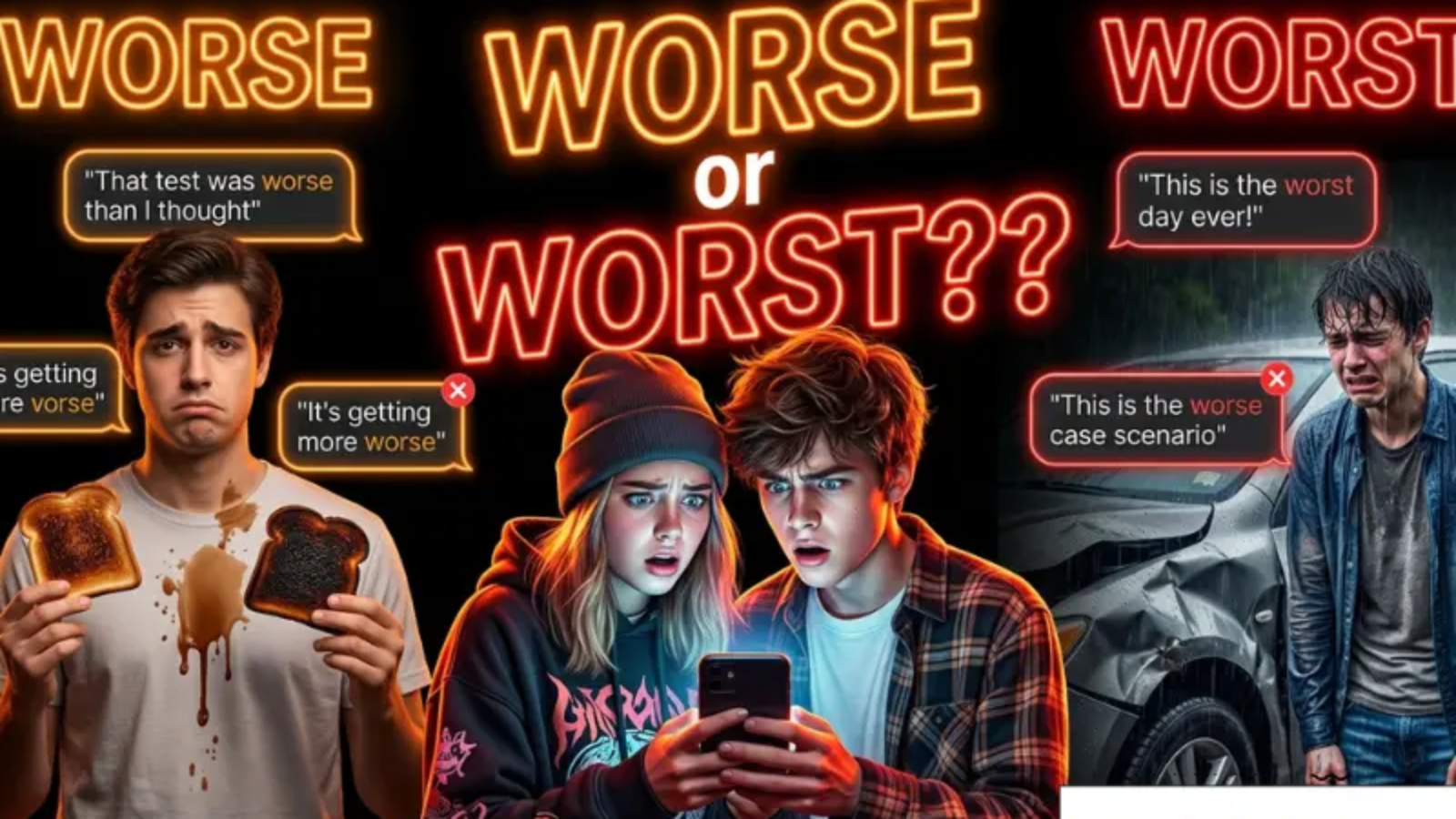
“Worse” and “worst” both describe something negative, but they are used differently.
✔ Worse = a comparison between two things
✔ Worst = the highest level of something bad
Examples:
- This movie is worse than the last one.
- This is the worst movie I have ever watched.
In simple words, worse vs worst depends on whether you are comparing two things or describing the most negative situation.
The words worse and worst are among the most commonly confused words in English. Many people use them interchangeably because they both relate to something bad, negative, or unpleasant. However, they have different roles in grammar and communicate different levels of comparison.
When someone says something is worse, they are comparing one thing with another. It means the situation has become more negative than before or another option. When someone says something is the worst, they mean it is at the lowest level compared with everything else.
The confusion between worst or worse happens because both words come from the same base word “bad.” Their meanings are connected, but their usage changes depending on the sentence.
This guide explains the difference clearly, covers common mistakes, gives examples, and shows how to use each word correctly in everyday communication.
Worse vs Worst Main Difference
| Word | Meaning | Grammar Role | Example |
| Worse | More bad than something else | Comparative form | Today is worse than yesterday |
| Worst | The most bad among all | Superlative form | This is the worst day ever |
| Bad | Negative condition | Base form | This is a bad idea |
| Better | Opposite of worse | Comparative positive | This option is better |
What Does Worse Mean?
The word worse means something is more unpleasant, harmful, difficult, or negative compared to another thing.
It is the comparative form of “bad.”
You use worse when comparing:
- Two situations
- Two objects
- Two experiences
- Two choices
- Two conditions
Examples of Worse:
- This weather is worse than yesterday.
- My headache feels worse today.
- The second episode was worse than the first one.
- This problem became worse after the delay.
In each example, two things are being compared.
What Does Worst Mean?
The word worst means something is at the highest level of negativity. It describes the most unpleasant, difficult, or unacceptable thing among many options.
It is the superlative form of “bad.”
You use worst when talking about:
- The lowest quality
- The biggest problem
- The most negative experience
Examples of Worst:
- This is the worst restaurant I have visited.
- That was the worst mistake of my life.
- Monday was the worst day of the week.
- This is the worst weather we have had.
Here, the speaker is comparing one thing against a larger group.
Worse or Worst Simple Rule to Remember
A quick trick:
Use worse when there are only two things being compared.
Use worst when something is number one in a negative way.
Examples:
Two options:
- Option A is bad.
- Option B is worse.
Many options:
- Option C is the worst choice of all.
Is It Worse or Worst? Correct Usage Explained
Many people search for its it worse or worst because they are confused about the correct phrase.
The correct question is:
✔ Is it worse or worst?
However, the answer depends on the situation.
Examples:
- Is your pain worse today? ✔
(Comparing today with before) - Is this the worst pain you have felt? ✔
(Comparing with all experiences)
The phrase “its it worse or worst” is incorrect because “its” and “is it” are different.
Worse vs Worst in Daily Conversations
People use these words constantly in normal conversations.
Example Conversation:
Person A:
“My phone battery is bad.”
Person B:
“Mine is worse.”
Person C:
“My battery is the worst.”
Here:
- Bad = negative
- Worse = more negative than another
- Worst = most negative
Grammar Difference Between Worse and Worst
Both words are forms of the adjective “bad.”
The pattern is:
| Form | Word |
| Positive | Bad |
| Comparative | Worse |
| Superlative | Worst |
This pattern is irregular because English does not use “badder” or “baddest” in standard grammar.
Incorrect:
- This is badder ❌
- This is the baddest ❌
Correct:
- This is worse ✔
- This is the worst ✔
Worst or Worse Which One Should You Use?
The choice depends on the sentence.
Ask yourself:
Am I comparing two things?
Use:
➡ Worse
Example:
“This laptop is worse than my old one.”
Am I talking about the lowest point?
Use:
➡ Worst
Example:
“This is the worst laptop I have ever owned.”
Common Mistakes People Make
Mistake 1
Using Worst for Two Things
Incorrect:
“My new phone is the worst than my old phone.” ❌
Correct:
“My new phone is worse than my old phone.” ✔
Mistake 2
Using Worse for the Top Negative Choice
Incorrect:
“This is the worse day of my life.” ❌
Correct:
“This is the worst day of my life.” ✔
Mistake 3
Writing Baddest Instead of Worst
Although people sometimes say “baddest” informally, the standard form is:
Worst ✔
Worse vs Worst Examples Table
| Sentence | Correct Word | Reason |
| This test is ___ than the last one | Worse | Comparing two tests |
| This is the ___ test ever | Worst | Comparing many tests |
| My cold feels ___ today | Worse | Compared with before |
| That was the ___ mistake | Worst | Highest level |
Worse and Worst in Texting
In online conversations, people often use these words quickly without checking grammar.
Examples:
- “This update is worse 😭”
- “That was the worst 😂”
- “My internet is getting worse”
Texting usually uses shorter sentences, but the difference between worse and worst remains the same.
How Worse and Worst Appear in Real Life
These words are useful in many situations.
Food
- This pizza tastes worse than yesterday.
- This is the worst restaurant experience.
Weather
- The storm is getting worse.
- This is the worst storm this year.
Work
- The situation became worse.
- This is the worst mistake at work.
Entertainment
- The sequel was worse.
- That was the worst movie ending.
Worse vs Worst vs Worst Case Scenario
The phrase “worst case scenario” is very common.
It means the most negative possible outcome.
Example:
“The worst case scenario is losing all the data.”
Not:
“The worse case scenario” ❌
Because it refers to the most extreme possibility.
Why People Confuse Worse and Worst
The confusion happens because:
Similar Spelling
The words look almost identical.
Same Root
Both come from “bad.”
SimilarMeaning
Both describe negative situations.
Fast Communication
People often write quickly and choose the wrong word.
The easiest way to avoid mistakes is to check whether you are comparing or choosing the lowest level.
Worse or Worst in Formal Writing
In professional writing, correct word choice matters because these words change the meaning of a sentence.
Compare:
“The second option is worse.”
Means:
The second option is not as good as another.
“The second option is the worst.”
Means:
The second option is the lowest quality among all choices.
A single letter changes the meaning completely.
More Examples With Explanations
Example 1
“My new job is worse than my old job.”
Meaning:
Two jobs are compared.
Example 2
“My old job was the worst experience.”
Meaning:
It was the most negative experience.
Example 3
“The traffic is getting worse.”
Meaning:
The traffic condition is becoming more difficult.
Example 4
“This is the worst traffic I have seen.”
Meaning:
No other traffic situation was as bad.
Similar Words Related to Worse and Worst
| Word | Meaning |
| Poor | Low quality |
| Terrible | Very bad |
| Awful | Extremely unpleasant |
| Horrible | Very negative |
| Unpleasant | Not enjoyable |
These words can describe negative situations but do not replace the grammar difference between worse and worst.
Quick Memory Trick
Remember:
Worse has “-er” like bigger or faster.
Comparative words often compare two things.
Worst has “-st” like first or last.
Superlative words describe the extreme level.
This simple connection helps you choose the right word quickly.
See Also:
FAQs
What is the difference between worse and worst?
Worse compares two things, while worst describes the most negative thing among many.
Is worse or worst correct?
Both are correct words, but they are used in different situations.
Is “worst or worse” the same thing?
No. The order does not matter in the phrase, but the meanings are different.
Is it “its it worse or worst”?
No. The correct phrase is “Is it worse or worst?”
Can I use worse for more than two things?
Usually, worse compares two situations, while worst is used for the highest negative level.
Is “baddest” correct?
In standard English, use “worst” instead of “baddest.”
Conclusion
The difference between worse and worst is simple once you know the comparison rule. Use worse when one thing is more negative than another, and use worst when something is the most negative among all choices.
The confusion around worse vs worst happens because both words describe bad situations, but their grammar roles are different. Remembering this small difference will help you write clearer sentences and avoid common mistakes.
Whenever you are deciding between worst or worse, ask yourself one question: am I comparing two things, or am I describing the lowest level? The answer will guide you to the correct word.