
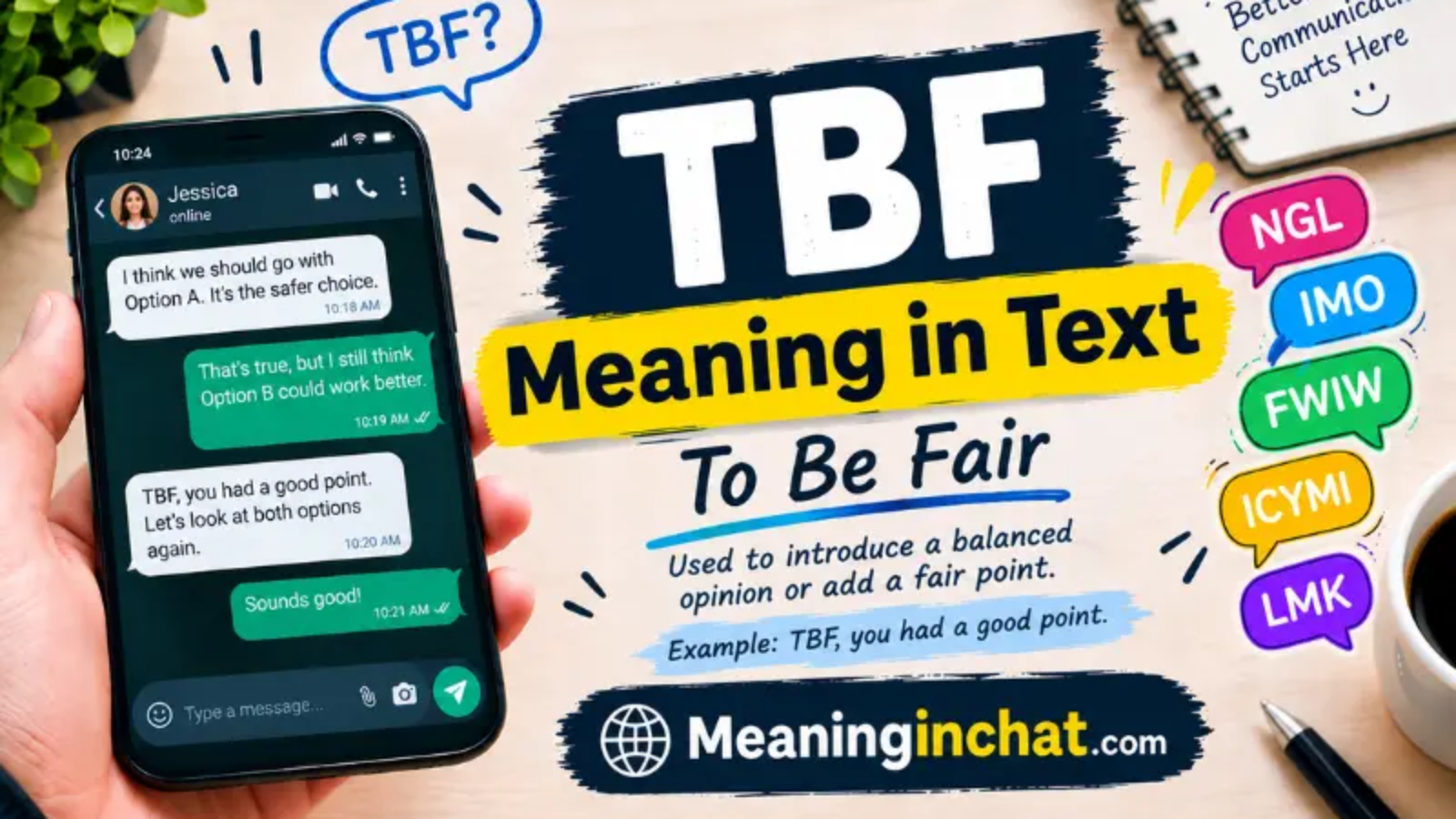
Ever received a message that starts with “TBF…” and wondered what the person is trying to say? This three-letter abbreviation is common in casual conversations, comments, and social media, but its meaning is much simpler than it may first appear.
TBF usually means “to be fair.” People use it when they want to add a balanced point, acknowledge another side of a situation, or slightly change what they just said. Cambridge Dictionary lists TBF as an informal abbreviation of “to be fair.”
Unlike some texting abbreviations that replace an entire sentence, TBF often works as a conversational phrase. It can introduce an opinion, soften criticism, or show that someone is trying to look at a situation from both sides.
TBF Meaning in Text — In One Line
TBF = “To Be Fair.”
In everyday texting, it often means:
- “To be fair…”
- “If I’m being fair…”
- “Looking at it from the other side…”
- “I have to admit…”
For example:
“TBF, he did warn you.”
This means:
“To be fair, he did warn you.”
The speaker isn’t necessarily changing their entire opinion. They’re simply acknowledging an important detail that should be considered.
What Does TBF Mean in Text?
When people ask what does TBF mean in text, they’re usually asking about the informal abbreviation used in chats and online conversations.
TBF is especially useful when someone wants to make their statement more balanced.
Imagine two friends are discussing a movie:
“The movie was way too long.”
Then someone replies:
“TBF, the ending was pretty good.”
Here, TBF introduces an opposing or balancing point. The person still may agree that the movie was too long, but they’re pointing out something positive.
That’s the basic idea behind the phrase.
Why Do People Say “TBF”?
People rarely use TBF randomly. It usually appears when someone wants to acknowledge something that makes a situation less one-sided.
It can be used to:
Add fairness:
“She’s annoying sometimes, but TBF, she’s always helpful.”
Acknowledge a point:
“TBF, you’re right about that.”
Soften criticism:
“TBF, they didn’t have much time to finish it.”
Correct an overly negative statement:
“I didn’t like the first episode. TBF, the second one was better.”
So when you see TBF, think of it as a small signal that says:
“Let’s look at the other side for a second.”
TBF Can Change the Tone of a Message
One interesting thing about TBF is that it can make a message sound less harsh.
Compare these two messages:
“You were late again.”
and:
“TBF, the traffic was terrible.”
The second message doesn’t necessarily deny that the person was late. Instead, it provides some context that makes the criticism feel more balanced.
That’s why TBF is often used during disagreements.
Someone may disagree with you overall while still admitting that one part of your argument is reasonable.
For example:
“I don’t think your idea will work, but TBF, the concept is interesting.”
The speaker is expressing criticism while also recognizing something positive.
TBF Meaning in Different Conversations
The meaning stays the same, but the purpose can change depending on the conversation.
During an argument
“TBF, you did say you’d be there.”
Here, TBF introduces a point supporting the other person’s position.
While discussing someone
“He’s difficult sometimes, but TBF, he helped us when nobody else did.”
The speaker is balancing criticism with a positive fact.
Talking about a decision
“I wouldn’t choose that option. TBF, it’s probably cheaper.”
The speaker is acknowledging an advantage despite disagreeing with the overall choice.
In a casual joke
“You ate the whole cake 😂 TBF, it was really good.”
The phrase can also be used humorously.
Real Examples of TBF in Texting
Here are some natural examples showing how TBF meaning works in everyday chats.
“TBF, I would’ve done the same thing.”
→ The speaker is admitting that the other person’s decision was understandable.
“TBF, she never said she was coming.”
→ The speaker is pointing out that someone may not deserve the blame.
“That game was frustrating. TBF, I wasn’t very good at it.”
→ The speaker is acknowledging their own part in the situation.
“TBF, you warned me 😂.”
→ The speaker admits the other person was right.
“TBF, this is actually better than I expected.”
→ The speaker is acknowledging a positive point.
These examples show that TBF doesn’t necessarily mean the speaker agrees with everything. It simply introduces a fair or balanced observation.
Is TBF Positive or Negative?
Neither.
TBF is generally neutral, and its emotional tone comes from the statement that follows it.
For example:
“TBF, she worked really hard.”
sounds positive.
But:
“TBF, he should have known better.”
sounds critical.
The abbreviation itself isn’t positive or negative. It signals that the speaker is adding another perspective.
This is also why TBF can work well in disagreements without automatically sounding confrontational.
TBF vs. TBH: What’s the Difference?
TBF is sometimes confused with TBH, but they serve different purposes.
| Abbreviation | Meaning | Main Use |
| TBF | To Be Fair | Adds balance or another side |
| TBH | To Be Honest | Introduces an honest opinion |
| IMO | In My Opinion | States a personal view |
| IMHO | In My Humble Opinion | Gives a personal opinion |
For example:
“TBF, that wasn’t completely his fault.”
You’re acknowledging another side.
“TBH, I didn’t enjoy the movie.”
You’re giving your honest opinion.
The two can even appear together:
“TBH, I didn’t like it. TBF, the acting was good.”
What Does TBF Mean on Social Media?
On social media, TBF is commonly used in comments, captions, replies, and discussions where someone wants to add a balanced observation.
For example, someone might post:
“This restaurant was overrated.”
A comment could say:
“TBF, their desserts were amazing.”
The commenter isn’t necessarily defending the entire restaurant. They’re simply pointing out that there was at least one positive aspect.
You’ll also see TBF used when people react to opinions, debates, reviews, sports discussions, entertainment, and everyday situations.
Because the abbreviation is short and widely understood in informal English, it fits naturally into quick online replies.
What Does TBF Mean When Someone Starts a Message With It?
When someone begins a message with “TBF,” they’re often preparing you for a qualification or counterpoint.
For example:
“TBF, you didn’t give him much time.”
The speaker may have been discussing someone’s mistake, but now they’re pointing out something that changes how the situation should be viewed.
You can mentally expand it to:
“To be fair…”
Doing that usually makes the sentence immediately clear.
Is TBF Rude?
Usually, no.
TBF is a normal informal abbreviation, but the sentence following it can still sound blunt.
For example:
“TBF, that’s your fault.”
is obviously more direct than:
“TBF, you were given the wrong information.”
So if someone sends you TBF during an argument, don’t assume the abbreviation itself is rude. Pay attention to the complete message and the tone of the conversation.
Can You Use TBF in Formal Writing?
TBF is mainly an informal abbreviation. It works well in texts, chats, social media, and casual online communication.
For formal writing, it’s better to write the complete phrase:
“To be fair…”
instead of:
“TBF…”
The full phrase is clearer and more appropriate for professional or academic communication.
How Should You Reply to TBF?
There’s no special response required when someone uses TBF.
If you agree with their point, you might say:
“Exactly.”
“That’s true.”
“Fair point.”
If you disagree:
“I see what you mean, but…”
If they’ve admitted that you’re right:
“I’ll take that 😂.”
The best response depends on the statement that comes after TBF, not the abbreviation itself.
A Simple Trick to Remember TBF
If you’re trying to remember what dose TBF mean or what the abbreviation stands for, connect the letters directly to the phrase:
T = To
B = Be
F = Fair
So:
TBF → To Be Fair
Whenever you see it in a message, mentally replace TBF with “to be fair.” If the sentence makes sense, you’ve probably found the intended meaning.
See Also:
FAQs
What does TBF mean in text?
TBF usually means “to be fair.” It’s used when someone wants to acknowledge another side of a situation or add a balanced point.
What does TBF mean in texting?
In texting, TBF is an informal abbreviation for “to be fair.” People often use it before giving a point that supports, qualifies, or balances what was just said.
What does TBF mean slang?
TBF is common informal internet and texting slang meaning “to be fair.” It can be used during opinions, disagreements, jokes, and everyday conversations.
Is TBF the same as TBH?
No. TBF means “to be fair,” while TBH means “to be honest.” TBF focuses on balance or another perspective, whereas TBH usually introduces an honest opinion.
Is TBF used only in texting?
No. TBF can also appear in social-media comments, online discussions, captions, and other informal digital conversations. In formal writing, spelling out “to be fair” is usually more appropriate.
Conclusion
TBF means “to be fair” in text and online conversations. It’s usually used when someone wants to acknowledge another side of an argument, add context, or make an opinion more balanced.
If someone writes “TBF, you’re right,” they’re essentially saying “To be fair, you’re right.” If you see TBF during a disagreement, it often signals that the person is about to recognize a point that deserves consideration.
So when you come across TBF, simply read it as “to be fair.” The rest of the sentence will tell you exactly what point the sender is trying to make.