
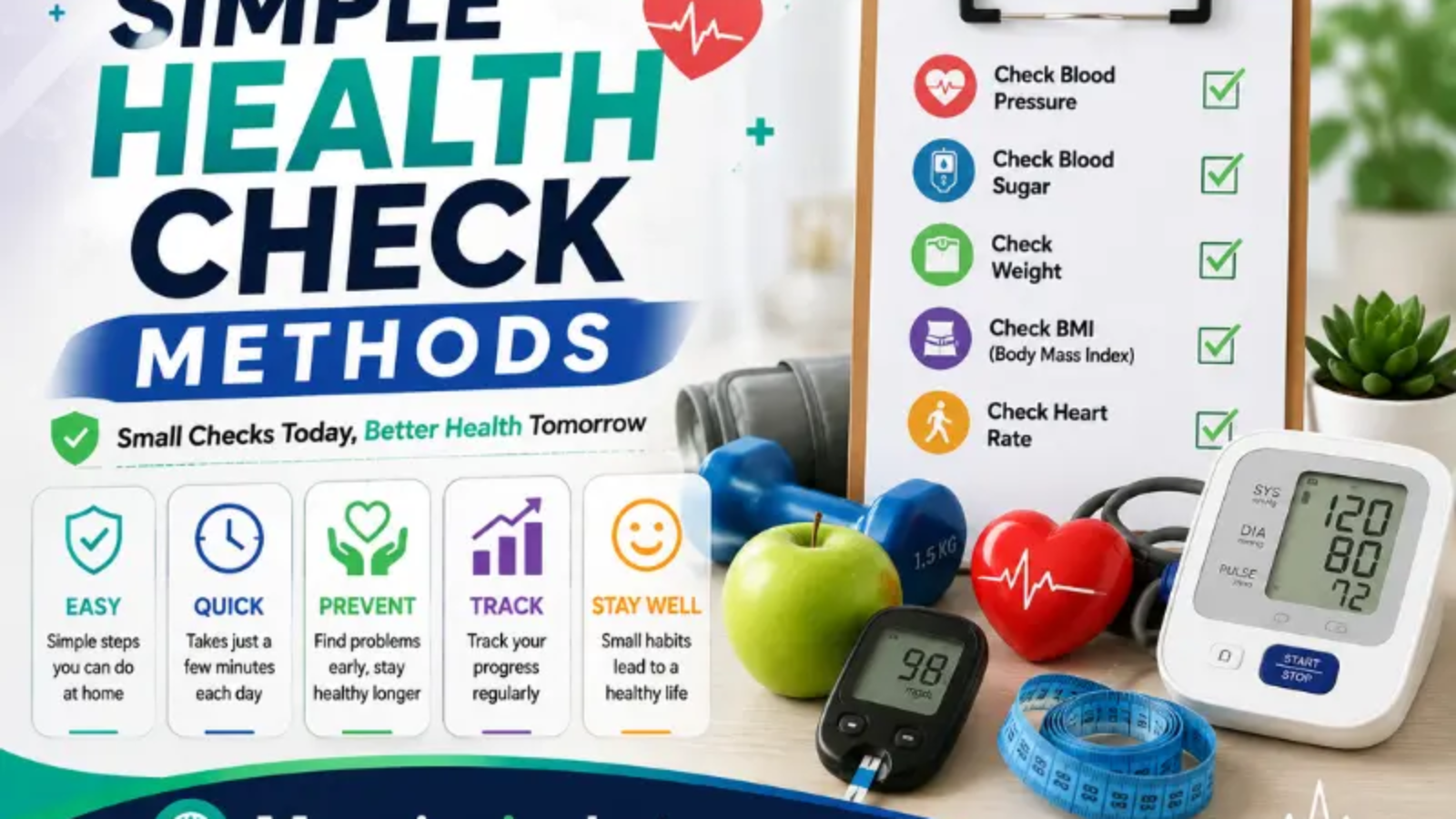
Simple health checks are easy ways to keep track of changes in your body between medical appointments. Depending on your situation, they can include checking your resting pulse, measuring blood pressure, taking your temperature when you feel unwell, tracking weight or waist changes, monitoring sleep and energy, and noticing new changes in your skin or mouth.
The point isn’t to diagnose yourself from a number or symptom. A home check is most useful when it gives you a baseline and helps you notice a persistent change. A single unusual reading can happen because of stress, exercise, caffeine, illness, poor sleep, or measurement errors.
Professional checkups and recommended screening tests still matter. Home monitoring works best alongside medical care, not as a substitute for it.
What Counts as a Simple Health Check?
A simple health check is a basic observation or measurement that doesn’t require a clinical examination or laboratory test.
Some need nothing more than your attention. Others require inexpensive equipment.
| Check | What you’re monitoring | Equipment |
| Resting pulse | Heart-rate pattern | Timer/clock |
| Blood pressure | Blood pressure | BP monitor |
| Temperature | Possible fever | Thermometer |
| Weight | Weight trend | Scale |
| Waist measurement | Waist-size trend | Measuring tape |
| Skin observation | New or changing spots | Mirror |
| Sleep tracking | Sleep duration and pattern | Notebook/app |
| Energy and mood | Changes in wellbeing | None |
These checks are most useful when you record them consistently rather than repeatedly measuring everything throughout the day.
Check Your Resting Pulse
Your resting pulse is one of the easiest measurements to take.
For many adults, a resting heart rate between 60 and 100 beats per minute is considered a typical range, although fitness, medications, age, illness, stress, and other factors can affect it.
To check your pulse:
- Sit quietly for a few minutes.
- Place two fingers on the inside of your wrist, below the thumb.
- Count the beats for 30 seconds.
- Multiply that number by two.
For a more direct measurement, count for a full 60 seconds.
Don’t use your thumb because it has its own pulse and can make the count confusing.
What should you look for?
Your normal number matters more than obsessing over a particular reading.
For example, if your usual resting pulse is around 65 and suddenly stays substantially higher for several days without an obvious reason, that change is worth noting.
Exercise, caffeine, fever, dehydration, anxiety, and some medications can temporarily raise heart rate.
Measure Your Blood Pressure
Blood pressure is particularly useful because high blood pressure can occur without obvious symptoms.
If you have a home monitor, use it correctly rather than taking a reading immediately after exercise or rushing around.
For a more reliable measurement:
- Sit quietly for about five minutes first.
- Keep your back supported.
- Put both feet flat on the floor.
- Support your arm at heart level.
- Place the cuff on bare skin.
- Avoid talking during the measurement.
- Take more than one reading when appropriate.
- Record the results.
A single elevated result doesn’t automatically establish a diagnosis. Repeated readings provide much more useful information.
If your readings are repeatedly outside the range your healthcare professional considers appropriate for you, discuss them with a medical professional.
Take Your Temperature When You Feel Unwell
A thermometer is useful when you feel feverish, have chills, or develop symptoms of an infection.
Temperature varies according to the person, time of day, measurement method, and other factors, so don’t treat one number as a complete picture of your health.
Record:
- Temperature
- Time
- Measurement method
- Other symptoms
- Whether the temperature is changing
If you’re monitoring an illness, the trend can be more useful than a single measurement.
Seek medical advice when fever is persistent, severe, occurs alongside concerning symptoms, or involves a young infant or another person at higher risk.
Track Your Weight Without Obsessing Over It
Weight can be useful for identifying a longer-term trend, but daily fluctuations are normal.
Changes can result from:
- Fluid retention
- Food intake
- Exercise
- Hormonal changes
- Illness
- Time of day
If you choose to monitor your weight, use similar conditions each time—for example, the same scale and roughly the same time of day.
The goal is to identify a meaningful trend, not react to every small change.
Unexpected or unexplained weight loss or gain should be discussed with a healthcare professional, particularly when it continues or occurs with other symptoms.
Measure Your Waist
Waist measurement can provide additional information about body composition and health risk, particularly when tracked over time.
Use a flexible measuring tape and keep the measurement conditions consistent.
Don’t use waist size as a standalone diagnosis. Age, sex, ethnicity, pregnancy, body shape, and other factors affect how measurements should be interpreted.
For people who are monitoring metabolic or cardiovascular risk, a clinician can explain which measurements are relevant and what they mean in context.
Pay Attention to Your Sleep
You don’t need a smartwatch to perform a useful sleep check.
Ask yourself:
- How long am I sleeping?
- Do I wake repeatedly?
- Do I feel rested in the morning?
- Am I unusually sleepy during the day?
- Has my sleep pattern changed recently?
Keep a simple sleep diary for a couple of weeks if you’re noticing a problem.
Repeated difficulty sleeping, persistent daytime sleepiness, loud snoring with breathing interruptions, or other ongoing problems may warrant professional advice.
Notice Changes in Your Skin
A basic skin check can help you notice something that wasn’t there before.
Look for:
- New spots
- Moles that change in appearance
- Persistent sores
- Unusual bleeding
- Changes in color, shape, size, or border
You don’t need to diagnose a skin condition yourself.
The useful action is noticing a new or changing feature and getting it checked if it concerns you.
Check Your Mouth and Gums
Your mouth can also provide clues that something needs attention.
When brushing or looking in the mirror, notice:
- Persistent gum bleeding
- Swelling
- Mouth sores that don’t heal
- Unusual lumps
- Persistent pain
- Changes in the appearance of your gums
Regular dental examinations remain important because looking in your mouth at home cannot replace a professional dental examination.
Monitor Your Breathing During Everyday Activity
You can pay attention to whether your breathing feels different from your normal pattern.
For example, ask:
Can I perform my usual activities without becoming unusually short of breath?
A change in exercise tolerance can have many explanations, including fitness, infection, stress, medications, or underlying health problems.
New or unexplained shortness of breath—especially when severe or accompanied by chest pain, fainting, confusion, or blue/gray lips or skin—requires urgent medical attention.
Keep Track of Energy and Mood
Not every useful health check produces a number.
Your everyday functioning matters too.
You might notice:
- Persistent fatigue
- Major changes in motivation
- Difficulty concentrating
- Unusual irritability
- Loss of interest in normal activities
- Major changes in appetite
- Persistent feelings of anxiety or low mood
Everyone has difficult days. What matters is a persistent or significant change from your usual pattern.
Keeping short notes can help you explain those changes more clearly to a healthcare professional.
The Most Useful Thing to Track Is Your Baseline
One of the biggest mistakes with home health monitoring is looking at an isolated number and immediately assuming something is wrong.
Imagine your resting pulse is 78 today.
That number means something different when:
- You just exercised
- You drank several cups of coffee
- You have a fever
- You are anxious
- You just woke up
- You are sitting quietly
Context matters.
A baseline gives you something to compare against.
| Situation | Better approach |
| One unusual reading | Repeat under appropriate conditions |
| Repeated abnormal readings | Record and discuss with a clinician |
| New persistent symptom | Seek professional advice |
| Severe sudden symptom | Seek urgent medical care |
| Normal reading but serious symptoms | Don’t rely on the number |
A “normal” measurement doesn’t guarantee that everything is fine.
Simple Health Checks vs Medical Screening
These two ideas are often mixed together, but they aren’t the same.
Home monitoring helps you notice changes.
Medical screening looks for certain diseases or risk factors in people who may not have symptoms and is usually based on age, sex, risk factors, family history, and local guidelines.
For example, checking your blood pressure at home is monitoring.
A recommended screening test performed through a healthcare system is a different process.
You should follow the preventive screening schedule recommended for your age and circumstances rather than assuming home checks cover everything.
A Simple Weekly Health Routine
You don’t need a complicated health dashboard.
A basic routine could look like this:
Daily:
Notice sleep, energy, mood, symptoms, hydration, and general wellbeing.
Weekly:
Review your notes and look for changes.
As needed:
Take your temperature when you’re unwell.
If advised or appropriate:
Monitor blood pressure or other measurements according to your healthcare professional’s recommendations.
Regularly:
Keep up with dental visits, medical checkups, vaccinations, and recommended screening.
This is much more sustainable than checking dozens of measurements every day.
When a Home Check Isn’t Enough
Home monitoring has limits.
You should seek professional medical advice if you notice:
- Symptoms that persist or worsen
- Repeated abnormal measurements
- Unexplained weight changes
- New or changing skin lesions
- Persistent breathing problems
- Ongoing severe fatigue
- Repeated dizziness or fainting
- New neurological symptoms
- Symptoms that interfere with normal activities
Some symptoms require urgent assessment rather than another home measurement.
For example, sudden severe chest pain, severe difficulty breathing, fainting, or signs of a stroke should not be managed by repeatedly checking your pulse or blood pressure at home.
Common Mistakes With Home Health Checks
Checking too often
More measurements don’t necessarily produce better information. Constant checking can create unnecessary anxiety.
Using equipment incorrectly
An incorrectly positioned blood-pressure cuff can produce misleading results.
Comparing yourself with someone else
Your baseline may be different from another person’s because of age, fitness, medications, and other factors.
Treating internet ranges as diagnoses
A number outside a general reference range doesn’t tell you what condition you have.
Ignoring symptoms because a number looks normal
Measurements are only one part of the picture.
Replacing professional screening
Home checks cannot replace recommended medical, dental, vision, or other preventive care.
A Better Way to Record Your Results
If you’re monitoring something regularly, keep a simple log.
| Date | Check | Result | Context |
| Monday | Resting pulse | 68 bpm | Before breakfast |
| Wednesday | Blood pressure | Record reading | Rested beforehand |
| Friday | Weight | Record weight | Morning |
| Sunday | Sleep | 7 hours | Felt rested |
The final column can be surprisingly useful.
For example, noting “poor sleep”, “after exercise”, or “feeling unwell” can explain why a measurement differed from your usual baseline.
See Also:
- Xendit Gamification Summit Work: What It Means
- USATop.co.uk: Review What Is This Website?
- Wearable Upgrade FeedWorldTech: The Future of Smart Wearables
FAQs
What are the easiest health checks to do at home?
Checking your resting pulse, monitoring blood pressure with a suitable device, taking your temperature when you’re ill, tracking weight trends, and paying attention to sleep and symptoms are among the simplest options.
Can I check my health without medical equipment?
Yes. You can observe sleep, energy, mood, breathing, skin changes, and other symptoms without equipment. Some measurements, such as blood pressure and temperature, require appropriate devices.
How often should I check my health at home?
There isn’t one schedule that fits everyone. Follow your healthcare professional’s advice if you’re monitoring a condition. Otherwise, focus on consistent awareness rather than constant measurement.
Is a home health check as good as a medical checkup?
No. Home checks can help you notice changes, but they cannot replace physical examinations, laboratory tests, professional screening, diagnosis, or treatment.
What should I do if a home health check gives an unusual result?
Don’t panic over one result. Repeat the measurement correctly when appropriate, record the result and surrounding circumstances, and seek professional advice if the result remains abnormal or you have concerning symptoms.
Can a normal home reading mean I’m completely healthy?
No. A normal reading only tells you something about that particular measurement at that particular time. It doesn’t rule out every health condition.
Conclusion
Simple health checks are most useful when they help you notice changes rather than diagnose problems yourself. A pulse check, blood-pressure reading, temperature measurement, weight trend, sleep record, or simple observation can give you useful information about your normal patterns.
The strongest habit is consistency without obsession. Keep sensible records, pay attention to persistent changes, continue recommended medical screening, and get professional advice when something doesn’t look or feel right.
That combination gives you the benefits of staying aware of your health without turning every ordinary fluctuation into a medical emergency.