
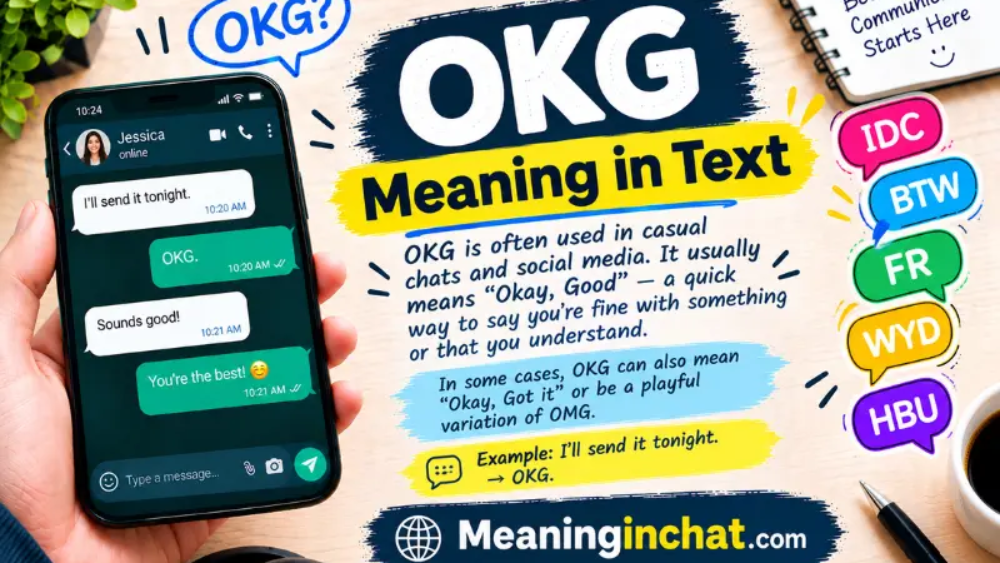
You receive a message that simply says “OKG” and stop for a second.
Is it another way of saying “okay”? Did the person mean “OMG”? Or is the G supposed to stand for something?
If you’ve searched what does OKG mean, you’re not the only one. Unlike common abbreviations such as LOL, BRB, or OMG, OKG does not have one universally accepted definition. Different people use it in slightly different ways, which makes the surrounding conversation especially important.
In casual chats, OKG is often interpreted as an acknowledgment such as “Okay, Good” or “Okay, Got it.” Some online users also use it as a playful variation of OMG, particularly when reacting to something surprising or funny.
The Meaning Depends on What Came Before It
There isn’t a single official expansion that works for every OKG text.
Think about these two messages:
“I finished the assignment.”
“OKG 👍”
Here, OKG can naturally read as “Okay, good” or “Okay, got it.”
Now consider:
“OKG 😭 look at this!”
In this situation, the sender may be using it as a playful version of OMG, especially if the message is reacting to something surprising, hilarious, or dramatic.
That’s why treating OKG as a fixed acronym can lead to the wrong interpretation.
A quick way to read it
- After information or instructions: likely acknowledgment
- After good news: possibly “Okay, good”
- Before an excited reaction: potentially an OMG-style variation
- In an unfamiliar conversation: could simply be a typo or personal shorthand
The sentence around OKG usually tells you more than the three letters themselves.
OKG Meaning in Text: The Common Uses
Here are the main interpretations you’ll come across.
“Okay, Good”
This is one of the commonly reported uses of OKG in casual messaging.
Someone might use it after receiving reassuring information:
“The package should arrive tomorrow.”
“OKG.”
The reply can mean:
“Okay, good.”
It shows that the information has been received and is satisfactory.
“Okay, Got It”
Another interpretation is “Okay, Got it.”
This works especially well when someone is confirming instructions or plans.
“Meet me outside at 7.”
“OKG, see you then.”
Here, the sender is essentially saying that they understand.
Several current references describe OKG as a quick acknowledgment of this type.
A Playful Version of “OMG”
A different online usage treats OKG as a playful variation of OMG — “Oh My God.”
For example:
“OKG that was insane 😭”
In this type of message, the sender isn’t confirming anything. They’re reacting emotionally.
Some recent slang references specifically describe this use as a playful or typo-like alternative to OMG.
A Typing Mistake
Sometimes there may be no special slang meaning at all.
If someone intended to type OK or OMG, they may accidentally hit an extra letter or mistype the word while typing quickly.
This is especially possible when the rest of the sentence makes a standard abbreviation more obvious.
So if someone writes:
“OKG thanks!”
and nothing else suggests a special meaning, it could simply be their personal shorthand or a typing error.
What Does OKG Mean in Different Conversations?
The easiest way to understand OKG text is to look at the type of conversation.
| Message | Most Natural Interpretation |
| “Meeting moved to 6.” → “OKG.” | Okay, got it |
| “Your order is ready.” → “OKG!” | Okay, good |
| “OKG that is hilarious 😂” | OMG-style reaction |
| “I’ll explain it later.” → “OKG.” | Acknowledgment |
| “OKG 😭 I can’t believe this.” | Excited or shocked reaction |
Notice that the same abbreviation can behave differently.
That is why an online definition saying “OKG always means X” should be treated carefully.
OKG Text on Instagram and Social Media
Social media makes abbreviations even more flexible.
You may see OKG in Instagram DMs, TikTok comments, Snapchat conversations, group chats, or replies to posts. Current references describe it as an informal expression rather than a standardized abbreviation.
For example:
“OKG your outfit 😭🔥”
could be intended as an excited reaction similar to:
“OMG, your outfit!”
Meanwhile:
“I sent you the details.”
“OKG.”
is more likely to be an acknowledgment.
Why social media makes it confusing
People often create their own shortcuts online. A phrase may become common inside one friend group without becoming a widely recognized abbreviation.
That’s particularly true for three-letter combinations such as OKG.
So if you see it in a comment and the meaning isn’t obvious, check the rest of the comment rather than relying on a single dictionary-style definition.
Is OKG the Same as OK?
Not exactly.
OK is a standard and widely understood way of showing agreement or acknowledgment.
OKG is much less standardized.
Compare:
“OK, I’ll be there.”
This clearly means the person agrees.
Now:
“OKG, I’ll be there.”
The extra G makes the message more informal and potentially ambiguous. Depending on the sender, it may be shorthand for “Okay, good,” “Okay, got it,” or simply a typing habit.
So if clarity matters, OK or Got it is safer.
OKG vs. OMG
This is one of the easiest mistakes to make.
| Abbreviation | Common Interpretation | Typical Use |
| OKG | Okay, good / Okay, got it / context-based | Acknowledgment |
| OMG | Oh My God | Surprise or strong reaction |
However, some people intentionally use OKG as a playful OMG-style expression, so the distinction isn’t absolute.
For example:
“OKG, you actually did it!”
If the sentence expresses surprise, OKG may be functioning more like OMG.
But:
“The meeting starts at 9.”
“OKG.”
clearly fits the acknowledgment meaning much better.
The words following OKG are often the giveaway.
Can OKG Sound Rude?
Not automatically.
The tone depends heavily on punctuation, context, and the relationship between the people chatting.
Consider:
“OKG 👍”
This feels fairly friendly.
“okg.”
This may feel neutral or slightly dry.
“OKG!!! 😭😂”
This sounds energetic and playful.
Because OKG is so short, the rest of the message does much of the emotional work.
If you’re trying to figure out whether someone was annoyed, don’t judge their mood from OKG alone. Look at what they said before and after it.
When Should You Use OKG?
OKG is best kept to informal conversations where the other person is likely to understand casual internet shorthand.
It can fit naturally in:
- Friend-to-friend texts
- Group chats
- Social-media comments
- DMs
- Gaming chats
- Casual online conversations
For formal emails, applications, school assignments, or professional communication, a clearer phrase is better.
Instead of:
“OKG.”
you could write:
“Got it, thanks.”
or:
“Okay, sounds good.”
That removes any possibility of confusion.
A Few Natural OKG Examples
When someone confirms a plan
“I’ll pick you up at 8.”
“OKG, see you then.”
Meaning: Okay, got it.
When someone shares good news
“The tickets are booked!”
“OKG! That’s great.”
Meaning: Okay, good.
When reacting to something shocking
“OKG 😭 did you seriously say that?”
Here, OKG may be an OMG-style reaction.
When acknowledging instructions
“Send me the screenshots when you’re done.”
“OKG 👍”
Meaning: Okay, got it.
When the meaning isn’t obvious
“OKG.”
By itself, this doesn’t provide enough information to determine exactly what the sender intended.
That’s when the surrounding conversation matters most.
What Should You Reply to OKG?
Your response can depend on what the sender appears to mean.
If they’re acknowledging your message:
“Perfect!”
“Sounds good.”
“Thanks!”
If they’re reacting with excitement:
“I know 😂”
“Right?! 😭”
“Exactly!”
And if you’re completely unsure:
“What do you mean by OKG?”
There’s nothing wrong with asking. Since OKG isn’t universally standardized, clarification is sometimes the most accurate response.
📚 See Also
Looking for more texting abbreviations? Explore these related guides to learn what common chat terms mean.
WYD Meaning in Text
Learn what WYD means in texting, Snapchat, and everyday chats.
Read More →HRU Meaning in Text
Find out what HRU means in chat and how to reply naturally.
Read More →DW Meaning in Text
Discover the meaning of DW and how people use it in casual texting.
Read More →TTM Meaning in Text
See what TTM means in messages, Instagram, Snapchat, and chats.
Read More →TM Meaning in Text
Learn the different meanings of TM and how context changes its use.
Read More →FAQs
What does OKG mean in text?
OKG is an informal abbreviation with no single universal definition. It can mean something like “Okay, Good” or “Okay, Got it,” while some users employ it as a playful OMG-style reaction.
What is the OKG meaning text users commonly intend?
In an ordinary acknowledgment, OKG is often interpreted as “Okay, good” or “Okay, got it.” The exact meaning depends on the surrounding message.
Is OKG slang?
Yes. OKG is best treated as informal internet or texting slang, not a standardized abbreviation with one official expansion.
Could OKG mean OMG?
Yes. Some users use OKG as a playful variation or typo-like version of OMG, especially when reacting to surprising, funny, or exciting content.
Is OKG the same as OK?
No. OK has a clear and widely recognized meaning, while OKG is less standardized and can have several interpretations.
Should I use OKG in formal messages?
It’s better to avoid it in formal communication. Because the abbreviation is ambiguous, phrases such as “Okay, sounds good” or “Got it” are clearer.
Conclusion
If you’ve been searching what does OKG mean, the honest answer is that context decides.
In a normal reply, OKG can work as a quick “Okay, Good” or “Okay, Got it.” In an emotional message, some people use it as a playful variation of OMG. It can also simply be a personal shorthand or typing mistake.
So don’t judge the meaning from the letters alone. Read the sentence around OKG, check the tone, and look at what the person was responding to. That usually gives you the clearest answer.
